Departure
88%
vs 95% ▼ 7
 MY FS FLIGHTS
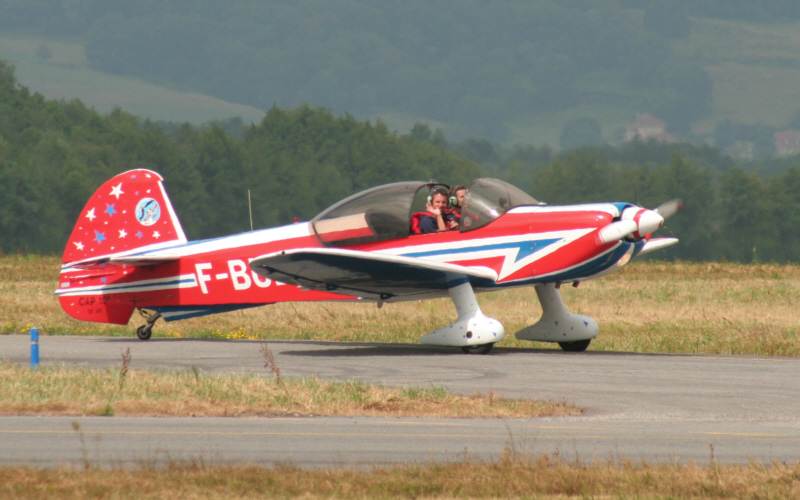
The Mudry CAP 10 is a two-seat, low-wing aerobatic training aircraft of wooden construction, developed in France from the Piel Super Emeraude and first flown in 1968. Built by Avions Mudry and later by Apex Aircraft and Robin Aircraft, it became one of the world's most successful aerobatic trainers, forming the basis on which generations of European aerobatic champions learned their craft. Its blend of docile handling and genuine aerobatic capability, along with its role as the mount of celebrated airshow performers, makes it a rewarding and characterful type for the simulator pilot to explore.
The Mudry CAP 10 is a two-seat aerobatic training aircraft of low-wing cantilever monoplane configuration, built predominantly in wood, though later CAP 10C models introduced a carbon-fibre wing spar. Designed and manufactured in France, it has passed through several manufacturers over its production life, from Avions Mudry & Cie through CAP Industries, Apex Aircraft, Dyn'Aviation, CEAPR and, most recently, Robin Aircraft. It occupies a well-established place in aviation as one of the most successful and enduring aerobatic trainers in the world, credited with launching nearly two generations of aerobatic champions.
The type traces its lineage to the Piel Super Emeraude, from which it was developed as the CP100, first flown in August 1968. The name was subsequently changed to CAP 10, CAP standing for 'Constructions Aéronautiques Parisiennes'. The initial production CAP 10 was followed by the CAP 10B, which introduced revised tail surfaces including a ventral fin and enlarged rudder. The aircraft was manufactured by Mudry, named after its designer, in Bernay, France, and production later passed to CAP Industries, which became Apex Aircraft. Following Apex's bankruptcy in 2008, rights to produce spares were awarded to Dyn'Aviation, and after DynAero's own bankruptcy in 2012, manufacture of spares was taken over by CEAPR in Darois. More than 300 aircraft were built between 1970 and 2007, and around 200 were still flying in the late 2000s. An updated version, the CAP 10C NG, has been produced by Robin Aircraft since 2021. The design lineage continued into the late 1970s with the single-seat CAP 20, 20L and 21 family, and in the 1980s into the highly successful CAP 230 series of competition single-seaters.
The CAP 10 is a low-wing cantilever monoplane of predominantly wooden construction, with the later CAP 10C featuring a carbon sandwich wing spar for improved structural performance. Power is provided by a 180 hp (134 kW) Lycoming AEIO-360-B2F four-cylinder, air-cooled, horizontally opposed, fuel-injected piston engine, fully lubricated to permit sustained inverted flight, driving a two-bladed Hoffmann fixed-pitch wooden propeller. The wing uses a NACA 23012 aerofoil. On the CAP 10B, length is 7.16 m (23 ft 6 in), wingspan 8.06 m (26 ft 5 in), height 2.55 m (8 ft 4 in) and wing area 10.85 sq m (116.8 sq ft). Empty weight is 540 kg (1,190 lb) and maximum take-off weight 760 kg (1,676 lb). Standard fuel capacity is 72 litres (19 US gal), with an optional auxiliary tank adding a further 75 litres (20 US gal).
The CAP 10B has a maximum speed of 270 km/h (170 mph, 150 kn) and a 75 percent power cruise speed of 260 km/h (160 mph, 140 kn). Stall speed is 100 km/h (62 mph, 54 kn) flaps up and 85 km/h (53 mph, 46 kn) flaps down, while never-exceed speed is 344 km/h (214 mph, 186 kn). Range is quoted at 1,200 km (750 mi, 650 nmi), service ceiling at 5,000 m (16,000 ft), and maximum rate of climb at sea level at 6 m/s (1,200 ft/min). The type is certified to g limits of +6/-4.5, though a later structural modification, the CAP 10B/K, restored these limitations after spar concerns, recovering the full +6.5/-4.5 g envelope. Despite its performance figures being unremarkable by later standards, pilots have widely praised the CAP 10B as an incredibly fun and enjoyable aircraft to fly.
The C.P.100 comprised two prototype aircraft developed directly from the Piel Emeraude. The initial production CAP 10 numbered only one aircraft, essentially the third prototype. The CAP 10B was the principal later production version, distinguished by a ventral fin and enlarged rudder. The CAP 10C introduced an improved structure with a carbon-fibre wing spar, and the CAP 10C NG is an updated version of this model in production since 2021 under Robin Aircraft. A CAP 10R was built as a prototype glider-tug variant (R for Remorqueur). The CAP 10S was a special version ordered by the French Navy, six of which entered service in 1980. The CAP 10B/K is a modified CAP 10B incorporating a wing spar repair design approved by EASA in 2013, developed by the French company Air-Menuiserie, which restored the aircraft's full flight envelope limitations of +6.5/-4.5 g.
The CAP 10 has served both military and civilian roles. In military service it has been operated by the French Air and Space Force and the French Navy; the Navy's CAP-10S entered service in 1980 with the Flight Initiation Section at Fréjus-Saint-Raphaël, later equipping the 51S squadron at Rochefort-Sur-Mer, and today equips the EIP 50S at Lanvéoc-Poulmic, used to assess and select naval aviation students. Morocco has used the type to equip its Equipe Voltige aerobatic display team, and the Mexican Air Force bought 20 examples delivered in 1982 and used until 1998. South Korea has also operated the type, and in Australia three examples have been operated by BAE Training Systems in Tamworth as part of the flight screening process for the Royal Australian Air Force, Royal Australian Navy and Australian Army. In civilian use, more than 200 CAP 10s have served aero-clubs worldwide, and a large number of European aerobatic champions began their careers on the type. The CAP 10B also achieved fame on the airshow circuit, most notably as the aircraft flown for three decades by the husband-and-wife team 'The French Connection'.
Pilots who have flown the CAP 10B consistently describe it as an aircraft that produces a smile and a gleam in the eye, praised as incredibly fun and enjoyable to fly despite speeds and g-limits that are unremarkable by modern standards. Its wooden, low-wing construction and inverted-flight-capable Lycoming AEIO-360 engine give it genuine aerobatic capability, while its role as an icon of the airshow circuit, including snap rolls performed on takeoff, underlines its reputation as an engaging and characterful handful for a simulator pilot seeking classic aerobatic training feel rather than outright performance.