Departure
94%
vs 95% ▼ 1
 MY FS FLIGHTS
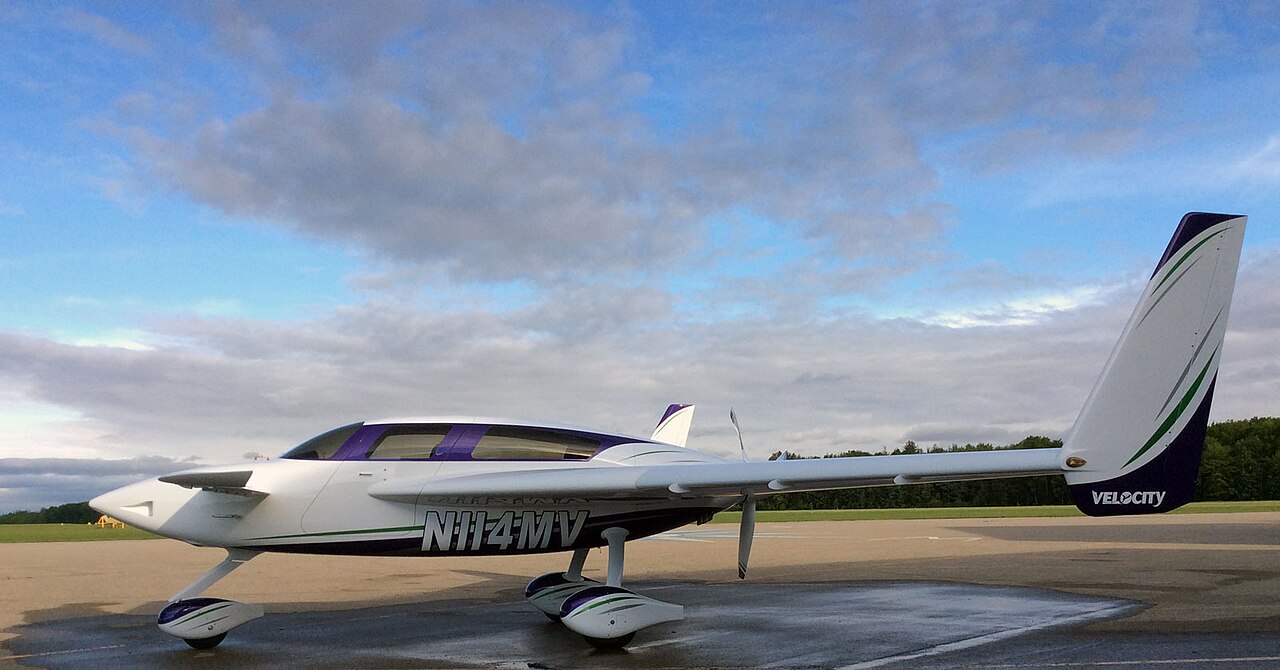
The Velocity XL is an American homebuilt canard pusher aircraft produced in kit form by Velocity, Inc., an enlarged derivative of the company's Velocity SE. Seating three or four passengers plus a pilot in a wide composite cabin, it is aimed at builders wanting genuine cross-country performance from a single piston engine, and its distinctive tandem-wing pusher layout has made it a recognisable fixture of the homebuilt scene and, more recently, of desktop simulation.
The Velocity XL is a single-engine, mid-wing, canard-configured pusher aircraft of amateur-built (homebuilt) origin, manufactured in kit form by Velocity, Inc. It is a tandem-wing design with a foreplane (canard) ahead of the main wing and a rear-mounted pusher propeller, a layout shared with other Velocity models and related canard pushers such as the Rutan Long-EZ and VariEze. The XL is the enlarged, longer-cabin member of the Velocity range, built primarily from composite materials and offered to amateur constructors as a kit rather than as a factory-completed aircraft.
The Velocity XL was developed by Velocity, Inc. as an enlarged version of the company's existing Velocity SE canard pusher design. Compared with the SE, the XL is 12 in (310 mm) longer overall and has a wingspan 20 in (510 mm) greater, giving it a larger cabin and, in most configurations, capacity for an additional passenger. As an amateur-built type it has been produced steadily by home constructors rather than in a single factory production run; by December 2011 a total of 229 examples across its variants had been completed and flown. The design also attracted attention beyond conventional homebuilding: a modified fixed-gear Velocity XL airframe was used by the now-defunct Rocket Racing League as the basis for its Mark-II and Mark-III X-Racer demonstration vehicles, fitted with an Armadillo Aerospace liquid-oxygen-and-ethanol rocket engine in place of the standard piston powerplant.
The Velocity XL uses a canard pusher layout, with a rear wing of 31 ft 0 in (9.45 m) span and 102 sq ft (9.5 sq m) area and a smaller forewing spanning 13 ft 8 in (4.17 m); overall length is 20 ft 0 in (6.10 m) and height 8 ft 5 in (2.56 m). It is offered with either fixed landing gear (FG) or retractable gear (RG), and in four- or five-seat configurations, the five-seat XL-5 and TXL-RG-5 versions substituting a rear three-person bench seat for the standard pair of individual seats. Empty weight for the XL-RG is quoted at 1,700 lb (771 kg) against a maximum take-off weight of 2,701 lb (1,225 kg); fuel capacity is 265 litres (58 imp gal). Velocity offers engine installation kits for the Lycoming IO-360 (180-200 hp / 134-149 kW), the Lycoming IO-540 (260-300 hp / 194-224 kW), the Continental IO-550 (310-350 hp / 231-261 kW) and the Franklin 6A350C1 (205-235 hp / 153-175 kW), though builders may also design their own installations around other engines of similar output. A representative XL-RG specification lists a Continental IO-550 air-cooled flat-six of 310 hp (230 kW) driving a three-bladed Catto propeller.
With the Continental IO-550 fitted, the Velocity XL-RG cruises at 240 mph (380 km/h; 210 kn) at 75% power, with a stall speed of 75 mph (121 km/h; 65 kn). Range at 65% power is quoted at 1,150 nautical miles (1,850 km; 1,000 nmi), while the standard XL's published cruising figures give a range of 875 nautical miles (1,620 km; 1,007 mi) and a 75%-power cruise speed of 185 knots (213 mph; 343 km/h). Take-off run is 1,300 ft (396 m) and landing run 1,500 ft (457 m). The type is rated to structural limits of +9/-7 g.
The Velocity XL-FG is the fixed-gear model with a gross weight of 2,700 lb (1,225 kg); forty had been completed and flown by December 2011. The XL-FG-5 is a fixed-gear five-seat variant with a higher gross weight of 2,900 lb (1,315 kg), with twenty-one completed by the same date. The XL-RG has retractable gear at the same 2,700 lb (1,225 kg) gross weight and was the most numerous variant, with 150 completed by December 2011. The TXL-RG-5 combines retractable gear with the five-seat cabin and a 2,900 lb (1,315 kg) gross weight, with eighteen completed. A twin-engine prototype, the Velocity V-Twin, was also built in small numbers (three examples), powered by two Superior IO-320-A engines. Beyond the standard production variants, heavily modified fixed-gear XL airframes were built as the Mark-II and Mark-III X-Racer for the Rocket Racing League, fitted with rocket propulsion and, in the Mark-III's case, a bespoke canopy, centre seat and control stick.
As an amateur-built kit aircraft, the Velocity XL has served predominantly private and sport-flying roles among homebuilders seeking a fast, wide-cabin cross-country tourer, with build quality and finish varying according to individual constructors. Its most distinctive operational use outside private ownership was as the airframe basis for the Rocket Racing League's X-Racer demonstration vehicles, which replaced the standard piston engine with a liquid-oxygen-and-ethanol rocket motor for exhibition rocket-powered racing.
The Velocity XL has been modelled for Microsoft Flight Simulator 2020/2024 as an add-on aircraft, published by Just Flight under its Black Square line, bringing the type's canard pusher layout and homebuilt character to desktop simulation for pilots wanting to experience its handling and performance without building the kit themselves.