Departure
89%
vs 95% ▼ 6
 MY FS FLIGHTS
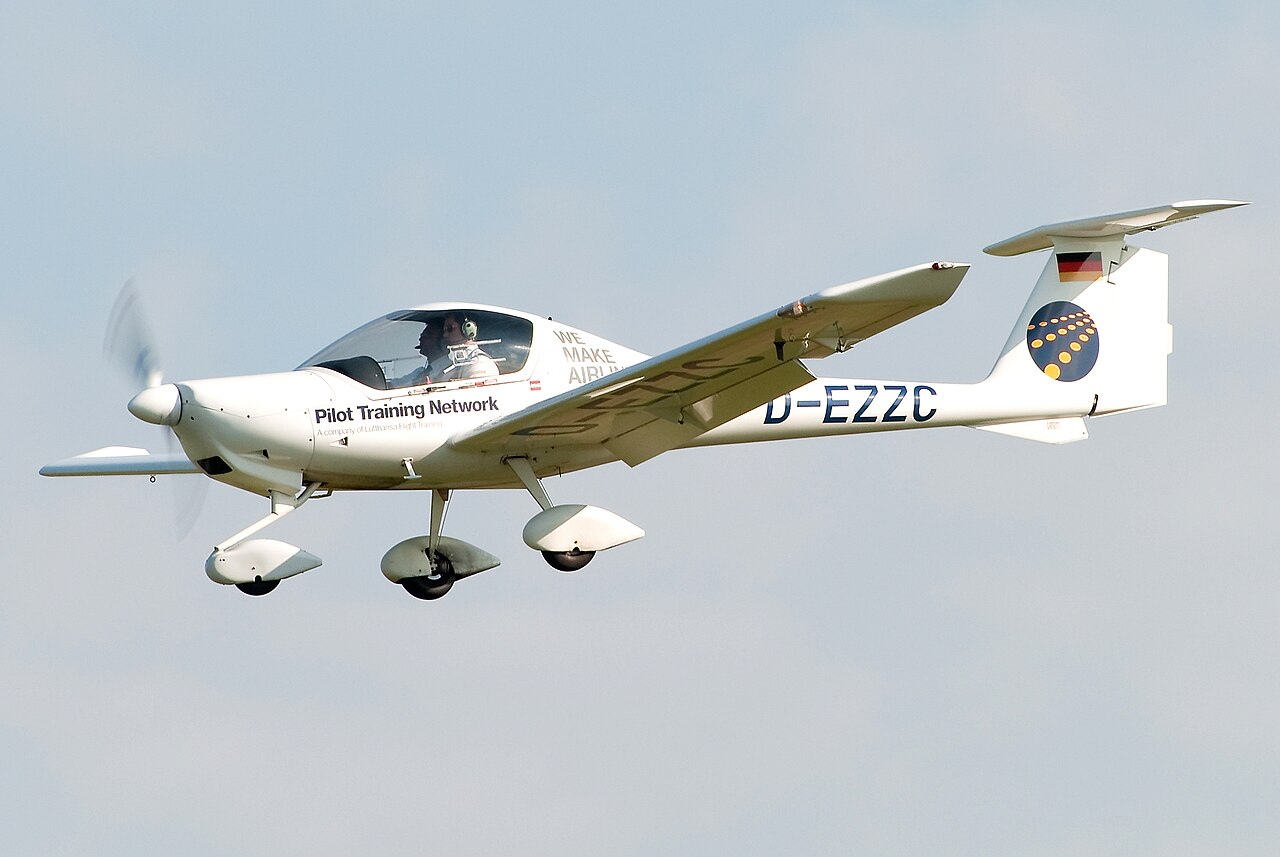
The Diamond DA20 Katana is a two-seat, low-wing composite light aircraft developed by Diamond Aircraft from its glider heritage, originally produced in Austria as the DV20 before Canadian production began in the 1990s. Conceived primarily as a low-cost, forgiving trainer, it has become a mainstay of flight schools and military primary training programmes, and remains attractive to sim pilots as an approachable, glider-derived design with docile handling and excellent visibility.
The Diamond DA20 Katana is a two-seat general aviation light aircraft designed in Austria and manufactured by Diamond Aircraft, originally as the DV20 before Canadian-built examples were designated DA20. It is a low-wing cantilever monoplane built with a composite airframe, commonly operated as a low-cost two-seat trainer, and Flight International has described it as relatively unorthodox among trainers for its heavy use of the manufacturer's earlier glider technology. It sits in Diamond's lineage between the HK36 Super Dimona motorglider and the later four-seat DA40 Diamond Star, which was itself heavily derived from the DA20.
The origins of the DA20 lie with Hoffmann Flugzeugbau, an Austrian company formed in 1981 with ambitions to become a major general aviation manufacturer; through several changes of name and ownership during the 1980s it became Diamond Aircraft. The new two-seat design, designated DV20 Katana, was based on the earlier and successful HK36 Dimona, but with a reduced wingspan, the addition of flaps, and a tricycle undercarriage in place of the Dimona's arrangement. The Katana made its maiden flight in 1991 and received type certification in May 1993, and was first shown publicly at the 1993 Paris Air Show. To meet demand in the sizeable North American market, Diamond established a purpose-built factory in London, Ontario, Canada, where the aircraft was redesignated DA20; the Canadian version incorporated around 40 individual improvements over the original. The first Canadian-produced DA20, a Rotax 912-powered A1 model, was completed in 1994 as the first Diamond aircraft available for sale in North America, and between 1994 and 1999 more than C$100 million was invested in the Canadian plant. Diamond produced 331 Rotax-powered DA20s in Canada between 1995 and 1998. In 1998 production shifted to the Continental IO-240-B3B-powered C1 Evolution and Eclipse models, offering greater power, increased comfort, slotted flaps and improved braking. Chinese certification followed in 2004, and both the A1 and C1 hold Joint Aviation Authorities certification as well as being certified in Canada under AWM 523-VLA and in the USA under FAR 23. Production of the original A1 Katana ended by 2010, while the C1 continued in manufacture. Glass cockpit options were introduced during this period, with an Aspen Avionics primary flight display offered from November 2008 and the Garmin G500 glass cockpit added as an option in October 2009. More recently, Diamond has announced a return to production in Wiener Neustadt of a new DV20-E variant powered by a Rotax 912iSc3 Sport engine driving a two-blade MTV-21-A/175-05 constant-speed propeller, with deliveries due to start in June 2026. Over its history the type has sold in excess of 1,000 aircraft.
The DA20 is a low-wing cantilever monoplane of composite construction, with the wings and fuselage built as semi-monocoque glass-fibre reinforced plastic and the bulkheads and wing spars made from carbon-fibre reinforced plastic. Its glider ancestry is evident in an impressive glide ratio, variously quoted as 11:1 or 14:1 depending on variant. The aircraft seats two under an expansive canopy with rear windows, giving notably panoramic visibility, and is flown from a center-stick control. The DA20-A1 was originally powered by an 80 hp Rotax 912 engine, the same unit used in the HK36 Super Dimona, with a fixed-pitch propeller and fuel capacity of 24 US gallons. The later DA20-C1 uses a fuel-injected Continental IO-240-B3B/B32B four-cylinder horizontally opposed engine producing 125 hp, driving a two-bladed Sensenich fixed-pitch propeller; this engine's greater weight, some 70 lb more than the Rotax, required structural accommodation in the design. Current production specifications list a maximum take-off mass of 800 kg (1,764 lb) for both current variants, with maximum useful load of 606 lb for the Rotax-powered DA20i Katana and 584 lb for the DA20-C1. The DA20i Katana is now offered with a 100 hp Rotax 912 iSc3 Sport engine capable of running on AVGAS 100LL or mogas, while the DA20-C1 continues with its 125 hp Continental IO-240-B32B on AVGAS 100LL alone. Despite being available with instrumentation suitable for instrument flight, the composite airframe lacks lightning protection and so the DA20 does not qualify for IFR certification; it does, however, hold EASA night VFR certification. The type is certified in the utility category and is approved for intentional spinning with flaps in the full-up position.
Diamond's current published figures for the DA20i Katana, with its 100 hp Rotax 912 iSc3 Sport engine, give a maximum cruise speed of 122 kts TAS (226 km/h), a maximum range at 8,000 ft and long-range cruise power of 703 nm (1,302 km) with no reserve, fuel consumption of 2.9 US gal/h at that setting, and a maximum operating altitude of 13,100 ft. The 125 hp Continental-powered DA20-C1 is faster, with a maximum cruise speed of 130 kts TAS (240 km/h), a maximum range of 525 nm (973 km) under the same conditions, fuel consumption of 5.3 US gal/h, and the same 13,100 ft maximum operating altitude. Earlier factory figures for the Rotax 912S-powered DA20-100 quoted a cruise performance of 123 ktas at 75 percent power at 7,500 ft and a service ceiling of 17,600 ft, an improvement over the original A1's 14,000 ft ceiling. The type has an excellent reputation for docility and forgiveness, with pilot reviews describing it as safe, slow, quiet and reliable, and noting its strong glide performance stemming from its motorglider heritage. It is also well regarded as a spin trainer, exhibiting a distinctly vertical nose-down spin that typically requires around a quarter to half turn to stop with opposite rudder.
The DV20 was the original Austrian-built version, sharing much of its design with the HK36 Super Dimona but featuring a reduced wingspan, flaps and tricycle undercarriage. The DA20-A1 was the first Canadian-built model, powered by an 80 hp Rotax 912 engine, and it received the Flying Eagle Award from Flying Magazine for best light aircraft. The DA20-100, introduced in 1999 for the European market, was a factory-refurbished, re-engined variant fitted with a 100 hp Rotax 912S, giving increased cruise speed and a higher service ceiling. The DA20-C1, marketed as the Eclipse and also known as the Evolution, introduced the more powerful 125 hp Continental IO-240 engine along with slotted flaps and improved braking. A military derivative, the DA20-C1 Falcon, was developed as a trainer with the instrument panel and controls rearranged so the stick sits in the student's right hand and throttle in the left, similar to fighter aircraft, and with a smaller fuel tank; it retains the rear windows for added visibility and is used by the United States Air Force Academy for primary flight instruction. Most recently, Diamond has announced the DV20-E, a Rotax 912iSc3 Sport-powered variant with a constant-speed propeller, marking a return of production to Wiener Neustadt.
The DA20 has been widely adopted as a primary trainer by flight schools and universities, valued for its low operating costs, forgiving handling and strong safety record; Moncton Flight College in New Brunswick, Canada, for example, has operated a fleet of 45 DA20-C1 Eclipses. The type has also found favour with military flight training organisations, most notably the United States Air Force Academy, which uses the DA20-C1 Falcon variant for initial flight instruction. Its combination of affordability, reliability and benign flight characteristics has made it a common choice both for ab initio civilian training and for private ownership.
For a simulator pilot, the DA20 offers a light, glider-influenced handling character consistent with its motorglider ancestry, including a notably strong glide ratio and gentle, predictable stall and spin behaviour, making it a natural platform for practising spin recovery and basic airmanship. The reclined seating position and expansive glazing that give real-world pilots panoramic visibility translate into a distinctive cockpit view, while the center-stick control and simple, uncluttered panel, especially on Rotax-powered variants, suit those wanting an accessible, low-workload trainer experience. Its evolution from a basic analogue panel to versions offered with Aspen or Garmin G500 glass cockpit displays, and now the Garmin G500TXi, means the type can also represent a step up into modern integrated avionics without the complexity of larger aircraft, making it a popular choice for both first solo-style training scenarios and light cross-country flying in the simulator.