Departure
92%
vs 96% ▼ 4
 MY FS FLIGHTS
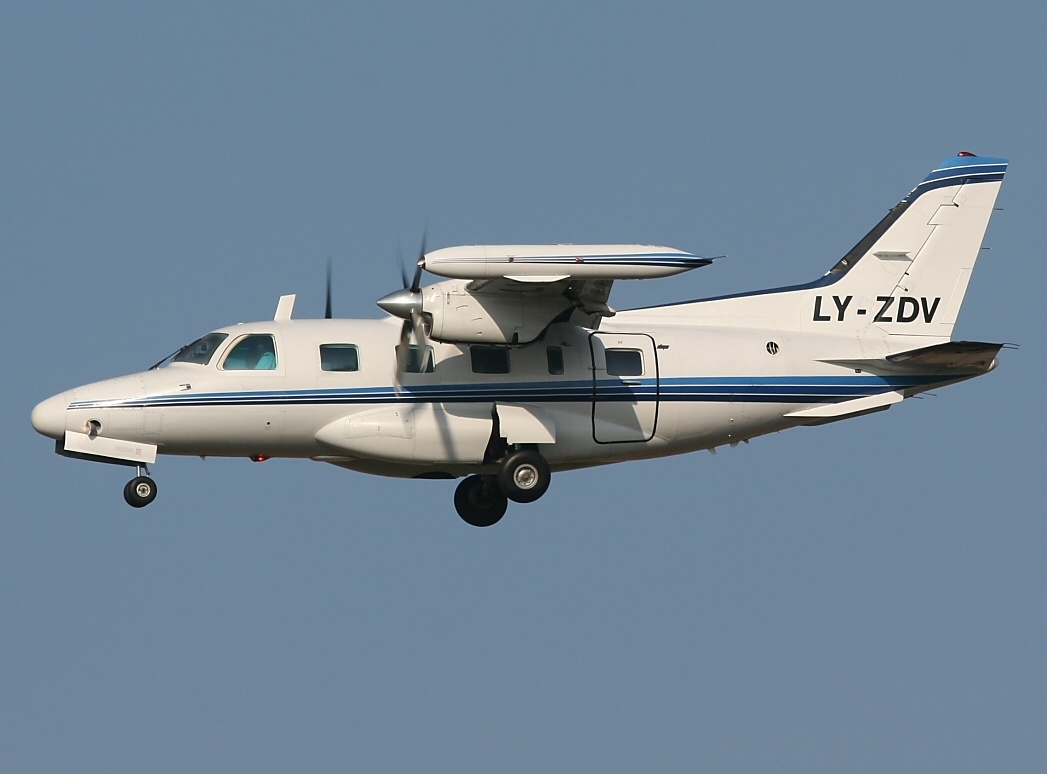
The Mitsubishi MU-2B-35, marketed as the MU-2J, is a long-fuselage, pressurised, high-wing twin turboprop built by Mitsubishi Heavy Industries. It was certified in March 1971 and followed the stretched MU-2G with more powerful TPE331 engines. It is of interest to a sim pilot for its fast cruise, its short-field ability and its unusual spoiler roll control.
The MU-2B-35 is the FAA type-certificate designation for the model sold as the MU-2J. It belongs to the Mitsubishi MU-2 family, a Japanese high-wing, twin-engined turboprop with a pressurised cabin, built from 1963 to 1986. The family was Mitsubishi's first postwar aircraft design and remains one of postwar Japan's most successful, with 704 built in Japan and at San Angelo, Texas. The aircraft was conceived as a light twin turboprop transport for a variety of civil and military roles, and it found its main market as a business aircraft, air taxi and freighter. The -35 sits in the long-fuselage branch of the family, which began with the MU-2G. Tip tanks at the wingtips and a long, thin wing make the type easy to recognise.
Work on the MU-2 began in 1959, and the first aircraft flew on 14 September 1963. The prototype and the three MU-2As were powered by the Turbomeca Astazou, after which production moved to the Garrett (later AiResearch and Honeywell) TPE331, which stayed standard on all later models. In 1963 Mitsubishi granted Mooney Aircraft the North American rights to assemble, sell and support the type, and in 1965 Mooney began assembly at its new San Angelo, Texas factory. Major components came from Japan, and San Angelo installed engines, avionics and interiors before painting, flight testing and delivery. Mooney was in financial difficulty by 1969, and the San Angelo plant was taken over by Mitsubishi. On 14 May 1970 Mitsubishi Heavy Industries cancelled the contract with Butler-Mooney and organised Mitsubishi Aircraft International to assemble and market the aircraft. The long-body J model, the MU-2B-35, was certified on 28 March 1971. It followed the first stretched model, the MU-2G (MU-2B-30), which first flew on 10 January 1969 with a fuselage 1.91 m (6 ft 3 in) longer than earlier aircraft. A total of 108 MU-2Js were built. US production ended in 1986, and the last Japanese-built aircraft was completed in January 1987.
The MU-2B-35 has the stretched fuselage introduced on the MU-2G. The cabin door sits behind the wing, and there is a third cabin window on each side plus one in the door. The nose gear sits slightly further aft than on the short-body aircraft and retracts forward, with doors that stay open when the gear is extended. The main gear retracts into pods against the lower sides of the fuselage. Small vanes sit at the bottom of the tip tanks, and the tail is somewhat higher than on the short-body models. Compared with the MU-2B-30, the -35 has two more powerful 'Dash 6' versions of the AiResearch TPE331. They are rated at a maximum of 840 shp but flat-rated to 665 shp, which lets the aircraft fly faster and higher than the earlier version. The wing is small and highly loaded, with full-span, double-slotted flaps. Roll control comes from over-wing spoilers rather than ailerons, and the tip tanks carry part of the fuel. Published figures for the closely related long-body MU-2L, the model measured for the reference data, include a length of 39 ft 5 in (12.01 m), a tail height of 13 ft 8 in (4.17 m), a fuselage diameter of 5 ft 3 in (1.60 m), a cabin length of 16 ft 0 in (4.87 m), a cabin width of 4 ft 11 in (1.50 m), a cabin height of 4 ft 4 in (1.32 m) and a baggage volume of 42 cu ft (1.2 cu m). The same data gives an empty weight of 7,568 lb (3,433 kg), a maximum take-off weight of 11,600 lb (5,250 kg), a maximum landing weight of 11,000 lb (5,000 kg), a maximum payload of 3,800 lb (1,750 kg) and a fuel capacity of 370 US gallons (1,400 L). Seating is up to 12 in that reference.
The MU-2 combines a high cruise speed with a low landing speed. The very large flaps give the wing a loading in the landing configuration comparable to a Beechcraft King Air, while in cruise the loading is comparable to a light jet. The spoilers remain highly effective even when the wing is stalled, and the absence of ailerons eliminates adverse yaw. Published figures for the long-body MU-2L, the model measured for the reference data, are a maximum speed of 295 kt, a cruise speed of 261 kt, an approach speed of 81 kt, a range of 1,260 nm, a ceiling of 29,590 ft, a rate of climb of 2,360 ft/min, a take-off distance of 2,150 ft and a landing distance of 1,880 ft. The small, highly loaded wing also makes the aircraft less forgiving than a typical light twin. Many early accidents involved pilots moving up from slower light twins who did not know its handling or its engine-out procedures. Type-specific training has since become a legal requirement in the United States: the FAA issued Special Federal Aviation Regulation 108 on 6 February 2008, with compliance required from early February 2009. In November 2017 the rule moved into 14 CFR Part 91, subpart N.
Civil MU-2s with Garrett engines are certified as MU-2B models followed by a number, and each also has a marketing letter. The MU-2B-10, for example, was sold as the MU-2D, and the MU-2B-36A as the MU-2N. The family divides into short and long fuselages. The short-body models are the MU-2B, MU-2D, MU-2F (MU-2B-20), MU-2K (MU-2B-25), MU-2M (MU-2B-26), MU-2P and the Solitaire (MU-2B-40, with TPE331-10 engines flat-rated to 665 shp). The long-body models are the MU-2G (MU-2B-30), the MU-2J (MU-2B-35, the subject of this guide), the MU-2L (MU-2B-36), the MU-2N (MU-2B-36A, with uprated engines and four-blade propellers) and the Marquise (MU-2B-60, with engines flat-rated to 715 shp). The MU-2G was essentially an MU-2F with the stretched fuselage and a somewhat higher tail, and the J replaced it with more powerful engines. The MU-2L was a higher-gross-weight development of the J. Military versions were the JGSDF LR-1, based on the MU-2C and MU-2K, and the MU-2S search-and-rescue aircraft, based on the MU-2E.
Most MU-2s were civilian. Corporate owners, charter operators and freight companies used them because they were fast for a turboprop and could reach small airfields. Some long-body aircraft were converted for dedicated cargo work, with a crew door in place of a cockpit window and a large cargo door in the rear left fuselage. Military use of the family has been modest. The Japan Ground Self-Defense Force flew the LR-1 for liaison and photo reconnaissance until 2016, and the Air Self-Defense Force flew the MU-2S for search and rescue until its replacement in 2008 by the British Aerospace U-125A. Argentina used four civilian MU-2s unarmed during the Falklands War as pathfinders, reconnaissance and communications-relay aircraft. In late 2009 the Royal New Zealand Air Force took delivery of four MU-2Fs as training aids. Retired US Air Force pilots also fly contract MU-2s at Tyndall Air Force Base to train air battle managers.
For a sim pilot the MU-2B-35 offers a fast turboprop with unusual flying qualities. Roll is controlled by spoilers rather than ailerons, so there is no adverse yaw, and the large double-slotted flaps allow a low approach speed. The aircraft cruises quickly yet can use short runways. It rewards a pilot who studies its procedures, since the real aircraft is less forgiving than a typical light twin and demands specific training. Engine-out handling deserves particular preparation. The flat-rated 665 shp engines mean power management follows torque limits rather than raw engine rating.