Departure
92%
vs 95% ▼ 3
 MY FS FLIGHTS
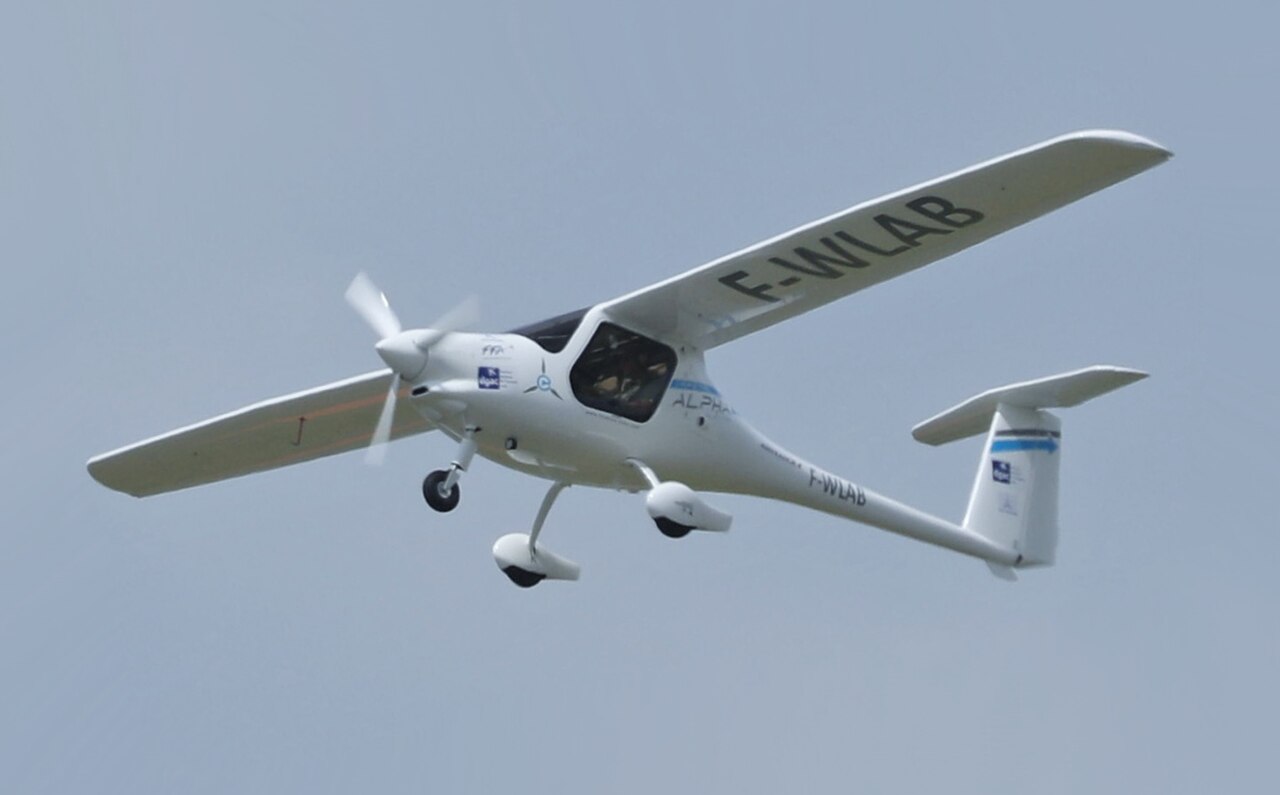
The Pipistrel Alpha Electro is a Slovenian two-seat, side-by-side electric light-sport and ultralight aircraft produced by Pipistrel, developed as an electrically powered derivative of the firm's Alpha Trainer. Announced in 2015, it was for several years the only commercially available electric aeroplane in the world outside of electric motorgliders, and it offers a sim pilot a genuine taste of low-cost, near-silent primary flight training. Its blend of brisk electric acceleration, benign handling and simple systems has made it a fixture of experimental electric-flight training programmes around the world.
The Alpha Electro is a cantilever high-wing, tricycle-gear, two-seat light aircraft built by Pipistrel, sharing its airframe and general layout with the piston-engined Alpha Trainer, which itself was developed from the Pipistrel Virus. Instead of a Rotax piston engine it uses a water-cooled electric motor drawing on lithium-polymer battery packs, making it one of the first electric aircraft offered as a turnkey customer product rather than a research prototype. It was conceived specifically as a low-cost, low-maintenance flight trainer, and it meets microlight and ASTM light-sport aircraft requirements as well as standards for electric propulsion systems.
The Alpha Electro traces its roots to the Pipistrel WATTsUP proof-of-concept design, developed under an EU Commission project of the same name to explore electric propulsion for light aircraft; the first iteration of the airframe that would become the Alpha Electro first flew in 2014. Pipistrel formally introduced the aircraft as the Alpha Electro in 2015, dropping the WattsUp name, at a launch price of 69,000 euros, and unveiled it at that year's Aero show. The project was led by Pipistrel founder Ivo Boscarol together with Dr Tine Tomazic of Pipistrel Vertical Solutions, who was responsible for the aircraft's development. In 2015 Pipistrel had intended to fly the Electro across the English Channel from France to England two days ahead of the Airbus E-Fan, but the attempt was prevented by Siemens. The aircraft was subsequently certified for use in the United States. Pipistrel later developed a type-certified successor, the Velis Electro, which built on the Alpha Electro's design and became the type-certified electric trainer offered in its place.
Structurally and aerodynamically the Alpha Electro shares its airframe with the Alpha Trainer, itself a simplified, single-skin composite laminate development of the Pipistrel Virus, with a cantilever high wing, side-by-side two-seat cockpit, tricycle landing gear and full-span flaperons offering strong roll authority. The differential wheel brakes of the Virus were replaced with a single centre-console handbrake operating dual-disc Beringer brakes, and a full airframe emergency ballistic parachute is fitted as standard equipment. Where the Trainer carries 35 kg of fuel, the Electro instead carries around 126 kg of lithium-polymer cells feeding a water-cooled electric motor; the motor itself weighs only about 11 kg in early production form, though later production aircraft use a 60-plus kW electric motor weighing around 20 kg paired with a 21 kWh dual-redundant battery pack designed to be swapped in minutes or recharged in under an hour. Maximum take-off power is 60 kW with 50 kW available for maximum continuous power. Maximum take-off mass is 550 kg (1,212 lb), and useful load is around 170 kg (380 lb), broadly comparable to the 160-220 kg useful load of a Cessna 152. Flight control surfaces are pushrod-actuated except for the cable-operated rudder. Published limiting speeds are a never-exceed speed of 135 KIAS, a maximum speed for normal operations of 108 KIAS, a design manoeuvring speed of 86 KIAS and a maximum flap-extended speed of 70 KIAS, with a service ceiling of 12,000 ft.
The Alpha Electro is a lively performer on electric power: with 60 kW available on take-off it accelerates rapidly and has been reported to become airborne in under 100 metres even with two occupants aboard. Even flown conservatively on a fuel-conserving 40 kW climb power setting it can climb at 800 to 1,000 feet per minute with two large adults on board. Endurance is limited by battery capacity rather than airframe performance: the aircraft carries energy for around one flight hour plus reserves, and after around 38 minutes of manoeuvring the battery charge may already be down to about 25 percent, with pilots typically advised to return to the circuit with around 30 percent capacity remaining. Batteries can be recharged in around 45 minutes or physically swapped in about 5 minutes, and running costs on electricity are roughly a tenth of those on petrol. One operator, flying from Parafield to Eyre to Adelaide, used the type to set a longest all-electric flight record of 730 nautical miles, surpassing a previous electric-flight endurance record of 405 nautical miles. In general handling the Electro flies much like a conventional two-seat trainer: it is described as a slippery airframe with real power-to-weight advantage from its 60 kW motor, giving good control harmony and a sporty feel, while remaining a benign, low-maintenance aircraft suited to ab-initio instruction.
The baseline airframe is the piston-powered Alpha Trainer, fitted with an 80 hp Rotax 912 UL engine, from which the Alpha Electro was directly derived by substituting an electric motor and battery system for the fuel engine and tank. The Electro itself grew out of the earlier WATTsUP proof-of-concept electric demonstrator built under an EU-funded research project. Pipistrel subsequently developed the type-certified Velis Electro as the production successor to the Alpha Electro, carrying the electric-trainer concept into full type certification.
The Alpha Electro has been used almost exclusively for flight training and demonstration of sustainable aviation concepts rather than general utility flying. WorldWide Wings placed an order for 15 examples for use at its flight school locations in California and Florida in the United States, and four Alpha Electro aircraft were introduced to provide flight training in Fresno, California from late 2017 as part of the Sustainable Aviation Project. A flight school in North America became the first in the region to operate electric aircraft using the type. In Canada, the first Alpha Electro imported into the country had, by the time it was reported on, accumulated 500 hours of flying time, with its owner noting that its rapid acceleration and short take-off run made it his preferred aircraft over a conventional piston type he also owned. In Australia, an operator based the type at its Adelaide headquarters and used it to set world electric-flight endurance records, with plans to establish local manufacturing of the type.
The Alpha Electro has been modelled for FlightGear, developed by Bea Wolf, Sven Seipp and Carsten Vogel using the JSBSim flight dynamics model, and is bound with dedicated key commands for the master switch, avionics switch, battery-enable and power-enable switches and cabin doors. The simulated aircraft reproduces the type's published limiting speeds, service ceiling and take-off and continuous power settings, giving a reasonably faithful representation of its electric powerplant behaviour, including the way available power and remaining endurance trade off against throttle setting in flight. A type-certified version of the same airframe, the Velis Electro, has also been made available for FlightGear in the same aircraft package. Real-world pilot accounts describe the type as flying much like other Pipistrel trainers from the inside, with the electric motor's power delivery giving crisp, immediate throttle response and quick acceleration on the runway, along with the same centre-mounted handbrake and flaperon controls found on the piston Alpha Trainer, making it a useful platform for practising short-field circuits and energy-managed training patterns.