Departure
93%
vs 95% ▼ 2
 MY FS FLIGHTS
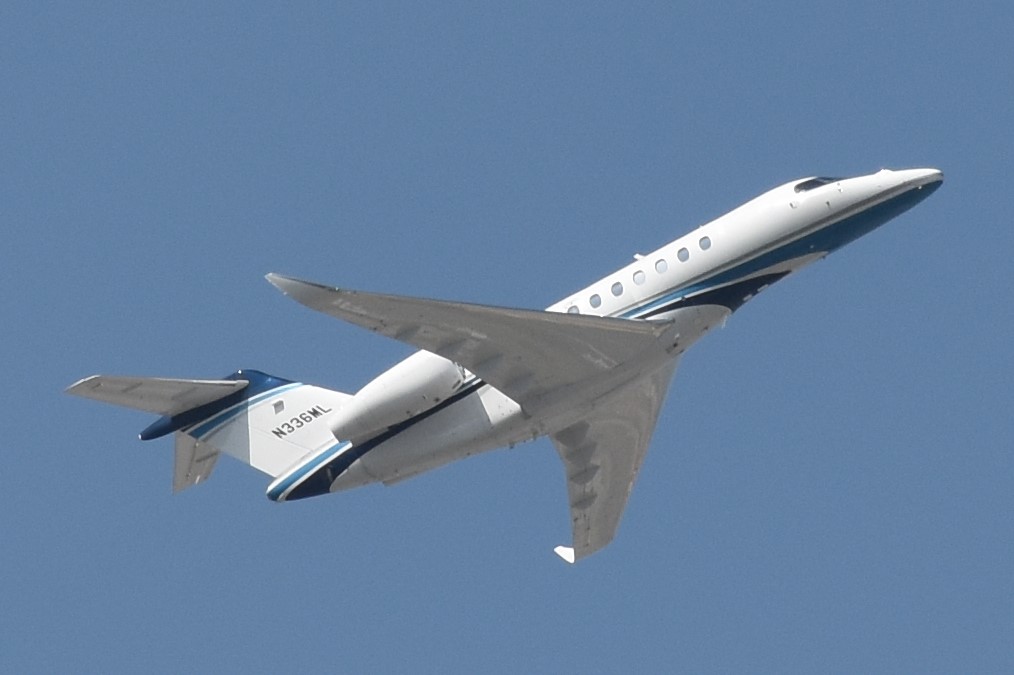
The Cessna Citation Longitude is a super-midsize business jet built by Textron Aviation, and is the largest jet in the Citation family. Developed from the Citation Latitude, it combines a stretched fuselage, new swept wing and T-tail with Honeywell HTF7000-series turbofans to give a super-midsize jet transcontinental range and a stand-up flat-floor cabin, making it a notable step up in capability for pilots moving through the Citation line.
The Citation Longitude, given the Cessna model designation 700, is a twin-engine business jet produced by Textron Aviation as part of the long-running Cessna Citation family. It sits at the top of the current Citation range as the largest business jet Cessna builds, occupying the super-midsize category. The aircraft is essentially a development of the Citation Latitude, sharing that model's fuselage cross-section but stretched by an additional row of seats, and fitted with a new wing and T-tail empennage. It is powered by Honeywell HTF7000-series turbofans and built with an aluminum wing and fuselage.
The Longitude project is regarded as the follow-on to the cancelled Cessna Citation Columbus, and was announced at the EBACE show in May 2012 with an originally planned 2017 introduction. The first flight-test aircraft flew on October 8, 2016, with a second following in November and a third joining in March 2017 to develop avionics and systems and gather flight-simulator data; by that point the fleet had logged 125 flights and more than 250 hours as production began at Textron Aviation's Wichita, Kansas facility. A fourth prototype joined the program on May 6, 2017, fully outfitted to evaluate the interior, environmental control system, pressurization and cabin technologies, by which time the program had flown more than 200 missions for nearly 400 hours. The first production unit was rolled out on June 13, 2017, with the four test aircraft having flown 550 hours and a fifth aircraft due to join that summer. By October 2017 the fleet had exceeded 1,200 flight hours over 600 flights, with certification expected by late 2017 or early 2018. In February 2018, with five aircraft having accumulated over 1,000 flights and 2,000 hours, US certification and deliveries of the then US$27 million jet were expected before the end of the second quarter, with European validation to follow six months later. Flight testing concluded by early June 2018 after 3,000 hours on five aircraft, and certification was subsequently expected in the third quarter of 2018. A partial exemption for fuel tank flammability requirements, valid through January 2020, was granted to keep the certification goal on track, with a compliance plan due by October 1, 2018. On October 15, 2018, NetJets announced an order for up to 175 Longitudes at $26 million each, alongside 150 Citation Hemispheres priced at $35 million each. After 4,050 hours across 1,650 test flights, the Longitude received provisional FAA type certification on December 20, 2018, allowing early 2019 deliveries; the fuel tank flammability issue was formally addressed on December 5, 2018, with production aircraft receiving the definitive installation subject to some operational limits. Full FAA Type Certification was granted on September 21, 2019, following 6,000 flight hours, 11,000 test points and a 31,000 nmi world tour. Deliveries to NetJets began shortly after, and the type entered service in October 2019. By May 2023, 100 examples had been produced.
The Longitude uses an aluminum airframe with the same 83.25-inch (211.5 cm) circular fuselage cross-section as the Citation Latitude, stretched by one seat row and fitted with a new, moderately super-critical wing swept at 26.8 degrees at the inner section and 28.6 degrees at the outer section, along with moderate winglets that give a wingspan 5.3 feet (1.6 m) greater than the similar wing and empennage fitted to the Hawker 4000. The tail is a T-tail configuration, and the fuselage uses area-rule contouring. The cabin is flat-floored and stands 6.0 ft (1.8 m) high, with a width of 6 ft 5 in (1.96 m), a floor width of 4 ft 1 in (1.24 m) and a cabin length of 25 ft (7.6 m); it seats up to eight in a double-club layout, with other sources citing configurations of up to twelve including an optional crew jump seat. The aircraft was originally intended to be powered by the Snecma Silvercrest engine, but production aircraft instead use Honeywell HTF7000-series turbofans (quoted elsewhere as the HTF7700L). Maximum take-off weight is 39,500 lb (17,900 kg), with basic operating weight estimated by industry analysts at 24,000-25,000 lb (10,900-11,300 kg) prior to final figures being announced. The baggage compartment is a walk-in design with capacity of up to 1,000 lb, accessible in flight.
The Longitude is designed for a range of around 3,500 nmi (6,500 km). At its maximum cruise speed of Mach 0.83, equating to 473 kn (876 km/h) true airspeed, fuel flow is around 860-880 lb (390-400 kg) per side per hour at FL430 in ISA -4 conditions. A long-range cruise at Mach 0.79 gives a true airspeed of 451 kn (835 km/h) with a fuel burn of about 1,820 lb (830 kg) per hour for an aircraft weighing 38,001 lb (17,237 kg), while at its maximum operating Mach of 0.84, true airspeed rises to 477 kn (883 km/h) with fuel burn of about 2,122 lb (963 kg) per hour. Overall fuel consumption is quoted at 2,400 lb (1,100 kg) for the first hour and 1,600-1,800 lb (730-820 kg) per hour in cruise thereafter. In a test climb, after a takeoff at 31,150 lb (14,130 kg), some 8,350 lb (3,790 kg) below MTOW, the aircraft achieved a climb rate of 2,550 ft/min (13.0 m/s) at FL200. Maximum cruise speed has also been quoted as 476 knots (549 mph).
The Longitude carries the Cessna model designation 700 and has developed from the Citation Latitude, sharing its fuselage cross-section but with a stretched cabin and new wing. It in turn served as a design basis for the larger Cessna Citation Hemisphere, which was originally intended to share the Silvercrest engine selection before that program's suspension. No distinct production sub-variants of the Longitude itself are noted beyond this developmental lineage.
The Longitude serves in the super-midsize business jet role, offering transcontinental and some intercontinental range for corporate and charter operators. NetJets is the type's largest fleet operator, having placed a launch order for up to 175 aircraft at $26 million each in October 2018 and taking delivery of its first example shortly after certification, with deliveries beginning in the fourth quarter of 2019. As of early 2025, around 128 Citation Longitudes were reported in operation worldwide, with the majority under fractional ownership arrangements and the largest single fleet held by NetJets.
The Longitude's flight-test program logged over 6,000 hours and 11,000 test points, including a 31,000 nmi world tour, before certification, reflecting the scope of handling and systems validation behind the type. Pilots transitioning from other Citation models will find the T-tail configuration, swept wing and Honeywell HTF7000-series turbofans a step up in performance from the Latitude, with fully integrated autothrottles and the LINXUS onboard diagnostic system supporting crew workload management in the cockpit.