Departure
95%
vs 95% ▼ 1
 MY FS FLIGHTS
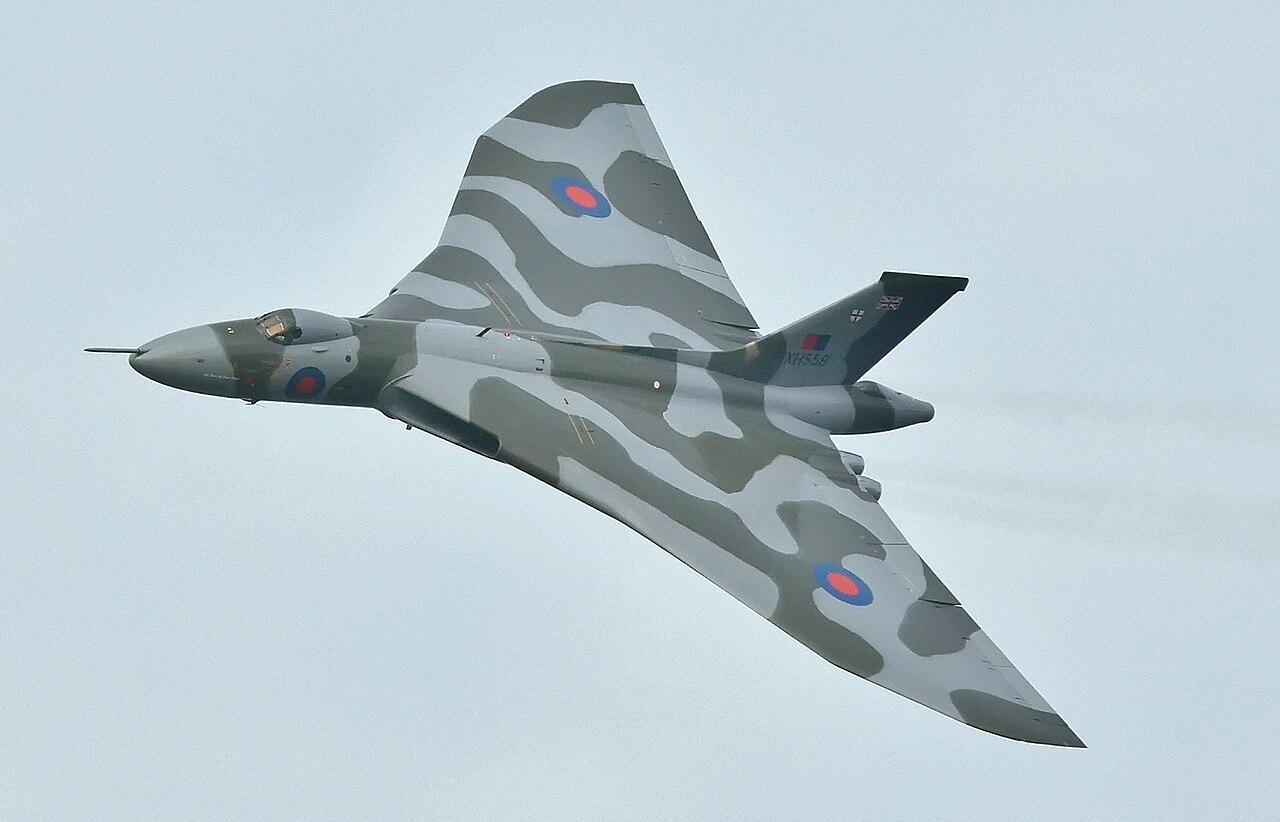
The Avro Vulcan B2 was the definitive version of Britain's iconic delta-winged strategic bomber, built by Avro to carry the RAF's nuclear deterrent through the height of the Cold War. Distinctive for its huge tailless delta wing and the thunderous howl of four Bristol Olympus turbojets, it served alongside the Handley Page Victor and Vickers Valiant as one of the RAF's V-bombers, and remains one of the most celebrated shapes in British aviation history. For the sim pilot it offers the chance to fly an aircraft renowned as much for its surprising agility as for its role at the sharp end of nuclear strategy.
The Avro Vulcan was a four-engined, delta-winged strategic bomber built by Avro for the Royal Air Force, and the B2 was the larger, more powerful definitive production version of the type. It formed part of the RAF's V-bomber force alongside the Handley Page Victor and Vickers Valiant, tasked with delivering Britain's airborne nuclear deterrent during the Cold War. Of the three V-bombers, the Vulcan is held in by far the greatest regard in British military history and among enthusiasts, thanks to its unmistakable silhouette and its later fame in the Falklands War and on the post-retirement airshow circuit.
The Vulcan's design was proved using the small Avro 707 research aircraft in 1949, and the prototype Vulcan B1, fitted with Olympus engines, first flew on 30 August 1952. The first production aircraft flew on 5 February 1955, and the second production aircraft caused a sensation at the Farnborough Air Show by performing a roll during its display, an early sign of the type's unexpected agility for so large an aircraft. Vulcans first entered RAF service in 1956 with No. 230 Operational Conversion Unit at Waddington. The larger, more capable B2 version entered service on 1 July 1960. The final production batch of thirteen Vulcans included XM645, the first aircraft built in that last batch, delivered in the mid-1960s.
The Vulcan B2 retained the tailless delta-wing configuration of the B1 but was enlarged, with a wingspan of 34m (111ft) and a length of 32m (105ft), compared with the B1's wingspan of 30m (99ft) and length of 31m (102ft). Power came from four Bristol Olympus twin-spool axial-flow turbojet engines, giving the aircraft its characteristic and formidable roar. The delta-wing layout, unusual for a heavy bomber of its era, was central to both its high-altitude performance and its later reputation for aerobatic-style manoeuvrability during display flying.
Despite its size and role as a strategic bomber, the Vulcan was renowned for its power and agility, qualities demonstrated as early as the Farnborough Air Show when the second production aircraft rolled during a public demonstration. This handling character was exploited in later years during airshow performances, where crews would put the big delta through phenomenally tight aerobatic manoeuvres more commonly associated with fighters than four-engined bombers.
The principal variants were the B1 and B1A, the original production versions, and the larger, more powerful B2 that became the definitive production standard from 1960. A specialised maritime reconnaissance derivative, the B2(MRR), was also operated; the sole surviving example of this configuration is XJ823, preserved at the Solway Aviation Museum. No complete examples of the B1 or B1A survive today, making the B2 and its B2(MRR) sub-variant the only Vulcans preserved.
The Vulcan B2 formed the backbone of the RAF's V-bomber nuclear deterrent force through the 1960s and 1970s, operating from bases including Waddington and Scampton with squadrons such as No. 27 and No. 617 Squadron. Aircraft in this role carried out long-range strategic patrols, and crews on nuclear alert duties reportedly wore a black eyepatch over one eye as protection against the flash of a nuclear detonation. The type's most famous operational use came during the Falklands War, when Vulcans flew the long-range Black Buck missions, and some aircraft were fitted to trial AIM-9G Sidewinder air-to-air missiles for self-defence. Following retirement from front-line service in the early 1980s, the RAF formed the Vulcan Display Flight in 1984 to keep the type flying at airshows, operating XL426 from 1984 to 1986 and XH558 from 1985 until the flight was disbanded in 1993 due to defence cuts. XH558 was later restored to flying condition by the Vulcan to the Sky Trust, returning to the display circuit in October 2007 before making its final flight on 28 October 2015. Today 21 Vulcan B2s are preserved across the UK, Canada and the United States, with three, XH558, XL426 and XM655, maintained in taxiable condition.
For Microsoft Flight Simulator, a freeware Avro Vulcan B2 has been produced by the developer Fsadni and is available via flightsim.to; it is a simple model rather than a deep systems simulation, aimed at pilots who want to jump into the cockpit and fly sorties over England or the Falklands rather than manage a fully modelled bomber. It has been praised for how it flies despite its lack of complexity, and is intended as an accessible way to experience the type rather than a study-level rendition. A more detailed payware Vulcan has also been in development by Just Flight, understood to have originated as a conversion of an existing X-Plane model, for pilots wanting a more systems-focused depiction of this historic delta-winged bomber.