Departure
93%
vs 95% ▼ 2
 MY FS FLIGHTS
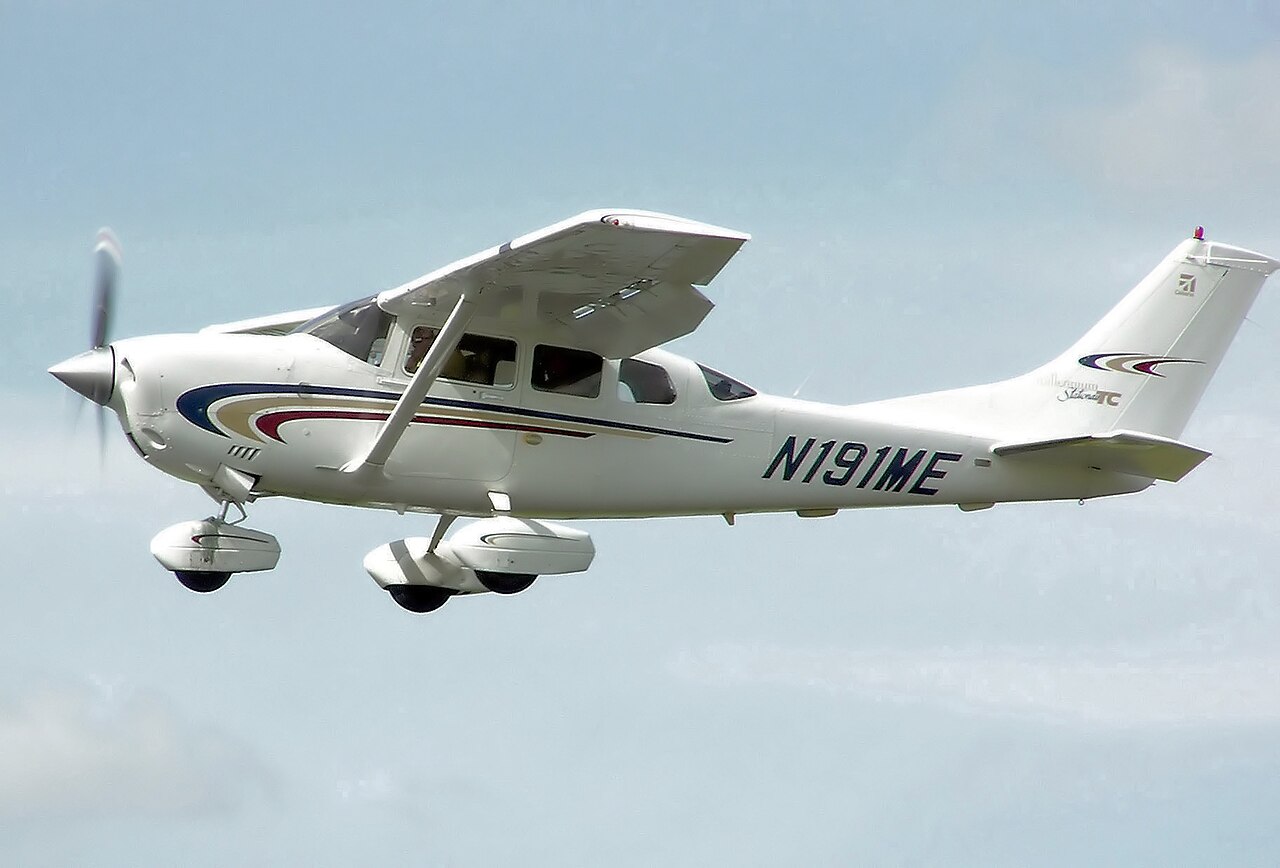
The Cessna T207A is the turbocharged, eight-seat derivative of the Cessna 207 Skywagon/Stationair, itself a stretched development of the highly successful 206 Stationair family that traces its ancestry back to the retractable-gear Cessna 210. Built for exactly the kind of work that makes a simple, rugged single worth flying - short-field bush operations, air taxi work, skydiving and aerial photography - the Turbo Stationair 207 combines a large, high-wing cabin with a powerful turbocharged Continental engine, making it a favourite among pilots who need to carry a full load out of unimproved strips at altitude.
The Cessna T207A Turbo Stationair is a single-engine, high-wing, fixed-gear utility aircraft built by Cessna, seating up to eight including the pilot. It is the turbocharged, longer-cabin member of the Cessna 205/206/207 Stationair family, aircraft that were developed from the retractable-gear Cessna 210 and became some of the most successful single-engine civil utility types ever produced. The T207A occupies the top of that family's size and power range, combining a capacious cabin with turbocharged performance intended for demanding bush, air-taxi and special-mission work.
The lineage of the T207A begins with the Cessna 210, a single-engine six-seat model introduced in 1957 with retractable landing gear. Using the 210 as a design base, Cessna developed the fixed-gear 206 line in the early 1960s, which went on to become one of the most successful families of single-engine civil light utility aircraft. Cessna then stretched the 206's fuselage by 45 inches to create the Model 207, which debuted in 1969. The 207 was manufactured from 1969 to 1984, with a total of 626 airframes built. Within the 207 line, the turbocharged T207A variant was initially certified in July 1976 and was subsequently certified to carry eight seats in September 1979. The engine was upgraded to the 310 hp Continental TSIO-520-M. For the 1978 model year, the 207A and T207A were renamed Stationair 7 and Turbo Stationair 7 respectively, the previously optional 28V electrical system became standard, and 1979 introduced a long-hub propeller and spinner alongside the move to eight-seat certification.
The T207A is a high-wing, all-metal design with fixed tricycle landing gear and a conventional tail unit, built around the stretched fuselage of the Model 206 to provide additional cabin length and four side passenger windows. It measures 32 feet 2 inches in length, stands 9 feet 7 inches tall, and has a wingspan of 36 feet. Power comes from a Continental TSIO-520-M, a turbocharged six-cylinder, horizontally opposed piston engine delivering up to 310 horsepower, driving a constant-speed propeller. The seven-seat version of this turbocharged variant was marketed as the Turbo Skywagon, while the eight-seat version was known as the Turbo Stationair. The aircraft is a straightforward, rugged design with proven systems, equipped for day and night VFR and, with additional equipment, for day and night IFR operations as well.
The T207A has a range of 671 miles, a service ceiling of 26,000 feet, and a climb rate of 810 feet per minute. Takeoff distance is quoted at 1,100 feet and landing distance at 765 feet, reflecting the short-field capability that made the type popular for bush operations. Cruise speed is given as 185 miles per hour with a top speed of 196 miles per hour. Approved manoeuvres are limited to those incidental to normal flying, stalls other than whip stalls, and turns in which the angle of bank does not exceed 60 degrees, underlining its role as a stable utility hauler rather than an aerobatic machine.
The T207A sits within the broader 207 line, which itself was a stretched, higher-seating development of the Cessna 206 family. Within the turbocharged 207 branch, the seven-seat configuration was marketed as the Turbo Skywagon and the eight-seat configuration, certified from September 1979, as the Turbo Stationair. From the 1978 model year the naming of the 207A and T207A shifted to Stationair 7 and Turbo Stationair 7, alongside standardisation of the 28V electrical system, and 1979 brought a long-hub propeller and spinner as part of the move to eight-seat capability.
The Cessna 207 series, including the turbocharged T207A, has been particularly popular with air taxi operators, especially on short routes where its full seating capacity could be exploited, functioning much like a minivan of the air by packing passengers and possessions in tight and whisking them off in reasonable comfort at modest expense. Beyond air taxi work, the type has seen wide use as a skydiving platform and for aerial photography and mapping, tasks well suited to its capacious cabin, load-carrying strength and short-field performance on unimproved airstrips.
In Microsoft Flight Simulator, the Cessna T207A Turbo Stationair was released as a dedicated add-on offered in three configurations: a standard passenger version, a cargo/freighter version, and a skydiving configuration, each with its own set of liveries drawn from classic Cessna colour schemes plus platform-specific options. The aircraft was modelled to reproduce the type's real-world character as a rugged, high-capacity bush and utility hauler, giving simmers a platform suited to short-field operations, cargo runs and skydiving scenarios rather than high-speed cross-country flying.