Departure
95%
vs 95%
 MY FS FLIGHTS
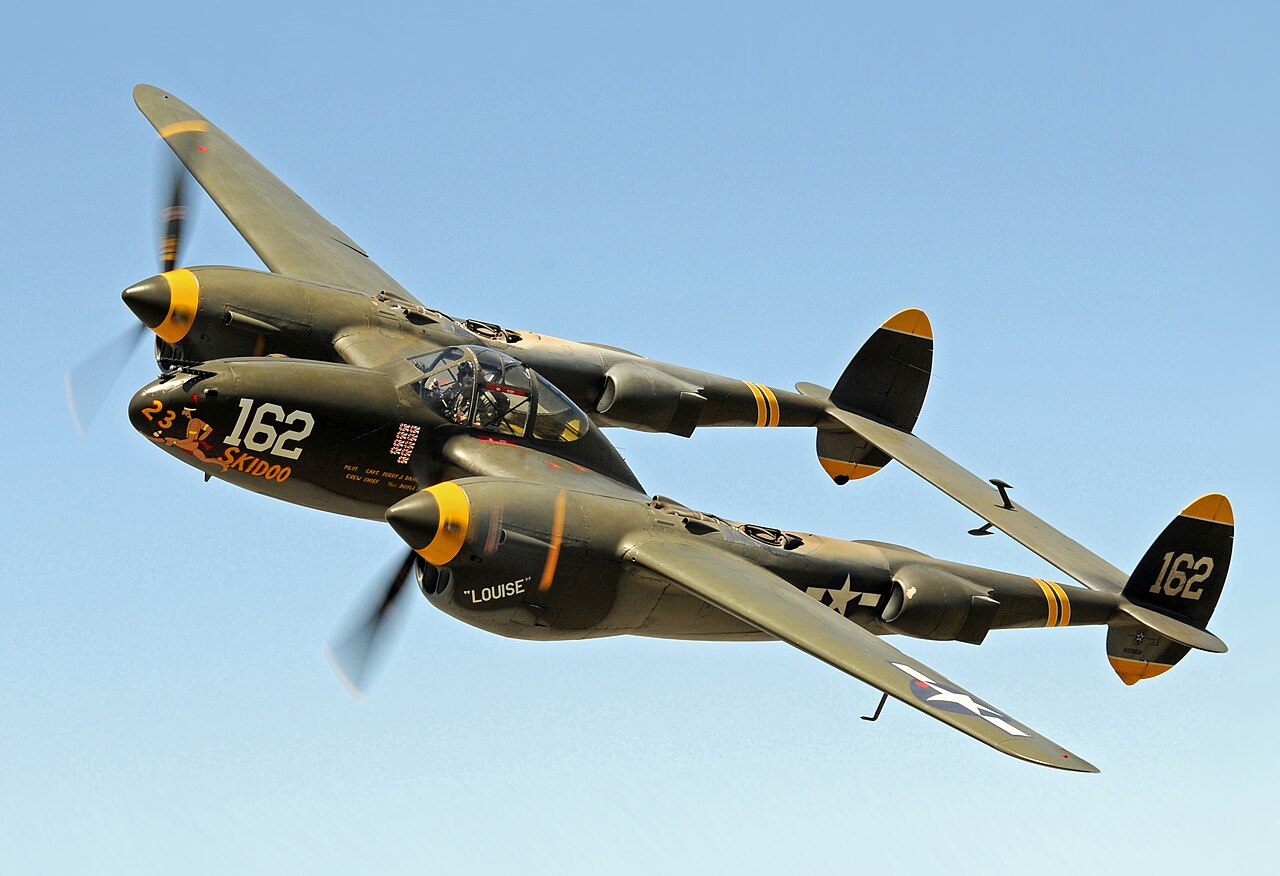
The Lockheed P-38L Lightning was the definitive and most numerous version of America's twin-engine, twin-boom fighter of the Second World War, combining greater power with the aerodynamic refinements developed over years of combat experience. Flown by the two top-scoring American aces of the war, Richard Bong and Thomas McGuire, and famous for the interception of Admiral Yamamoto's transport in 1943, it remains one of the most distinctive and capable piston fighters ever built, and a natural subject for simulation given its unusual twin-engine handling and long over-water range.
The P-38L was the final and most produced variant of the Lockheed P-38 Lightning, a twin-engine, single-seat fighter built around a central pod housing the pilot and armament, flanked by two long tail booms carrying the Allison engines and joined by a single tailplane. Originally designed as Lockheed's Model 22 to meet a 1937 United States Army Air Corps requirement for a high-altitude interceptor, it grew into one of the most versatile combat aircraft of the Second World War, serving as an interceptor, long-range escort fighter, fighter-bomber, photo-reconnaissance platform and night fighter. It was the only American fighter type kept in continuous production throughout the entire war.
The P-38 originated from a 1937 Army Air Corps specification for an advanced, high-performance twin-engine interceptor, and the prototype demonstrated its potential early on: on 11 February 1939, Lieutenant Ben Kelsey flew the prototype Lightning coast to coast in a record 7 hours 48 minutes, though the aircraft was written off in a crash at the end of that flight. Design work was led by a Lockheed team under Clarence Johnson and Hal Hibbard. Roughly 10,000 P-38 airframes of all variants were eventually built, and the P-38L became by far the most numerous single version, with more than 3,800 built (some sources cite 3,810). The type's twin-boom, single-nacelle layout, unconventional for its day, proved especially well suited to the long over-water missions flown in the Pacific theatre. A late derivative, the P-38M two-seat night fighter, was converted by Lockheed from P-38L airframes and was among the first radar-equipped American fighters, distinguished by a raised rear seat and extended canopy for a second crewman; its top speed exceeded that of the Northrop P-61A Black Widow by more than 30 mph.
The P-38L retained the classic Lightning layout: a central fuselage pod carrying the pilot and nose armament, with twin tail booms each housing an Allison engine and joined by a single horizontal tailplane. It was powered by two Allison V-1710 engines - recorded variously as the V-17105 and the counter-rotating V-1710-89/91 - each rated at 1,475 horsepower, driving three-bladed Curtiss Electric constant-speed propellers turning in opposite directions to cancel out torque and yaw effects. Fixed armament typically comprised four .50-calibre machine guns and one 20mm cannon grouped in the nose, and the aircraft could also carry up to 4,000 pounds of external stores, including rockets, bombs or depth charges. Dimensions given for preserved airframes include a wingspan of 52 feet, a wing area of 327.5 square feet, and a length recorded as either 37 feet or 37 feet 10 inches depending on the individual aircraft; height is recorded variously as 9 feet or 12 feet 10 inches. Empty weight was around 12,780 to 12,800 pounds, with a gross or maximum takeoff weight of 21,600 pounds.
The P-38L had a maximum speed of 414 mph. Cruise speed is recorded at 290 mph. Range figures vary with fuel and mission: one source gives a range of 1,175 miles, while another cites a combat range of 450 miles reflecting a fully armed, mission-configured aircraft. Later production incorporated hydraulically powered aileron boosters, manoeuvre flaps and dive flaps, refinements that improved control response and helped address the compressibility and dive problems that had affected earlier Lightning variants at high speed.
The P-38L was the final and most-produced production version of the Lightning family, distinguished from earlier models by more powerful Allison engines and other incremental upgrades that led many to regard it as the best of the line. The P-38M was a two-seat night fighter conversion of P-38L airframes, fitted with radar, an elevated rear seat and an extended rear canopy for a radar operator, and was one of the first American fighters equipped with radar; its top speed exceeded that of the Northrop P-61A Black Widow by over 30 mph. Individual P-38L aircraft were also produced in sub-block designations such as the P-38L-5-LO.
The P-38 fought in every major theatre of the Second World War and proved highly adaptable, serving as a pursuit fighter, bomber escort, ground-attack fighter, radar-equipped night fighter, light bomber and target-marking pathfinder, and it could carry a bomb load as heavy as some medium bombers before switching immediately to a ground-attack role. It was the only type flown by the two top-scoring American aces of the war, Major Richard Bong (40 kills) and Major Thomas McGuire (38 kills), and it was the first American fighter of the three principal US types to be deployed and to score an aerial kill. Its most celebrated mission was the interception and shoot-down of Admiral Isoroku Yamamoto's transport aircraft in 1943. It was credited with more Japanese aircraft losses than any other American aircraft type and saw extensive service in the Pacific and China-Burma-India theatres as well as in Europe. After the war, surplus P-38Ls were sold off cheaply, including a batch of 48 Lightnings sold to a single buyer for $1,250 each in 1946; some airframes went on to serve with foreign air arms, including the Honduran Air Force in the 1950s.
The P-38L's twin-engine, counter-rotating propeller layout was designed specifically to eliminate the torque and yaw tendencies found in single-engine fighters, giving it a notably different handling character from contemporaries and making engine-out and asymmetric procedures a distinctive part of flying the type. Its hydraulically boosted ailerons, manoeuvre flaps and dive flaps were introduced to sharpen control response and tame the high-speed compressibility problems that had troubled earlier Lightnings, and these systems remain a key part of replicating the aircraft's late-war handling in simulation. Detailed simulator recreations model the aircraft's fuel, engine, cooling and electrical systems along with the sound and feel of its Allison V-1710 engines, reflecting the type's reputation among pilots as a fast, capable and highly versatile warbird suited to escort, interception and ground-attack roles alike.