Departure
94%
vs 95% ▼ 1
 MY FS FLIGHTS
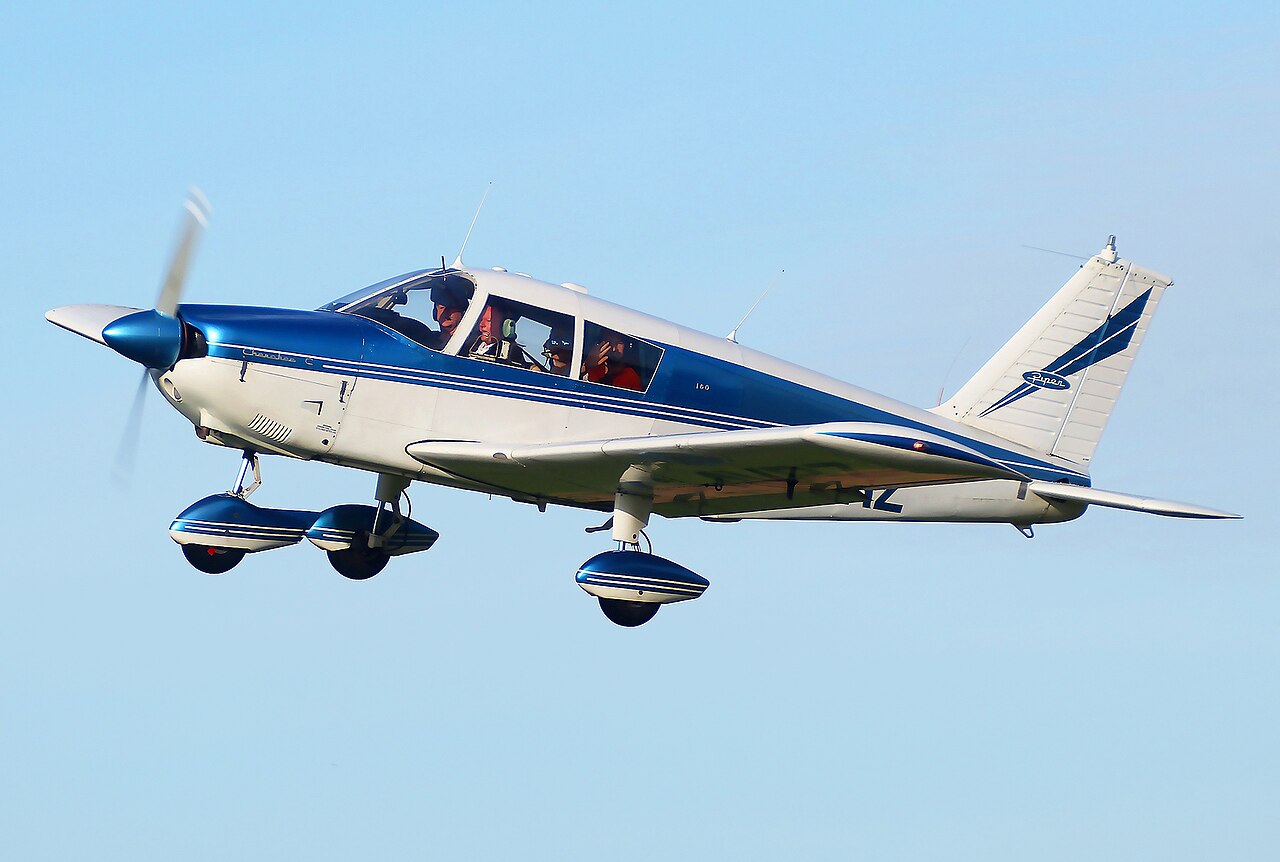
The Piper PA-28R-201 Arrow III is a retractable-gear, four-seat, single-engine light aircraft built by Piper Aircraft, introduced in 1977 as the third generation of the Cherokee Arrow line. It combined the semi-tapered wing and longer stabilator first proven on the PA-28-181 with a substantially enlarged fuel capacity, making it a popular complex trainer and touring aircraft for pilots progressing beyond fixed-gear Cherokees. A turbocharged sibling, the Turbo Arrow III, extended its performance envelope with a Continental engine, and both remain a common sight in flying club and training fleets today.
The PA-28R-201 Arrow III is a low-wing, all-metal, single-engine aircraft with retractable tricycle landing gear, produced by Piper Aircraft as part of the long-running PA-28 Cherokee family. It is a four-seat design, entered via a single door on the right side reached by stepping on the wing, and represents the third major iteration of the Cherokee Arrow, Piper's retractable-gear, constant-speed-propeller derivative of the basic Cherokee. Within the wider PA-28 range, which also includes fixed-gear trainers such as the Warrior and Archer, the Arrow III occupies the step-up niche for pilots seeking complex-aircraft experience and cross-country capability.
The Arrow lineage began in 1967 with the PA-28R-180 Cherokee Arrow, which added a constant-speed propeller and retractable landing gear to the basic Cherokee airframe, powered by a 180 hp Lycoming IO-360-B1E. A more powerful 200 hp version using a Lycoming IO-360-C1C followed from 1969 as the PA-28R-200, after which the 180 hp model was dropped in 1971. The Arrow II, introduced in 1972, stretched the fuselage by 5 in to give rear-seat passengers more legroom. In 1977 Piper introduced the Arrow III (PA-28R-201), which adopted the semi-tapered wing and longer stabilator that had already improved low-speed handling on the PA-28-181, and increased fuel capacity from 50 to 77 US gallons. A single prototype was converted from a 1976 Arrow II and certified at a gross weight of 2,750 lb (1,247 kg) on 2 November 1976, ahead of 493 production aircraft built across 1977 (176 examples) and 1978 (317 examples); these totals include kits supplied to Embraer subsidiary Neiva in Brazil for local completion. The same year also saw the introduction of the first turbocharged Arrow, the PA-28R-201T, fitted with a Continental TSIO-360-F engine and a Rajay turbocharger, with a three-bladed propeller offered as an option. In 1979 Piper restyled the Arrow again as the PA-28RT-201 Arrow IV, giving it a T-tail, which superseded the Arrow III in the catalogue.
The Arrow III retains the all-metal, low-wing, tricycle-gear layout common to the PA-28 family, but distinguishes itself with a semi-tapered wing planform and a longer stabilator, both features carried over from the fixed-gear PA-28-181. Fuel capacity was increased substantially over earlier Arrows, from 50 US gallons to 77 US gallons (190 to 290 litres), extending range for touring work. The normally aspirated Arrow III is powered by a Lycoming IO-360-C1C6 engine of 200 hp, driving a constant-speed propeller, and was certified at a gross weight of 2,750 lb (1,247 kg). The turbocharged Turbo Arrow III variant instead uses a six-cylinder Continental TSIO-360-F, later TSIO-360-FB, engine of 200 hp fitted with a Rajay turbocharger, with an optional three-bladed propeller; this engine carries an 1,800-hour time between overhauls. The aircraft seats one pilot and three passengers.
Owners of the type describe the Turbo Arrow III as practical and well suited to four-place, single-engine cross-country flying, sitting in the middle of the performance range for aircraft of its class. The semi-tapered wing and longer stabilator introduced on the Arrow III were specifically credited with improving low-speed handling compared with the earlier straight-wing Arrow II. The turbocharged model retains useful performance at altitude, a characteristic valued by owners even when based in low-lying terrain, since the turbocharger allows the engine to maintain rated power well above sea level.
The Arrow line progressed through several distinct models before and after the Arrow III. The original PA-28R-180 Cherokee Arrow (from 1967) used a 180 hp Lycoming IO-360-B1E, followed by the 200 hp PA-28R-200 with a Lycoming IO-360-C1C from 1969. The Arrow II, introduced in 1972, added a 5 in fuselage stretch. The Arrow III (PA-28R-201), covered here, arrived in 1977 with the semi-tapered wing, longer stabilator and enlarged fuel tanks, built to the tune of 493 production aircraft over 1977 and 1978 plus a converted prototype. Alongside it, Piper offered the turbocharged PA-28R-201T Turbo Arrow III with the Continental TSIO-360-F/-FB engine and Rajay turbocharging. In 1979 the line was restyled again as the T-tailed PA-28RT-201 Arrow IV, with a corresponding turbocharged PA-28RT-201T Turbo Arrow IV, both of which superseded the Arrow III in production. Many Arrow III and Turbo Arrow III airframes were also produced from Piper-supplied kits by Neiva in Brazil, and related Arrow and Turbo Arrow variants were built in Argentina by Chincul SACAIFI, which produced 960 airplanes across the wider Cherokee family, including Arrows, between 1972 and 1995.
The Arrow III has served principally as a personal touring aircraft and as a complex-aircraft trainer, giving pilots experience of retractable gear and a constant-speed propeller ahead of transition to larger or faster types. It remains in active use in flight training programmes, including university aviation courses that operate the PA-28R-201 Arrow III alongside fixed-gear PA-28 trainers such as the Warrior III and Archer TX. Production under license in Brazil by Neiva and in Argentina by Chincul extended the type's operational reach well beyond Piper's own output, supporting flight schools and private owners internationally. Long-term private owners have reported airframes accumulating several thousand flying hours with proven reliability, and the type continues to be actively bought, sold, and maintained decades after production ended.
The PA-28R Arrow III has been modelled as an add-on aircraft for Microsoft Flight Simulator and X-Plane 11, developed by Just Flight in partnership with Thranda Design, with an accompanying operations manual reflecting the type's systems and procedures. Its combination of retractable gear, a constant-speed propeller and, in the turbocharged version, boost management makes it a natural choice for simulator pilots working through complex-aircraft and instrument training syllabi, mirroring its real-world role as a step-up trainer from fixed-gear Cherokees.