Departure
95%
vs 95%
 MY FS FLIGHTS
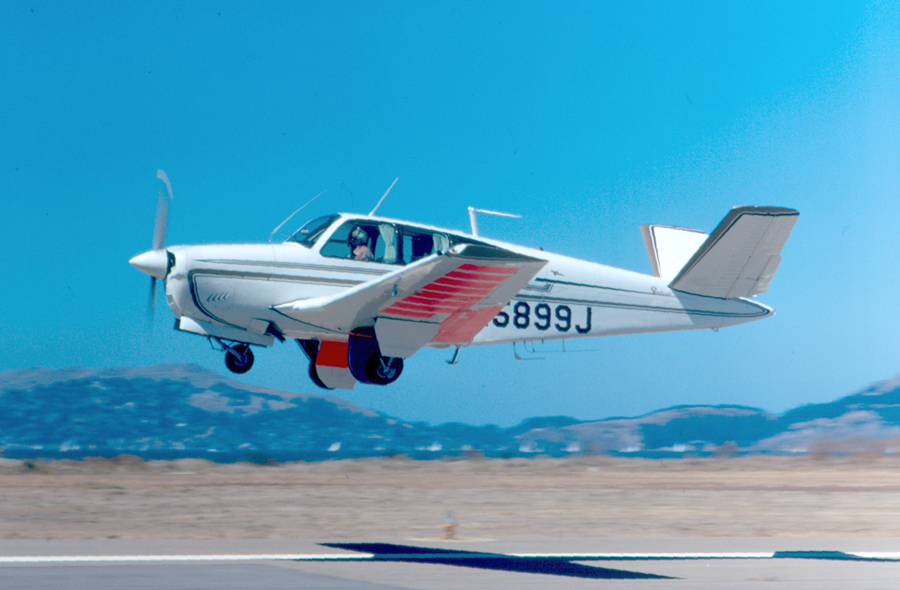
The Beechcraft A36 Bonanza is a six-seat, single-engine light aircraft built by Beechcraft, the stretched, straight-tail derivative of the original V-tail Bonanza family and introduced in 1968. As the flagship of the longest continuously produced aircraft line in history, it has long been a favourite for private and business cross-country flying, offering a roomy cabin and complex, high-performance handling that appeals to owner-pilots stepping up from simpler trainers.
The A36 is a low-wing, all-metal, retractable-gear, six-seat single-engine aircraft produced by Beechcraft. It belongs to the wider Bonanza family, which began with the V-tail Model 35 and also includes the conventional-tail Model 33 Debonair; the Model 36, of which the A36 is a variant, is a stretched, straight-tail development of the Model 33 that entered production in 1968. The Bonanza line as a whole has been in continuous production longer than any other aircraft in history, with more than 18,000 examples of all variants built.
The Bonanza family traces back to the Model 35, which first flew on December 22, 1945 and received its airworthiness certificate on March 25, 1947, with production beginning that year. The conventional-tail Model 33 Debonair appeared in 1960 as a lower-cost alternative to the prestigious V-tail Bonanza, and Beechcraft dropped the Debonair name in 1968 with the introduction of the E33. The Model 36 Bonanza, a longer-bodied, straight-tail development of the Model 33, was introduced that same year, 1968, and remains in production. The A36 variant specifically was built from 1969 to 2005, carrying serial numbers E-185 through E-3269 and E-3631 through E-3635. In November 2025 Textron Aviation, the later corporate owner of Beechcraft, announced that the Bonanza and the Beechcraft Baron would cease production once the existing order backlog was filled, while assuring owners that parts, maintenance and support would continue.
The A36 shares the Bonanza family's all-metal, low-wing construction with retractable tricycle undercarriage, but uses the stretched fuselage and conventional (straight) tail of the Model 36 rather than the original V-tail ruddervator arrangement. It is configured as a six-seat aircraft. Engine fitment changed over the production run: from 1970 to 1983 the A36 was powered by a Continental IO-520B rated at 285 hp, and from 1984 to 2005 by a Continental IO-550B rated at 300 hp. Aftermarket turboprop conversions have also been offered for the type, including a Tradewind Turbines conversion using an Allison 250-B17F/2 turboprop under an STC originally held by Soloy, and a Rocket Engineering/West Pacific Air conversion fitting a 500 hp Pratt & Whitney PT6A-21 turboprop with 124 US gallons of fuel capacity; turbonormalized versions have also been produced under the Whirlwind System II programme covering the 36, A36 and G36 models.
The core A36 was produced from 1969 to 2005. The A36TC, built from 1982 to 2002 with 116 examples completed, featured a longer-span wing, increased range, a redesigned instrument panel and controls, and a higher takeoff weight than the standard A36. Beyond the factory variants, the type has also been the basis for several aftermarket turboprop conversions, including the Tradewind Turbines Allison-powered conversion and the Rocket Engineering PT6A-21 conversion, as well as turbonormalized versions produced under the Whirlwind System II programme.
The A36, like other Bonanzas, has served principally as a personal and business transport for professional and executive owner-pilots, valued for its six-seat cabin and cross-country capability. The type has been involved in a number of high-profile accidents: game show host Peter Tomarken and his wife were killed when his Bonanza A36 crashed into Santa Monica Bay on March 13, 2006 shortly after departing Santa Monica Airport, and satellite television broadcasting pioneer Henry Howard Taylor died on November 13, 2002 when his Beechcraft A36TC suffered an engine failure just after takeoff from San Andreas, California and crashed in a rock-strewn field. The broader Bonanza line, including its conventional-tailed variants, has at times attracted the informal and unflattering nickname "doctor killer" following a pattern of fatal accidents attributed by some analyses to overconfident amateur pilots rather than to any inherent flaw in the aircraft.