Departure
95%
vs 95%
 MY FS FLIGHTS
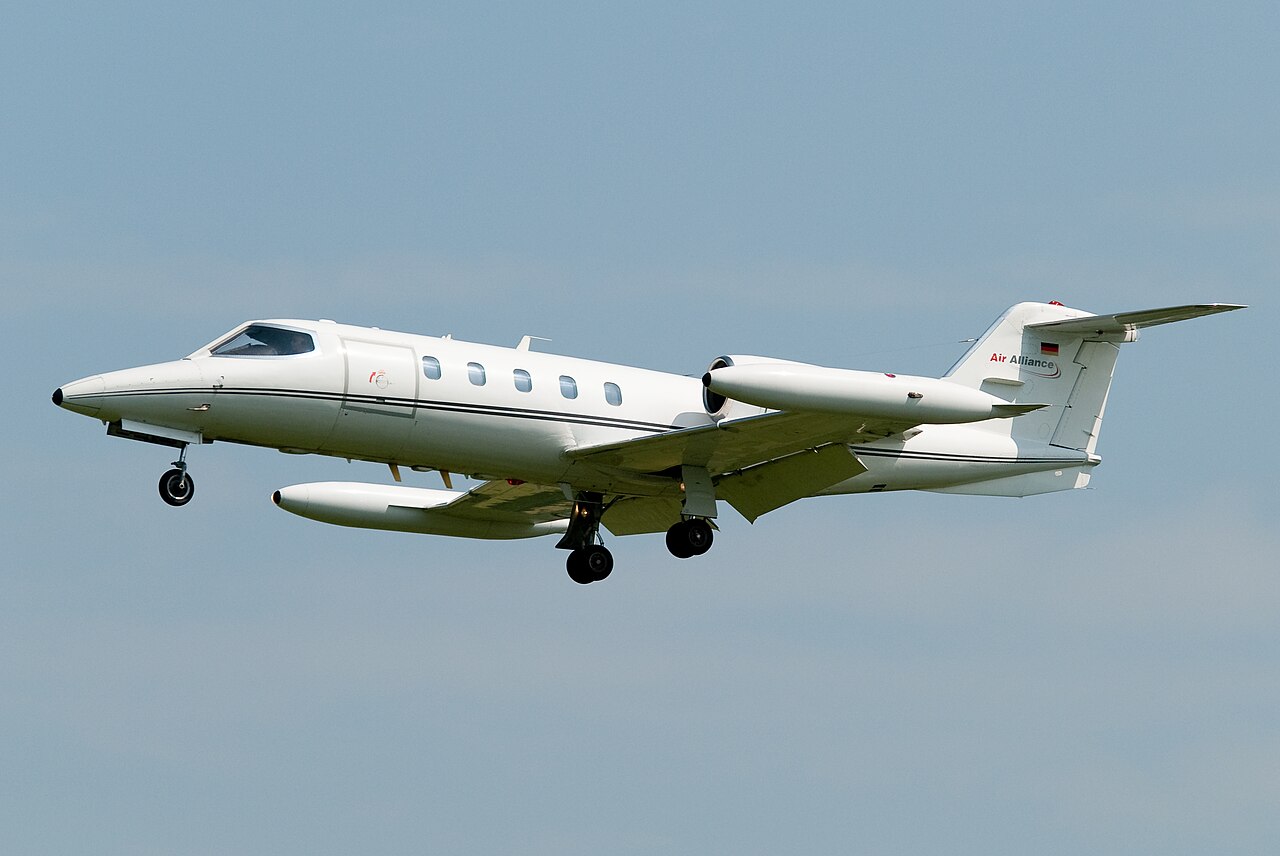
The Learjet 35A is a light business jet built by Learjet, an upgraded version of the original Learjet 35 fitted with more powerful Garrett TFE731-2-2B turbofans and wingtip fuel tanks that give it long range for its class. Prized for its speed, range and compact size, it became one of the best-selling Learjets ever produced and also served military air arms worldwide, including the US Air Force as the C-21A. For a simmer it represents the classic Learjet flying experience: brisk, fighter-like handling in a small executive cabin.
The Learjet 35A is an American light business jet manufactured by Learjet, developed from the earlier Learjet 25 and 35 lines. It is a twin-engine, low-wing jet with engines mounted in nacelles on the sides of the aft fuselage and distinctive wingtip fuel tanks, and it was built for the multi-role business and military transport market, approved for VFR, IFR, day, night and icing conditions. The type's combination of speed, range and compact dimensions made it one of the most numerous and enduring Learjet models, with more than 500 still active decades after production ended.
The design that became the Learjet 35 originated as the Learjet 25BGF, a Learjet 25 testbed fitted on one side with a new Garrett TFE731 turbofan in place of the 25's General Electric CJ610 turbojet, first flying in May 1971. The improved power and reduced noise of the new engine led Learjet to develop a fresh model rather than a simple variant, resulting in the Model 35. Initially Learjet had planned simply to fit the quieter TFE731 turbofans to the Learjet 25 to create a Learjet 26, but the engine change required a 13-inch fuselage plug and a two-foot extension of the wing on each side, producing the definitive Model 35 airframe. The prototype Model 35 first flew on 22 August 1973, and the aircraft received FAA certification in July 1974, with deliveries beginning later that year. The improved Model 35A, with upgraded TFE731-2-2B engines and a higher maximum gross weight, was introduced in 1976 and replaced the original Model 35 on the production line. Learjet was acquired by Bombardier Aviation in 1990, after which the type was also marketed as the Bombardier Learjet 35A. Production of the 35/36 series ran from 1973 to 1994, with 738 aircraft built in total; of the 35-series, 64 base Model 35s were built before the 35A line took over, and more than 600 35As were produced, with the production line ending at serial number 677 in 1993.
The Learjet 35A retains the swept low-wing, twin-engine layout of the Learjet family, with engines mounted in nacelles on the aft fuselage sides and wingtip fuel tanks that distinguish it from other business jets of similar role; the wings carry single-slotted flaps. It is powered by two Garrett (later Honeywell) TFE731-2-2B turbofan engines, each rated at 3,500 pounds of thrust. The aircraft is 48 feet 8 inches (14.83 metres) long with a wingspan of 43 feet 9 inches (13.34 metres), and has a maximum takeoff weight of 18,300 pounds (8,301 kilograms). Fuel capacity is 931 US gallons (3,520 litres), with refuelling accomplished at ground level through each wingtip tank. The cabin measures 4.3 feet wide, 4.9 feet high and 12.9 feet long, giving a cabin volume of 268 cubic feet, and it can accommodate up to eight passengers, though it lacks a fully enclosed toilet. Baggage space is quoted at 40 cubic feet.
The Learjet 35A has a service ceiling of 45,000 feet and a maximum operating speed of 470 knots. Cruise performance is quoted with a high-speed cruise of 436 knots and a long-range cruise of 424 knots, while maximum cruise speed figures as high as 518 knots (597 mph) are also cited. Range is given as up to 2,789 nautical miles (3,206 miles) with the 35A's increased fuel capacity, an improvement over the original Model 35's range of roughly 2,056 nautical miles. Pilots and operators have noted the type's good handling characteristics, low fuel burn for its era, and fast cruise speeds relative to its size. In 1976 an Arnold Palmer-flown Learjet 36 set a round-the-world class record of 22,894 miles in 57 hours 25 minutes 42 seconds, and in 1996 a Learjet 35A owned by Bill Daniels completed an around-the-world flight in 49 hours 21 minutes 8 seconds, a record that still stood as of 2015.
The original Model 35, powered by two TFE731-2-2A engines and 13 inches longer than the Model 25, first flew as a prototype on 22 August 1973 and was FAA certified in July 1974; 64 base-model 35s were built before it was replaced. The Model 35A, introduced in 1976, upgraded to TFE731-2-2B engines and a longer range of 2,789 miles, with over 600 built before the line ended at serial number 677 in 1993. The Model 36 is essentially identical to the 35 but has a larger fuselage fuel tank, giving 500 miles of extra range at the cost of an 18-inch reduction in passenger cabin length; it was certified alongside the 35 in July 1974. The Model 36A, introduced in 1976, carried the same engine and gross weight upgrades as the 35A. Military variants include the C-21A, an off-the-shelf US Air Force version of the Learjet 35A with room for eight passengers, 42 cubic feet of cargo space and a medevac litter capability, delivered between April 1984 and October 1985; the Brazilian Air Force's C-35 cargo version, R-35A reconnaissance version, and VU-35A VIP transport version of the Learjet 35.
Because of its speed and range, the Learjet 35/35A was adopted by government and military users worldwide, including Brazil, Chile, Finland, Switzerland and Saudi Arabia, often as leadership transport. During the Cold War the Finnish Air Force flew the type as a short-range airborne early warning aircraft to monitor Soviet bomber and fighter activity over the Baltic Sea and Arctic. Learjet 35s formed the bulk of Argentina's Escuadrón Fenix flights during the 1982 Falklands War, mainly on diversion and reconnaissance missions. In US military service, the C-21A variant equips both active-duty and Air National Guard units; from 1 April 1997, all continental US-based C-21As were realigned under Air Mobility Command with the 375th Airlift Wing at Scott Air Force Base as lead command, while aircraft stationed outside the continental United States report to theatre commanders. In the civil world, more than 400 Learjet 35 and 35As remain in service, with Michigan-based Royal Air Freight/Royal Air Charter operating one of the largest civil fleets, running some 1970s-vintage 35As up to six hours a day. As of January 2018 the US National Transportation Safety Board database listed 25 fatal accidents for the 35/35A and two for the 36/36A; notable incidents include the 1996 Christmas Eve New Hampshire crash of a Learjet 35A, which prompted the longest missing-aircraft search in that state's history and later led to Congressional legislation mandating improved emergency locator transmitters on US-registered business jets, and the 29 August 1999 shooting down of a US-registered Learjet 35A near Adwa, Ethiopia, which killed both crew members aboard.
The Learjet 35A is a popular subject for desktop simulation, with detailed add-ons built with input from real-world Learjet 35 pilots and instructors to replicate its systems accurately, reflecting the type's reputation among owners as a reliable, capable performer even as many airframes approach or exceed 12,000 flight hours. Its swept-wing, twin-podded layout with wingtip tanks gives it the classic Learjet look and feel, and simulator pilots can expect the type's known traits of brisk cruise speeds, a compact eight-seat cabin, and the handling qualities that have long made it a favourite among light-jet operators for its combination of pace and range.