Departure
82%
vs 95% ▼ 13
 MY FS FLIGHTS
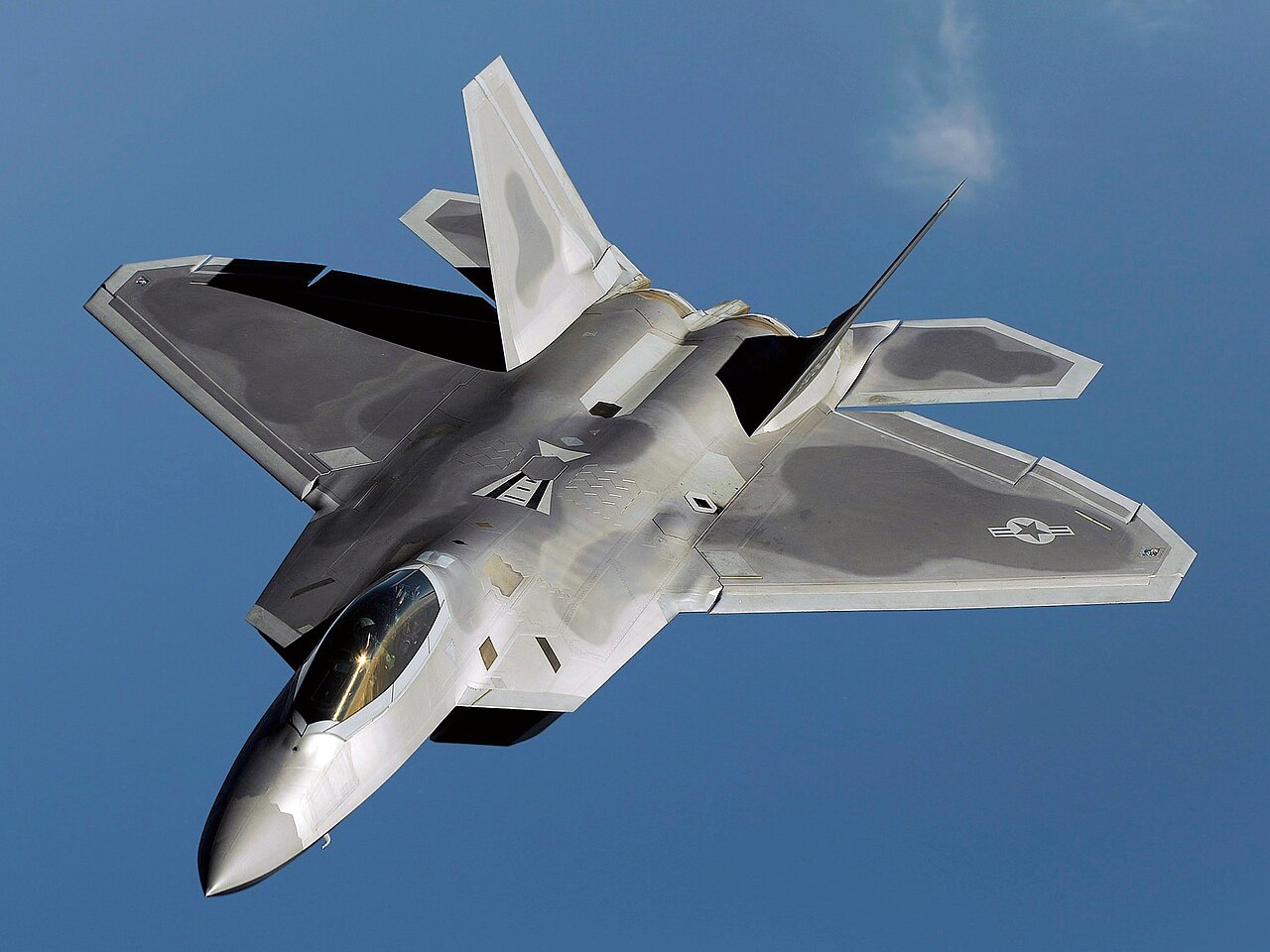
The Lockheed Martin F-22 Raptor is an American twin-engine, stealth air superiority fighter developed for the United States Air Force under the Advanced Tactical Fighter programme, first flown in 1997 and entering service in December 2005. Built primarily by Lockheed Martin with Boeing as a major partner, it combines low observability, supercruise and highly integrated avionics, and remains the USAF's most capable air dominance fighter and a benchmark fifth-generation design for any simulator pilot interested in modern air combat.
The F-22 Raptor is a twin-engine, jet-powered, all-weather supersonic stealth fighter, designed by Lockheed Martin with Boeing as a major programme partner. Lockheed Martin built most of the airframe and weapons systems and conducted final assembly, while Boeing supplied the wings, aft fuselage, avionics integration and training systems. Conceived primarily as an air superiority fighter, it also incorporates ground attack, electronic warfare and signals intelligence capabilities, and is regarded as the Air Force's fifth-generation fighter. It replaced the F-15 Eagle in most active duty USAF squadrons and remains the service's leading counter-air platform.
The F-22 originated from the Advanced Tactical Fighter (ATF) programme that the USAF initiated in 1981 to replace the F-15 Eagle and F-16 Fighting Falcon, driven by intelligence on emerging Soviet threats including new surface-to-air missile networks, the Beriev A-50 AWACS, and the Sukhoi Su-27 and Mikoyan MiG-29 fighter classes. Code-named Senior Sky, the programme sought a leap in capability through composite materials, lightweight alloys, advanced flight control systems and avionics, propulsion for supersonic cruise (supercruise) around Mach 1.5, and stealth technology. Following a request for information in May 1981 and a demonstration and validation request for proposals in September 1985 emphasising stealth, supersonic cruise and manoeuvre, Lockheed and Northrop were selected as finalists on 31 October 1986. Lockheed, through its Skunk Works division, teamed with Boeing and General Dynamics, while Northrop teamed with McDonnell Douglas; Pratt & Whitney and General Electric competed to supply the ATF's engines. The two teams built the Lockheed YF-22 and Northrop YF-23 technology demonstrators to prove concept viability rather than compete head to head in a flyoff. The Engineering and Manufacturing Development (EMD) contract originally called for seven single-seat F-22As and two twin-seat F-22Bs, though the two-seat variant was cancelled in 1996 and its orders converted to single-seaters. The first F-22A, tail number 91-4001, was unveiled at Air Force Plant 6, Dobbins Air Reserve Base, Marietta, on 9 April 1997, where it was officially named Raptor, and first flew on 7 September 1997 piloted by chief test pilot Alfred Paul Metz. The type's designation was briefly changed to F/A-22 from September 2002, echoing the Navy's F/A-18 Hornet designation, to highlight a planned ground-attack role amid debate over the aircraft's purpose. Flight testing involved a third aircraft with production-level internal structure that tested flight loads, flutter and stores separation, two non-flying airframes for static load and fatigue testing, and a Boeing 757 flying testbed for avionics, environmental qualification and observables work; the first combat-capable Block 3.0 software flew in 2001. Testing led to structural modifications, including tail fin strengthening to resolve buffeting in certain flight conditions. The first EMD aircraft, 4001, was retired from flight testing in 2000 and sent to Wright-Patterson AFB for survivability and live-fire testing and battle damage repair training. The aircraft formally entered service in December 2005 as the F-22A. The USAF originally planned to buy 750 ATFs to replace its entire F-15 fleet, later scaling this to 381, before the programme was cut to 195 aircraft, of which 187 were operational models, in 2009 amid high costs, a perceived lack of air-to-air threats, and the parallel development of the more affordable F-35 Lightning II. The last aircraft was delivered in 2012, with production having run from 1996 to 2011.
The F-22 was built to combine low observability with supersonic cruise performance, incorporating composite materials, lightweight alloys, advanced flight control systems and avionics developed during the ATF programme. It employs an active-aperture phased-array radar, in which each radiating element carries its own transmitter, receiver, phase shifter, duplexer and control, rather than a mechanically scanned antenna. Lockheed Martin built the majority of the airframe and weapons systems, with Boeing contributing the wings, aft fuselage and avionics integration. Pratt & Whitney and General Electric competed to provide the aircraft's engines during development. The design emphasises stealth, supercruise and manoeuvrability as its central pillars, coupled with highly integrated avionics intended to fuse sensor data for the pilot.
The ATF requirement that shaped the Raptor called for propulsion capable of sustained supersonic cruise, or supercruise, at around Mach 1.5 without reliance on afterburner, and the F-22 is noted for being able to reach supersonic speeds in this manner. Its combination of stealth, supercruise and manoeuvrability was intended to represent a substantial leap in warfighting capability over preceding fighters such as the F-15, allowing the aircraft to operate effectively in the kind of contested, integrated air defence environments the ATF programme was designed to counter.
The principal production variant is the single-seat F-22A. A twin-seat trainer variant, the F-22B, was included in the original Engineering and Manufacturing Development contract but was cancelled in 1996 to reduce development costs, with its orders converted to additional single-seat aircraft. The designation was briefly amended to F/A-22 from September 2002 to emphasise a ground-attack role before reverting. The Raptor's technology also fed into related concepts, including the Lockheed Martin X-44 MANTA and the Lockheed Martin FB-22, both developed from the F-22 lineage.
The F-22 replaced the F-15 Eagle in most active duty USAF squadrons after entering service in December 2005, with its first operational sortie flown during Operation Noble Eagle in 2006. Regular deployments have included Okinawa, the Middle East, and NATO's eastern flank. Despite being designed for air superiority, the Raptor's combat debut came in 2014 with airstrikes against Islamic State ground targets during Operation Inherent Resolve in Syria. In November 2017, F-22s operating alongside B-52s bombed opium production and storage facilities in Taliban-controlled parts of Afghanistan. The type has since been involved in strikes on Iran in 2025, strikes on Venezuela in 2026, and the 2026 Iran war. On 3 February 2023 an F-22 achieved the type's first air-to-air kill, downing a Chinese surveillance balloon off the coast of North Carolina. To improve deployment responsiveness against peer and near-peer adversaries, the USAF developed the Rapid Raptor concept, first proposed in 2008 by two F-22 pilots, involving two to four F-22s supported by a single C-17 for logistics. The fleet has accumulated extensive flight experience under sustained modernisation programmes, and the F-22 is expected to remain a cornerstone of USAF fighter airpower until its eventual successor enters service.
For a simulator pilot, the Raptor's appeal lies in the same qualities that defined its real-world design brief: a low-observable airframe paired with supercruise performance that lets it operate at sustained supersonic speed without afterburner, and a suite of integrated, sensor-fused avionics built around an active-aperture phased-array radar. These characteristics make it a natural subject for high-fidelity modern air combat simulation, where the interplay of stealth, speed and situational awareness rather than raw dogfighting alone defines the tactical picture. Its status as the USAF's primary air superiority platform, and its documented combat use from airstrikes in Syria and Afghanistan to its balloon intercept in 2023, gives simulator scenarios built around the type a strong grounding in real operational history.