Departure
95%
vs 95%
 MY FS FLIGHTS
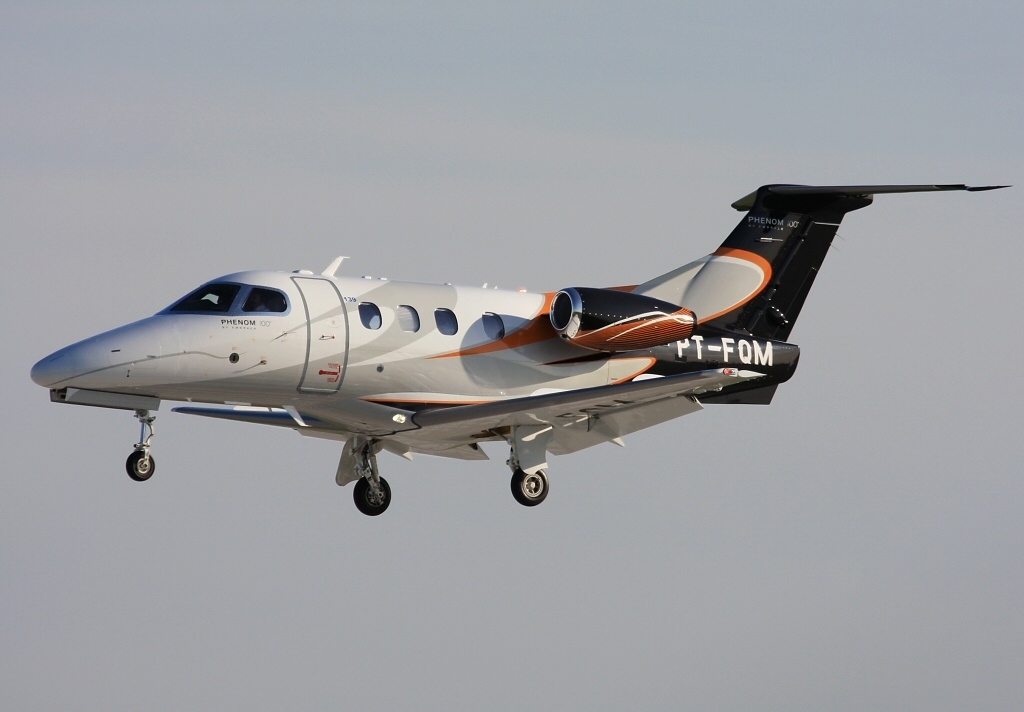
The Embraer Phenom 100 is a Brazilian-built very light business jet, the smallest member of Embraer's Phenom family, designed to carry up to seven occupants over routes of around a thousand nautical miles. Powered by twin rear-mounted Pratt & Whitney Canada turbofans and fitted with Garmin glass-cockpit avionics, it was conceived to compete in the very-light-jet segment that emerged in the mid-2000s. For a simulator pilot it represents an accessible, single-pilot-capable entry-level jet with modern systems and a surprisingly roomy cabin for its class.
The Embraer EMB-500 Phenom 100 is a very light business jet designed and produced by Embraer of Brazil. It is a low-wing cantilever monoplane with a T-tail and retractable tricycle undercarriage, powered by two rear-fuselage-mounted turbofans, and was developed alongside the larger, stretched Embraer Phenom 300. Marketed as a compact but comfortable jet capable of carrying four to seven passengers, it occupies the entry level of Embraer's business jet range and was one of the aircraft that defined the very-light-jet category.
Embraer's board approved development of very light and light jets in April 2005, with the aim of the company becoming a major player in the global business jet market within a decade. The Phenom 100 name and a full-scale mock-up were unveiled at the NBAA convention on 9 November 2005, alongside the selection of Garmin's G1000 avionics suite for the cockpit. The digital definition phase was completed in March 2006, and by May of that year 50 orders had been secured, announced at the EBACE conference. Pratt & Whitney began testing the PW617-F engines intended for the aircraft in October 2006, with the first engines delivered to Embraer in March 2007. Wing-to-fuselage mating of the first aircraft took place in April 2007, the prototype was rolled out in June 2007, and it made its maiden flight from Embraer's São José dos Campos facility on 26 July 2007, before transferring to Gaviao Peixoto for the bulk of flight testing. Serial production began in April 2008, though the flight test programme uncovered issues with the ice protection system and flaps. The type was awarded its type certificate by both Brazil's civil aviation authority and the US FAA in December 2008, and the first delivery took place on 24 December 2008. Early production aircraft, priced around 3.18 million dollars, faced quality and fit-and-finish criticism, particularly over the original passenger seat design, before Embraer introduced improvements in later variants.
The Phenom 100 is a low-wing cantilever monoplane with a T-tail and retractable tricycle landing gear, built with an oval fuselage enclosing a 7.985 cubic metre (282 cubic foot) passenger cabin. The cabin door measures 1.47 m high by 0.74 m wide, and there is a separate unpressurised cargo hold of 1.56 cubic metres (54.9 cubic feet). The airframe is built from around 20 percent composite materials and has a structural life rated at 28,000 flight cycles or 35,000 hours. In its normal layout the cabin seats four passengers, but with a single crew member it can carry up to seven, using an optional side-facing seat and a belted lavatory; the interior was designed by BMW DesignworksUSA. Power comes from two rear-mounted Pratt & Whitney Canada PW617-F turbofans, each rated at 7.2 kN (1,695 lb) of takeoff thrust at ISA+10 degrees C, with dual full authority digital engine control (FADEC). In the event of an engine failure at takeoff, an automatic performance reserve function boosts output on the remaining engine to 1,777 lb, and later PW617F-E engines carry a ten-minute rating of 1,820 lb. The cockpit was originally fitted with the Garmin G1000-based Prodigy Flight Deck avionics suite, offering two primary flight displays and one multi-function display along with the GFC 700 three-axis digital autopilot.
The Phenom 100 has a maximum range of 1,178 nautical miles (2,182 km; 1,356 mi) with four occupants and NBAA IFR reserves. It is capable of a cruise speed of around 390 knots, appreciably faster than rival types such as the Cessna Citation Mustang. Its short-field capability allows it to operate from smaller runways than many light jets, broadening the range of airports it can use, and it is regarded as offering stable, smooth handling across the flight envelope, which has helped make it popular for both charter and owner-flown operations.
The base EMB-500 Embraer designation covers several marketed variants. The initial production Phenom 100 combined G1000 avionics with two PW617F-E engines. The Phenom 100E, introduced from 2013, added multifunction wing spoilers that enable slower descents, improved manoeuvrability and better ground braking, while retaining G1000 avionics and PW617F-E engines. The Phenom 100EV Evolution brought weight savings and a thrust increase from 1,695 lb to 1,730 lb, cutting the climb time to 41,000 feet from 33 minutes to 25 minutes and reducing high-altitude, high-temperature takeoff distance from 6,609 feet to 5,663 feet; it also introduced the Garmin G3000 touch-screen Prodigy Touch flight deck, offered for single-pilot operation.
The Phenom 100 has been in continuous production since December 2008, with hundreds built and delivered to owner-operators, charter companies and air taxi operators around the world; Embraer had explored the air-taxi role for the type from early in its development. It is widely used in the air-charter sector, where it is noted for good dispatch reliability and high utilisation, supported by Embraer's established service network built on its experience as a commercial airliner manufacturer. Despite early criticism of cabin fit and finish, later examples with improved seating and the 100E's spoiler upgrades have made the type a durable seller in the light-jet market, valued for its larger cabin and higher cruise speed relative to direct competitors.
In the simulator, the Phenom 100 offers a modern, glass-cockpit light-jet experience built around Garmin avionics, with the original G1000-based Prodigy Flight Deck and its three-axis GFC 700 autopilot on early models, or the touch-controlled G3000-based Prodigy Touch deck on the 100EV, giving pilots practice with the kind of integrated flight management systems found on many contemporary business jets. Its twin rear-mounted turbofans and T-tail configuration, together with its automatic performance reserve system for single-engine takeoff scenarios, make it a useful type for exploring light-jet performance planning and engine-out procedures. The type's short-field capability and reputation for stable, forgiving handling make it approachable for pilots stepping up from turboprops or piston twins into jet operations.