Departure
89%
vs 95% ▼ 6
 MY FS FLIGHTS
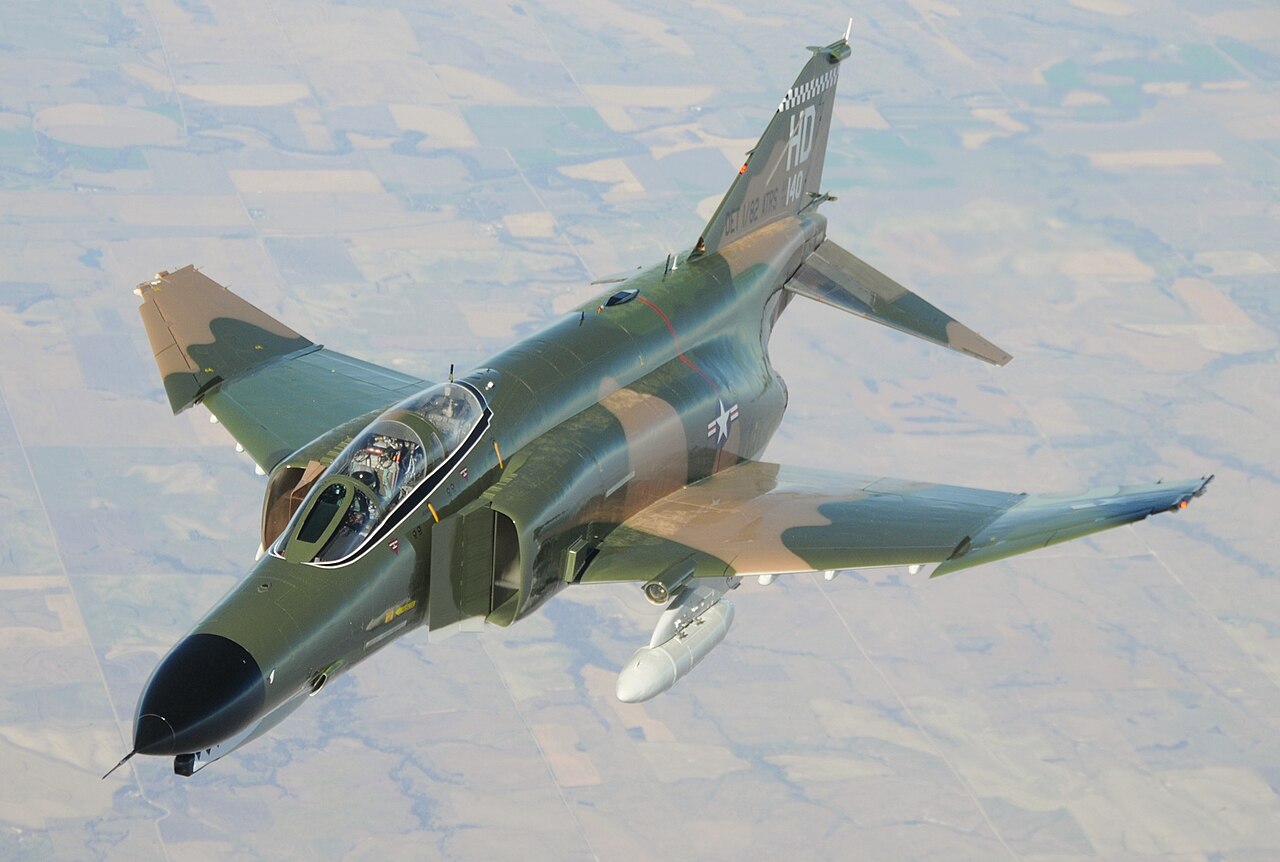
The McDonnell Douglas F-4 Phantom II is an American tandem two-seat, twin-engine, all-weather supersonic jet interceptor and fighter-bomber originally developed by McDonnell Aircraft for the United States Navy. With 5,195 built between 1958 and 1981, it became the most-produced American supersonic military aircraft and a defining combat type of the Cold War, serving with the US Navy, Air Force and Marine Corps as well as eleven other nations. For a simulator pilot it represents a huge, powerful, missile-and-cannon-armed fighter-bomber whose brute-force performance and Vietnam-era combat history make it one of the most storied jets of the twentieth century.
The F-4 Phantom II is a large, tandem two-seat, twin-engine, all-weather, long-range supersonic jet built by McDonnell Aircraft (later McDonnell Douglas) for the United States Navy, and subsequently adopted by the US Marine Corps and US Air Force. It served as an interceptor, air superiority fighter, fighter-bomber and reconnaissance platform, and with a top speed of over Mach 2.2 and the ability to carry more than 18,000 pounds of weapons on nine external hardpoints, it became the standard by which other fighters of its era were judged, remaining in front-line use until superseded in US service by types such as the F-15 Eagle, F-16 Fighting Falcon, F-14 Tomcat and F/A-18 Hornet.
The Phantom's origins lie in McDonnell's 1953 efforts to rework its F3H Demon naval fighter into a more capable design. The company's Chief of Aerodynamics, Dave Lewis, led preliminary studies that produced several proposals, including versions powered by a Wright J67, twin Wright J65s, or twin General Electric J79 engines, the latter promising a top speed of Mach 1.97. On 19 September 1953 McDonnell pitched the Navy a modular "Super Demon" concept that could be fitted with different nose sections for radar, cameras, cannon or unguided rockets, and carry stores on nine hardpoints beneath the wings and fuselage. Although the Navy ordered a full-scale mock-up, it judged that the forthcoming Grumman XF9F-9 and Vought XF8U-1 already met the need for a supersonic fighter, so the design was reworked into an all-weather fighter-bomber with eleven external hardpoints, leading to a letter of intent on 18 October 1954 for two YAH-1 prototypes. On 26 May 1955 Navy officers presented McDonnell with an entirely new requirement: since the Douglas A-4 Skyhawk covered ground attack and the F-8 Crusader covered dogfighting, the new aircraft was to be an all-weather fleet defense interceptor. A second crew position was added to operate the powerful radar, as designers believed a single pilot would be overloaded in future air combat. The resulting XF4H-1 was designed to carry four semi-recessed AAM-N-6 Sparrow III radar-guided missiles and two J79-GE-8 engines mounted low in the fuselage, in the manner of the McDonnell F-101 Voodoo. In July 1955 the Navy ordered two XF4H-1 prototypes and five YF4H-1 pre-production aircraft, and the type made its maiden flight on 27 May 1958. It then competed against the Chance/Vought F8U-3 for the Navy's fleet defense role; McDonnell was awarded a limited production contract, and the following year the newly designated F-4B Phantom II joined the fleet with Fighting Squadron 121. Production of Phantoms continued until 1981, with 5,195 built in total (5,057 by McDonnell Douglas and 138 under licence in Japan by Mitsubishi), making it the most-produced American supersonic military aircraft and second only to the MiG-21 in overall numbers.
The Phantom is a large twin-engine, tandem two-seat aircraft powered, in most variants, by a pair of General Electric J79 afterburning turbojets; thrust ratings varied by model, from 16,100 lbf per engine on the early F-4A's J79-GE-2/-2A, through 16,950 lbf on the F-4B's J79-GE-8A/-8B, to 17,900 lbf on the F-4E's J79-GE-17. A representative F-4C airframe had a wingspan of 38.42 ft, length of 58 ft, height of 16 ft, wing area of 530 sq ft, an empty weight of 28,496 lb and a gross weight of 51,441 lb. The related F-4B/F-4S line had a loaded weight of around 44,600 lb. Each aircraft was an intricate piece of engineering, reportedly containing 54,197 feet of wiring and 643,000 fasteners. Like other interceptors of its generation the Phantom was initially designed without an internal cannon, relying instead on four semi-recessed AAM-N-6/AIM-7 Sparrow radar-guided missiles; the definitive F-4E variant later introduced an integral M61 Vulcan rotary cannon housed in an elongated nose, paired with the smaller-profile AN/APQ-120 radar and an additional rear fuselage fuel tank to compensate for the cannon's weight. Late-production F-4Es replaced the earlier boundary layer control system with leading-edge slats under the Agile Eagle program, trading some top speed for improved manoeuvrability, and from Block 53 onward gained AGM-65 Maverick capability along with smokeless J79-GE-17C or -17E engines. The aircraft could carry over 18,000 lb of stores across nine external hardpoints, spanning air-to-air missiles, air-to-ground missiles and a wide range of bombs.
The Phantom was capable of speeds in excess of Mach 2.2, and set fifteen world records for in-flight performance beginning in 1959, including an absolute speed record and an absolute altitude record. A representative F-4C is recorded with a maximum speed of 1,433 mph, a cruise speed of 587 mph and a range of 538 miles, while the F-4B/S line offered a maximum speed of 1,485 mph at 48,000 feet, a cruising speed of 575 mph, a service ceiling of 62,000 feet and a maximum range of 2,300 miles. It was known as a powerful but demanding aircraft to fly; in the words of Vietnam-era ace Chuck DeBellevue, it had "a reputation of being a clumsy bruiser reliant on brute engine power," a machine that, in his description, "could go through a flock of birds and kick out barbeque from the back." This character, brute power and speed over outright agility in its early forms, defined the type's reputation until the addition of leading-edge slats on later F-4Es improved its manoeuvrability.
The family began with the XF4H-1 prototypes, followed by the US Navy's F4H-1F (F-4A), a two-seat carrier-based fighter of which 45 were built, some later converted to TF-4A trainers. The F4H-1 (F-4B), with 649 built, served the Navy and Marine Corps as a fighter and attack aircraft, and was further developed into drone, ECM-trainer and target-drone conversions (DF-4B, EF-4B, QF-4B). The RF-4B was a Marine Corps tactical reconnaissance version with a stretched nose and dedicated camera bays, 46 built. The US Air Force received the F-4C, externally similar to the Navy F-4B but with dual controls, boom refuelling and AN/APQ-100 radar, of which 583 were built; some were converted to EF-4C Wild Weasel IV standard for the SEAD role. The RF-4C reconnaissance variant, with 503 built, could carry the long-range HIAC-1 LOROP camera pod. The F-4D followed with updated avionics and AN/APQ-109 radar, 825 built, with a small number converted to EF-4D Wild Weasels capable of carrying the AGM-78 Standard ARM. The most numerous variant, the F-4E, introduced the integral M61 Vulcan cannon and AN/APQ-120 radar, with 1,370 built; it was further developed into the Israeli F-4E Kurnass 2000 upgrade and Turkey's F-4E 2020 Terminator (54 aircraft). Other notable variants included the F-4EJ and RF-4EJ built for Japan (140 and 15 respectively), the RF-4E export reconnaissance version (149 built), the F-4F for Germany (175 built), the F-4G Wild Weasel dedicated SEAD conversion (134 built), the Navy's F-4J (522 built), the Fleet Air Arm's F-4K Phantom FG.1 (50 built) and the RAF's F-4M Phantom FGR.2 (116 built) and F-4J Phantom F.3 (15 built), plus later US Navy service-life-extension variants F-4N (228) and F-4S (302).
The Phantom entered US Navy service in 1961 as a fleet defense interceptor before being adopted by the Marine Corps and Air Force, and it became the principal air superiority fighter for all three services during the Vietnam War, later taking on ground-attack and aerial reconnaissance roles as well. All five American servicemen who became aces in Vietnam, one US Air Force pilot and two weapon systems officers, and one US Navy pilot and one radar intercept officer, did so flying F-4s. Marine Corps RF-4Bs flew unarmed reconnaissance sorties, required to fly straight and level at 5,000 feet to allow their cameras to work, relying on the limitations of enemy air defences for survival. The type was the only aircraft flown concurrently by both US flight demonstration teams, the USAF Thunderbirds in the F-4E and the US Navy Blue Angels in the F-4J. The F-4G Wild Weasel variant flew reconnaissance and Suppression of Enemy Air Defenses missions during the 1991 Gulf War, and the type's last US combat use came in 1996. Beyond the United States, the F-4 was flown by eleven other nations; Israeli Phantoms saw extensive combat across several Arab-Israeli conflicts, while Iran used its large pre-revolution Phantom fleet throughout the Iran-Iraq War. Retirements from various air arms occurred over decades, Israel in 2004, Germany in 2013, Japan in 2021 and South Korea in 2024, while the type remains in active service with the Hellenic Air Force and the Turkish Air Force, whose upgraded F-4E 2020 Terminator is intended to serve until at least 2030.
For simulator pilots the Phantom offers the experience of a big, heavy, missile-armed Cold War fighter-bomber whose reputation rests on raw twin-engine power rather than delicate handling, an aircraft one Vietnam-era ace described as looking "like it was made to kill somebody" and being flown as "a beast" reliant on brute engine thrust. Its long production run and huge variety of variants, from Navy interceptors and Wild Weasel SEAD aircraft to RAF and Fleet Air Arm versions, give simulated Phantoms a wide range of loadouts and mission profiles to explore, from Vietnam-era air combat and ground attack to later Gulf War Wild Weasel work.