Departure
94%
vs 95% ▼ 1
 MY FS FLIGHTS
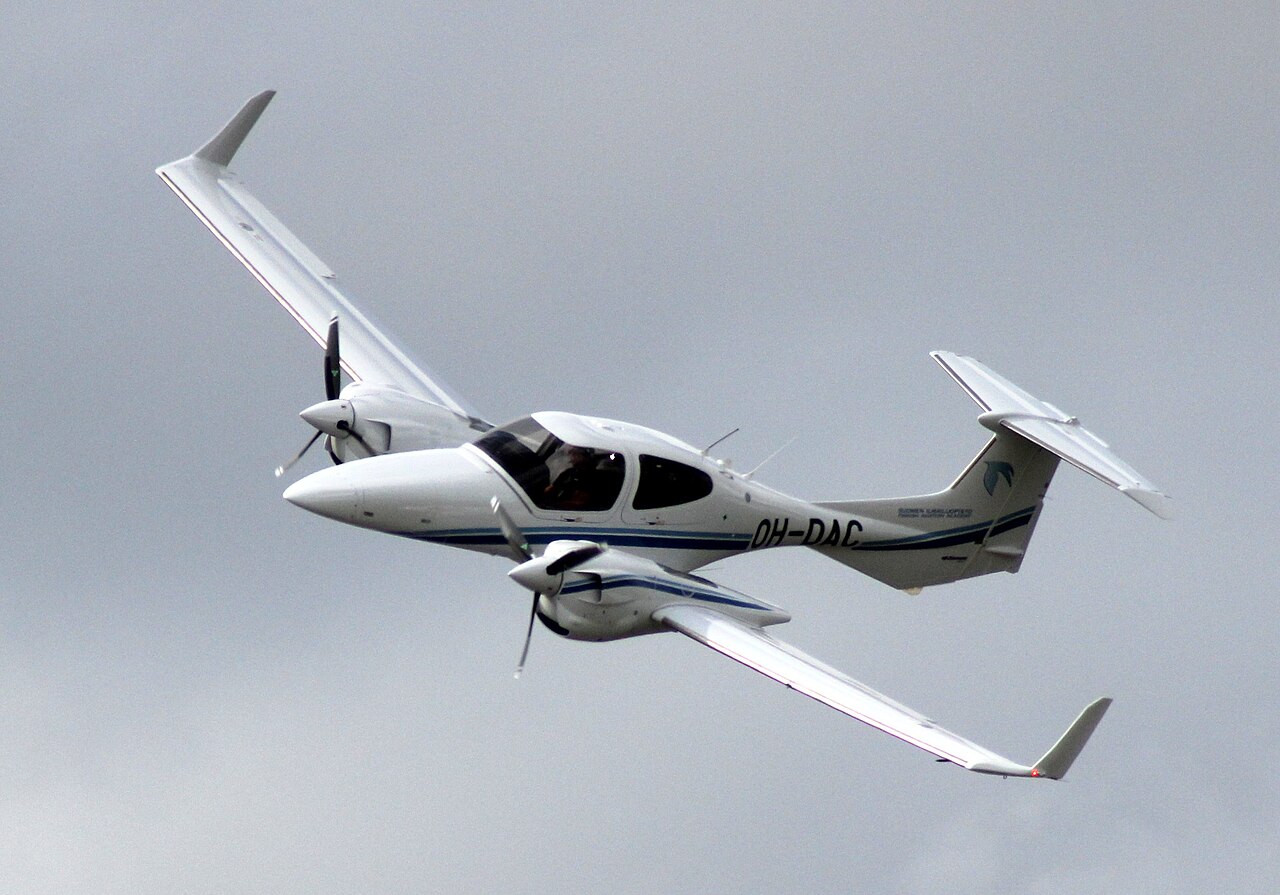
The Diamond DA42 Twin Star is a four-seat, twin-engine, propeller-driven light aircraft developed and manufactured by Austrian company Diamond Aircraft Industries, first flown in December 2002. Built around an all-composite airframe and originally offered with diesel-cycle engines for exceptional fuel efficiency, it became one of the best-selling piston twins in the world and a mainstay of both private ownership and multi-engine flight training. For the simulator pilot it offers a modern, glass-cockpit twin-engine trainer experience that bridges the gap between single-engine aircraft and turboprops.
The Diamond DA42 Twin Star is a four-seat, twin-engine, propeller-driven low-wing cantilever monoplane manufactured in Austria and Canada by Diamond Aircraft Industries, an Austrian subsidiary of China-based Wanfeng Aviation. It was Diamond's first twin-engine design and the first new European twin-engine aircraft in its category to be developed in over 25 years. Classed as a light twin-engined utility and trainer aircraft, it is used across general aviation for touring, private ownership, flight training, and government and military surveillance work. The type features a T-tail, retractable tricycle landing gear, and a distinctive all-carbon composite airframe that has made it a familiar and easily recognisable shape on ramps and at airshows.
Diamond Aircraft Industries, founded in Austria in the 1980s, had built an extensive single-engine product line before founder and chief executive Christian Dries proposed a twin-engined concept in the late 1990s as the next step beyond the Diamond DA40. The design brief called for an aircraft that was simple to operate and fuel-efficient while offering a luxurious four-seat cabin comparable to a modern automobile; Flying Magazine described the choice to pursue a light-piston twin as something of a surprise at the time. The DA42 Twin Star first flew on 9 December 2002 and received EASA certification in April 2004 under the agency's newly introduced Part procedures, followed by FAA certification in July 2005. Flight International observed on its introduction that the DA42 had no natural competitors in its class and set a benchmark for European general aviation. In August 2004 a DA42 flown by Gerard Guillaumaud became the first diesel-powered fixed-wing aircraft to complete a non-stop crossing of the North Atlantic, taking 12.5 hours at an average fuel consumption of 21.73 litres per hour (10.86 litres per hour per engine). The insolvency of engine manufacturer Thielert, including the cancellation of warranty support and the prorating of time-between-overhaul on its engines, forced Diamond to suspend DA42 production in July 2008, at which point the type held around 80 percent of the piston twin market. Diamond achieved EASA certification for the in-house Austro Engine AE300 in March 2009, allowing production to resume under the DA42 NG designation, with the first Austro-powered aircraft delivered to a Swedish customer in April 2009 and FAA certification for the NG following in April 2010. By March 2012 the DA42 had become Diamond's major income driver, with the Great Recession pushing the company toward deriving two-thirds of its revenue from military and government contracts, chiefly manned and unmanned surveillance work including the Aeronautics Defense Dominator UAV derived from the DA42. Also in 2012 Diamond announced development of a fly-by-wire version intended to reduce light-aircraft accident rates through flight envelope protection, turbulence righting, autoland capability and damage-tolerant bypass systems; an autonomous DA42 was flown and landed without ground support in 2015. In June 2010 a DA42 powered by Austro AE300 engines became the first aircraft to be publicly flown on algae-derived jet fuel. By 2010 more than 600 examples had been built, and the type was named 2006 Airplane of the Year in the General Aviation Piston Twin category by Aero-News Network, with the DA42-VI later receiving the Golden A' Design Award in 2020.
The DA42 is built around an all-carbon composite airframe that Diamond states is durable and easily maintained. It is a low-wing cantilever monoplane with a T-tail and retractable tricycle landing gear, using hydraulic actuation, with the current DA42-VI offering optional Beringer brakes with real-time tire pressure and temperature monitoring via SensAIR. Access is through a forward-swinging canopy and a large rear door that opens onto folding rear seats and a fuselage baggage area, supplemented by two nose baggage compartments sized for golf bags. The panoramic wrap-around canopy and generous rear windows give exceptional visibility for both pilots and passengers. Current production DA42-VI aircraft are powered by two 168 hp Austro AE300 Jet A-1 (diesel-cycle) engines managed by a single-lever EECU digital control system, driving three-blade MT hydraulic constant-speed propellers with automatic digital feathering. Cabin dimensions have been quoted at around 4 feet 1 inch high, 3 feet 9 inches wide, and 8 feet 5 inches long, with the aircraft configured for four seats and a stated baggage-related figure of 1,276 lbs. The avionics suite centres on the Garmin G1000 NXi glass cockpit with two 10-inch displays, a standard 3-axis GFC700 automated flight control system, yaw damper and Electronic Stability and Protection, complemented by options including GWX75 weather radar, Synthetic Vision Technology, GTS 800 traffic advisory and a proven TKS ice protection system covering the wings, tail, propellers and windshield for flight into known icing conditions. The wingspan exceeds 44 feet, which the AOPA pilot report noted was too wide to fit through the 40-foot hangar doors common at many general aviation airports.
Diamond quotes a fuel burn of 10.4 gallons per hour, a cruise speed of 197 knots, a service ceiling of 18,000 feet and a range of 1,225 nautical miles for the current DA42-VI. An owner report cited in Diamond's own material described true airspeeds of 175 to 180 knots with a total fuel burn of 13 gallons per hour at altitude, and a climb rate of 1,350 feet per minute initially, settling to 1,100 to 1,200 feet per minute at altitude. During its 2004 transatlantic crossing, an early diesel-powered DA42 averaged a fuel consumption of 21.73 litres per hour overall, or 10.86 litres per hour per engine. Aircraft Cost Calculator data for earlier production aircraft (2005 to 2012) lists a normal cruise speed of 152 knots, a range of 572 nautical miles, a maximum operating altitude of 18,000 feet, and balanced field length and landing distance figures of 2,486 feet and 2,460 feet respectively; these figures reflect the original TAE 125 diesel-engined variant rather than the later, faster DA42-VI. AOPA's pilot report characterised the aircraft's handling favourably during a long cross-country flight, and Diamond markets the type as easy to fly and delivering fuel economy comparable to a single-engine aircraft while retaining twin-engine redundancy.
The original DA42 Twin Star was powered by Thielert TAE 125-01 Centurion 1.7 diesel engines. Following Thielert's insolvency and the resulting suspension of production in 2008, Diamond re-engined the type with the in-house Austro Engine AE300, certifying it in March 2009 and marketing this version as the DA42 NG. The DA42-VI, introduced in March 2012, featured new propellers and improved aerodynamics that increased cruise speed and range over earlier models, and remains the current production standard equipped with the 168 hp Austro AE300 engines. Military and surveillance variants have included the DA42MPP used by the Royal Air Force in 2008 and 2009 for surveillance work, and the type has served as the basis for the Aeronautics Defense Dominator, a medium-altitude long-endurance unmanned aerial vehicle derived from the DA42 airframe. A further unmanned derivative, the DA-42B, was reported in 2018 to be armed with the 9M120 Ataka anti-tank missile.
The DA42 has been widely adopted by flight training organisations, with Embry-Riddle's Chairman of the Flight Department describing it as representing the leading edge of technology, safety and performance for students and instructors, and Diamond positions the type as an aircraft that eases the transition from single-engine to twin-engine flying. It has also proven popular with private owners and business operators seeking cross-country performance with the safety margin of a second engine. Beyond civil use, the DA42 has been employed by numerous government and military operators, particularly for aerial surveillance and mapping; recorded military and government users include the Royal Air Force, the Ghana Air Force, the Niger Air Force, the Swiss Army and the Ukraine Border Guard Service. By March 2012 military and government contracts, chiefly for manned and unmanned surveillance platforms, accounted for roughly two-thirds of Diamond's revenue as the civil market contracted following the Great Recession. One aircraft was lost, with its crew killed, in a 2012 accident in Zakarpattia.
Pilots who have flown the DA42 describe it as straightforward and rewarding, with an AOPA pilot report likening it to a twenty-first-century twin-engine sports sedan rather than a traditional light twin, noting handling and systems management that reward attention during long cross-country legs. Owners report brisk climb performance, with rates around 1,350 feet per minute off the ground settling to 1,100 to 1,200 feet per minute at altitude, and cruise speeds in the 175 to 180 knot range while burning around 13 gallons per hour total, figures that make the type feel closer to a turboprop in efficiency than a traditional piston twin. The Garmin G1000 NXi glass cockpit, coupled with the GFC700 autopilot, yaw damper and Electronic Stability and Protection, gives the aircraft a modern, airliner-style workflow that is well suited to instrument training and instructs pilots in managing an integrated flight deck alongside twin-engine procedures such as single-lever engine control and automatic propeller feathering. Its wide wingspan and glazed canopy, prized for visibility, are the main practical quirks noted by pilots, since the aircraft is too wide for many standard general aviation hangar doors.