Departure
90%
vs 95% ▼ 5
 MY FS FLIGHTS
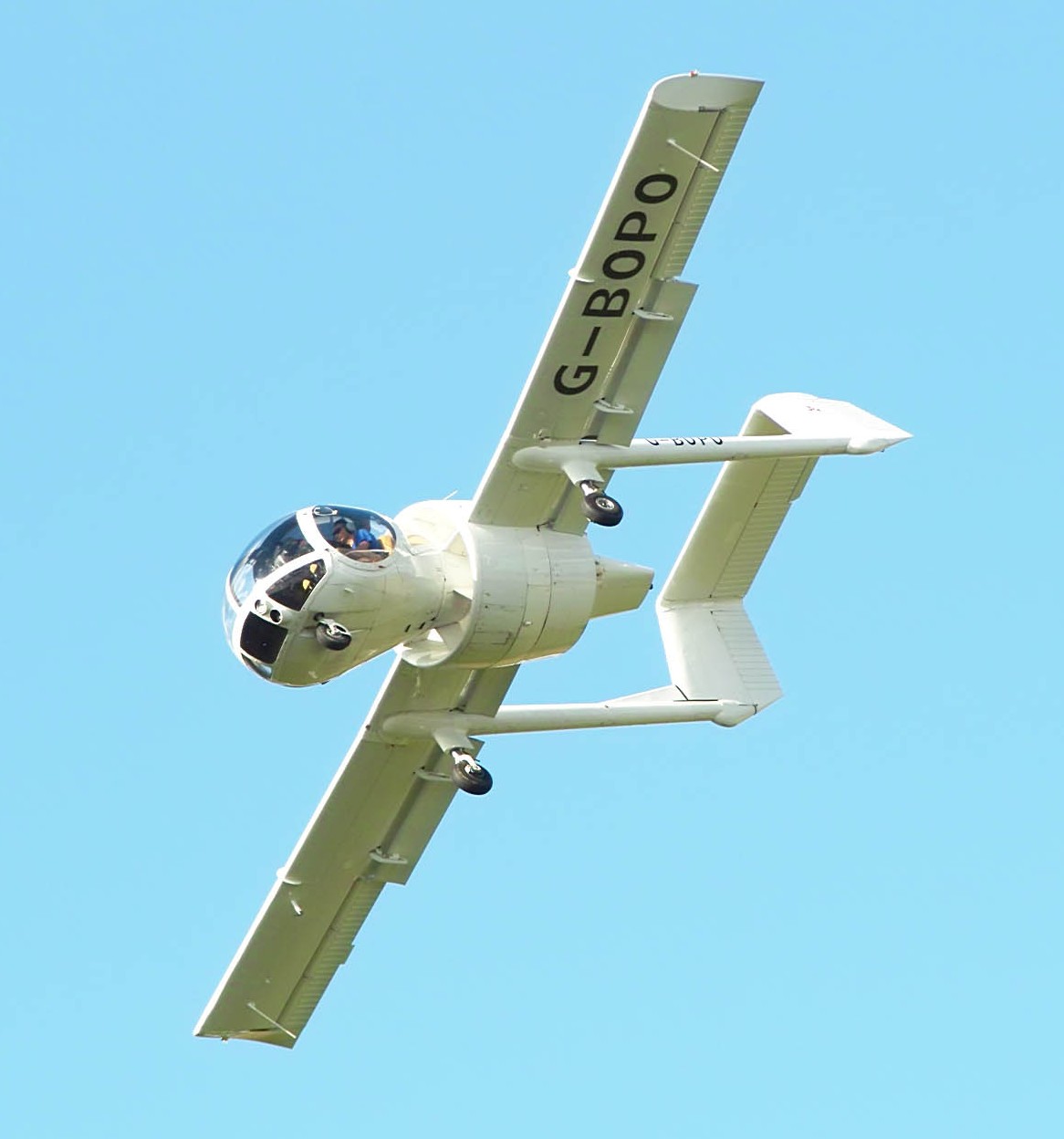
The Edgley Optica is a distinctive British light aircraft designed purely for low-speed aerial observation, offering helicopter-like visibility at fixed-wing running costs. Created by designer John Edgley and first flown in December 1979, its glazed forward cabin, twin-boom tail and rear-mounted ducted fan give it an unmistakable silhouette and a reputation as one of the quietest powered aircraft ever built. Only a small number were produced before financial and ownership troubles halted manufacture, making it a rare but fascinating type for any simmer interested in unconventional aircraft.
The Edgley EA-7 Optica is a British light aircraft built specifically for low-speed observation work, conceived as a low-cost, fixed-wing alternative to the helicopter. It is unmistakable in appearance: a fully glazed, helicopter-style forward cabin sits ahead of a pusher engine driving a ducted fan, with the tail carried on twin booms bearing twin rudders and a high-mounted tailplane. Designed by John Edgley and built by Edgley Aircraft Limited, the type was manufactured in very small numbers during the 1980s and has since passed through several owners, with periodic attempts to return it to production.
The Optica project began in 1974 when John Edgley, then a post-graduate student at Imperial College of Science and Technology in London, began the final aerodynamic design of an aircraft built around the pilot's view outward rather than around an engine or a set airframe layout. A model was wind-tunnel tested in 1975, and construction of a prototype began in London in 1976, with final assembly carried out at the College of Aeronautics, Cranfield. The prototype made its first flight on 14 December 1979, flown by Squadron Leader Angus McVitie, the college's chief pilot, powered by a 160 hp Avco Lycoming engine. In 1982 institutional investors bought into the project and a production line was established at Old Sarum Airfield in Wiltshire; over the following three years the company built up full manufacturing capability, the aircraft gained UK Civil Aviation Authority certification on 8 February 1985, and the first customer aircraft was delivered. The additional investment needed for full-scale production was not forthcoming, however, and the business went into receivership, with John Edgley forced out of his own company. Aircraft already on the line were completed by new owners and the Optica entered limited service, but in 1987 an arson attack on the factory destroyed ten aircraft and effectively ended production. A total of 22 Opticas were completed, with a 23rd left unfinished. Rights to the design, together with those to a related two-seat ab-initio trainer called the Sprint designed by Sydney Holloway, later passed to FLS Aerospace (Lovaux Ltd), which intended to develop both aircraft but ultimately cancelled both projects when the Sprint was not adopted as a UK military trainer. The Optica and Sprint then passed through further owners until 2007, when they were offered back to John Edgley, who formed a new company, AeroElvira Limited, with three former Edgley Aircraft employees. AeroElvira returned demonstrator G-BOPO to flight on 3 June 2008. In 2016 Interflight Global announced plans to value the dormant programme with a view to relaunching production, completing its valuation in December 2016 and delivering a letter of intent to AeroElvira in June 2017 to pursue relaunch of the EA-7 Optica in the 2018-19 timeframe, with fabrication and final assembly intended to be outsourced to a certified manufacturer.
The Optica has a highly unconventional layout built around maximising outward view. The pilot and two passengers sit three-abreast in a fully glazed forward cabin, reminiscent of a Hiller Model 360 or Hughes Model 269 helicopter cockpit, giving 270 degree panoramic vision and almost vertical downward vision; the canopy panels are designed to permit photography through them. Internal cabin width is 1.68 metres, with baggage space and mounting positions for observation equipment behind the seats and an unrestricted floor area ahead of the passenger seats for further equipment. Behind the cabin sits a normally-aspirated Lycoming flat-six engine driving a five-bladed fixed-pitch ducted fan; the aircraft first flew with a 160 hp engine before production examples were upgraded to the more powerful Lycoming IO-540. The ducted fan configuration makes the aircraft exceptionally quiet, reputedly the quietest powered aircraft in the world at the time. The tail is carried on twin booms with twin rudders and a high-mounted tailplane. The undercarriage is a fixed, unfaired tricycle arrangement with maintenance-free solid suspension and the nosewheel offset to the left. Construction is conventional all-metal stressed-skin aluminium, with unswept, untapered wings using a NASA GA(W)-1 aerofoil. General characteristics quoted include a crew/capacity of three, length of 8.15 m (26 ft 9 in), wingspan of 12.00 m (39 ft 4 in), height of 2.31 m (7 ft 7 in), wing area of 15.84 sq m (170.5 sq ft) and an aspect ratio of 9.1:1. Following an in-service incident in which a ducted fan hub suffered metal-fatigue cracking, the original fan was superseded by a replacement unit designed and manufactured by Hoffmann Propeller.
The Optica is a genuinely low-speed aircraft, with a loiter speed of 130 km/h (70 kn; 81 mph) and a stall speed of 108 km/h (58 kn; 67 mph), figures that reflect its design purpose of sustained slow observation flight rather than transit speed. Its combination of a light, unswept wing, ducted-fan propulsion and helicopter-style all-round visibility was intended to let it perform much of a helicopter's low-speed observation role while retaining the range and lower running costs of a fixed-wing aircraft.
No distinct production sub-variants of the Optica were built beyond the progression from prototype to production standard; the principal change through the aircraft's short manufacturing life was the engine upgrade from the original 160 hp Lycoming fitted to the 1979 prototype to the more powerful Lycoming IO-540 used on later production aircraft, and the later replacement of the original ducted fan hub with a Hoffmann Propeller-designed unit following a fatigue-related incident. A related but separate design, the Sprint, a two-seat ab-initio trainer designed by Sydney Holloway, was acquired alongside the Optica by FLS Aerospace (Lovaux Ltd) with a view to parallel development as a military trainer, but this project was cancelled together with further Optica development.
The Optica was intended for roles including aerial photography, surveillance and police patrol work, traffic reporting and powerline inspection, exploiting its slow, quiet, high-visibility flight characteristics. Early operators included police forces: Hampshire Constabulary operated an Optica, G-KATY, which crashed on 15 May 1985, killing the pilot and his photographer passenger, an accident attributed by investigators to loss of control rather than structural or mechanical failure. The type's operational career was further curtailed when an arson attack on the Old Sarum factory in 1987 destroyed ten aircraft. Surviving Opticas passed through a succession of owners, including Brooklands Aerospace and FLS Aerospace (Lovaux Ltd), before rights returned to designer John Edgley's AeroElvira Limited in 2007, which returned demonstrator G-BOPO to flight in 2008. In more recent years a small number of surviving aircraft have continued to operate in niche roles, including aerial sightseeing work, while Interflight Global's 2016-2017 valuation and letter of intent aimed at relaunching production reflected continued interest in the type's low-cost intelligence, surveillance and reconnaissance potential.
Because the Optica's occupants sit well forward of the wing in a light airframe, the type is notably sensitive to weight and balance; the real aircraft carries a rack for ballast weights ahead of the instrument pylon, with further adjustable sliding weights concealed in the tail booms to manage trim, a characteristic that has been carried through into at least one detailed desktop simulation of the type. That model, built as a hybrid representation of Optica airframes due to the scarcity of documentation on this rare aircraft, features a fully instrumented cabin with a modelled electrical system and variable lighting for night flying. For simulator pilots the appeal lies less in outright performance than in experiencing the Optica's unusual helicopter-style panoramic view combined with genuine fixed-wing slow-flight handling, and in managing the aircraft's distinctive centre-of-gravity sensitivity that its ballast system was designed to address.