Departure
98%
vs 95% ▲ 3
 MY FS FLIGHTS
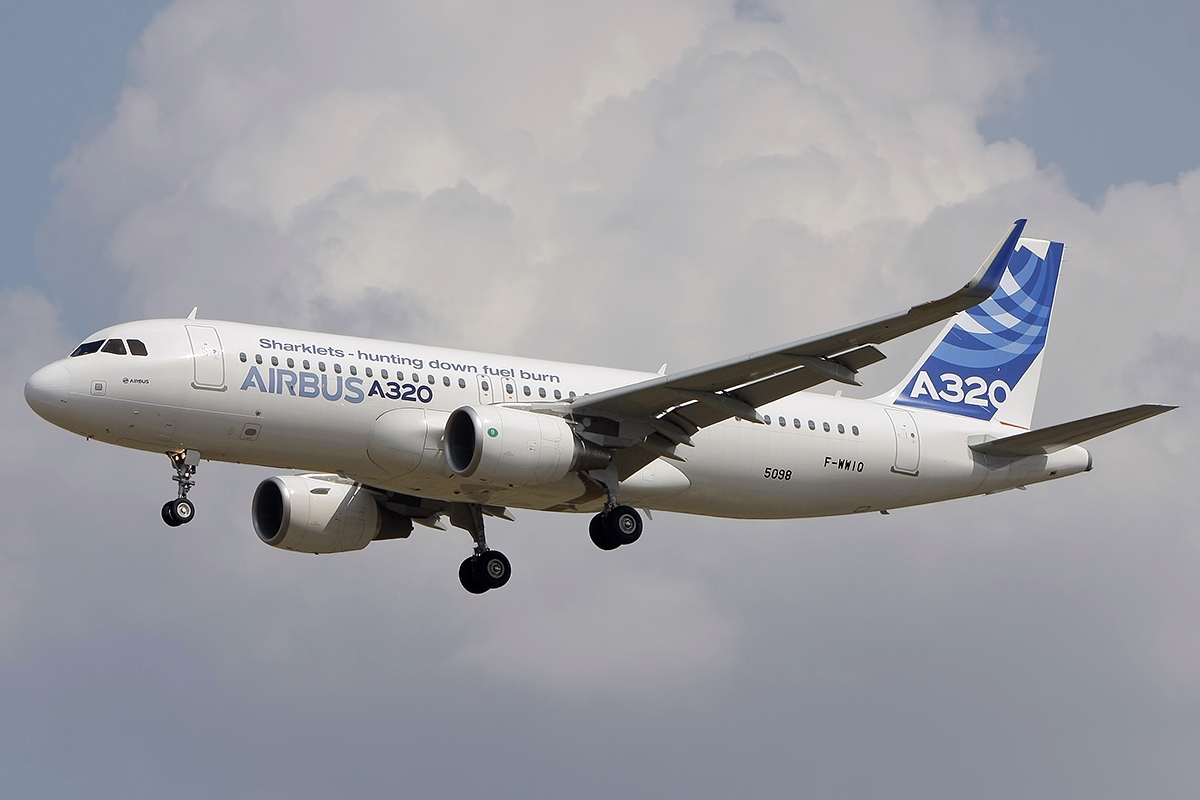
The Airbus A320 is a narrow-body, twin-engine jet airliner developed by Airbus as the founding member of the A320 family, the best-selling airliner series ever built. Launched in March 1984 and first flown on 22 February 1987, it entered service with Air France in April 1988 and introduced digital fly-by-wire flight controls and sidestick handling to commercial aviation. For the simulator pilot it represents the archetypal modern short/medium-haul airliner, flown by hundreds of operators worldwide and forming the baseline from which the larger A321, smaller A319 and A318, and the re-engined A320neo family were all derived.
The Airbus A320 is a narrow-body jet airliner manufactured by Airbus, the baseline and namesake member of the A320 family series. It is a twin-engine, six-abreast single-aisle design intended for short- to medium-haul routes, and it was the aircraft that introduced digital fly-by-wire flight controls and side-stick handling to airliners. Final assembly of A320 family aircraft takes place in Toulouse, France; Hamburg, Germany; Tianjin, China since 2009; and Mobile, Alabama, in the United States since April 2016.
Airbus's ambitions for a broad airliner family dated back to the design of the A300 in the late 1960s and early 1970s, when engineers identified nine possible A300 derivatives, A300B1 to B9, followed by a tenth concept in 1973, the A300B10, which was later developed into the Airbus A310. Airbus subsequently turned its attention to the single-aisle market then dominated by the Boeing 737 and McDonnell Douglas DC-9. A number of European manufacturers explored successors to the BAC One-Eleven and replacements for the 737-200 and DC-9: Germany's MBB, British Aircraft Corporation, Sweden's Saab and Spain's CASA worked on the 180- to 200-seat EUROPLANE, later abandoned as it encroached on A310 territory, while VFW-Fokker, Dornier and Hawker Siddeley pursued a number of 150-seat designs. A design lineage can be traced back further still to Hawker Siddeley's 1965 HS.134 "Airbus" concept, itself an evolution of the HS.121 (formerly DH.121) Trident. In June 1977 British Aerospace, Aerospatiale, Dornier and Fokker established the Joint European Transport (JET) programme, based at the former Vickers site at Weybridge, Surrey, regarded by its partners as a separate collaboration from Airbus proper. This programme, covering a 130- to 188-seat aircraft powered by two CFM56 engines with a target cruise speed of Mach 0.84, faster than the 737, was considered the direct forerunner of the A320. The carried-forward JET2 study, seating 163 passengers, evolved into the Airbus S.A1/2/3 Single Aisle series before the programme was formally launched as the A320 in March 1984. The aircraft first flew on 22 February 1987 and entered service with Air France on 18 April 1988. The family subsequently grew with the stretched A321, first delivered in January 1994, the shorter A319 in April 1996, and the shortest variant, the A318, in July 2003.
The A320 is a low-wing, twin-engine monoplane with a six-abreast economy-class cabin cross-section, measuring 37.6 metres (123 ft) in length and accommodating between 150 and 186 passengers. It was powered by either CFM56-5A or CFM56-5B turbofans, or IAE V2500 engines. The A320 family was notable for pioneering the use of digital fly-by-wire flight control systems and side-stick controllers in commercial airliners, a design philosophy carried through the entire family. Across the family, maximum take-off weights range from 68 to 93.5 tonnes (150,000 to 206,000 lb).
Across the A320 family, range varies from 5,740 to 6,940 kilometres (3,570 to 4,320 miles; 3,100 to 3,750 nautical miles) depending on variant and engine fit. The type's defining handling characteristic, carried across all family members, is its digital fly-by-wire flight control system paired with side-stick controls, a departure from the conventional yoke-and-cable arrangements of earlier airliner generations.
The family comprises four fuselage lengths built around the common A320 design. The A318, the shortest at 31.4 metres (103 ft), typically seats 107 to 132 passengers and was offered with CFM56-5B or PW6000 engines. The A319, at 33.8 metres (111 ft), seats 124 to 156 and entered service in April 1996. The A320 itself is 37.6 metres (123 ft) long, seating 150 to 186. The stretched A321, at 44.5 metres (146 ft), offers 185 to 230 seats and was first delivered in January 1994. Airbus Corporate Jets are modified business-jet versions of the standard commercial variants. In December 2010 Airbus announced the re-engined A320neo (new engine option), which entered service with Lufthansa in January 2016; fitted with more efficient turbofans and "sharklet" winglets, it offers up to 15 percent better fuel economy, and the earlier generation was retrospectively renamed the A320ceo (current engine option).
The A320 family has become the best-selling airliner series ever built, with more than 20,210 aircraft ordered, 12,743 delivered and 11,244 in service with over 375 operators. American Airlines is the largest operator of A320 family aircraft, with 489 in its fleet, while IndiGo is the largest customer with 930 on order. The family overtook the Boeing 737 family in total fleet size in 2017, in total orders in October 2019, and in total deliveries in September 2025. The global A320 fleet has completed more than 176 million flights and 328 million block hours since entering service. The A320ceo generation originally competed against the 737 Classic and the McDonnell Douglas MD-80, and later their successors, the 737 Next Generation and the MD-90, while Boeing's 737 MAX was developed as a direct response to the A320neo.
For a simulator pilot, the A320's most defining feature is the digital fly-by-wire flight control system with side-stick handling, which it pioneered among airliners and which fundamentally shapes how the aircraft is flown compared with conventional yoke-controlled types. As the type that established this control philosophy across an entire family of airliners, from the smaller A318 and A319 through to the stretched A321, and later the re-engined A320neo generation, it remains one of the most widely represented and studied narrow-body types in the simulated airline environment.