Departure
86%
vs 95% ▼ 10
 MY FS FLIGHTS
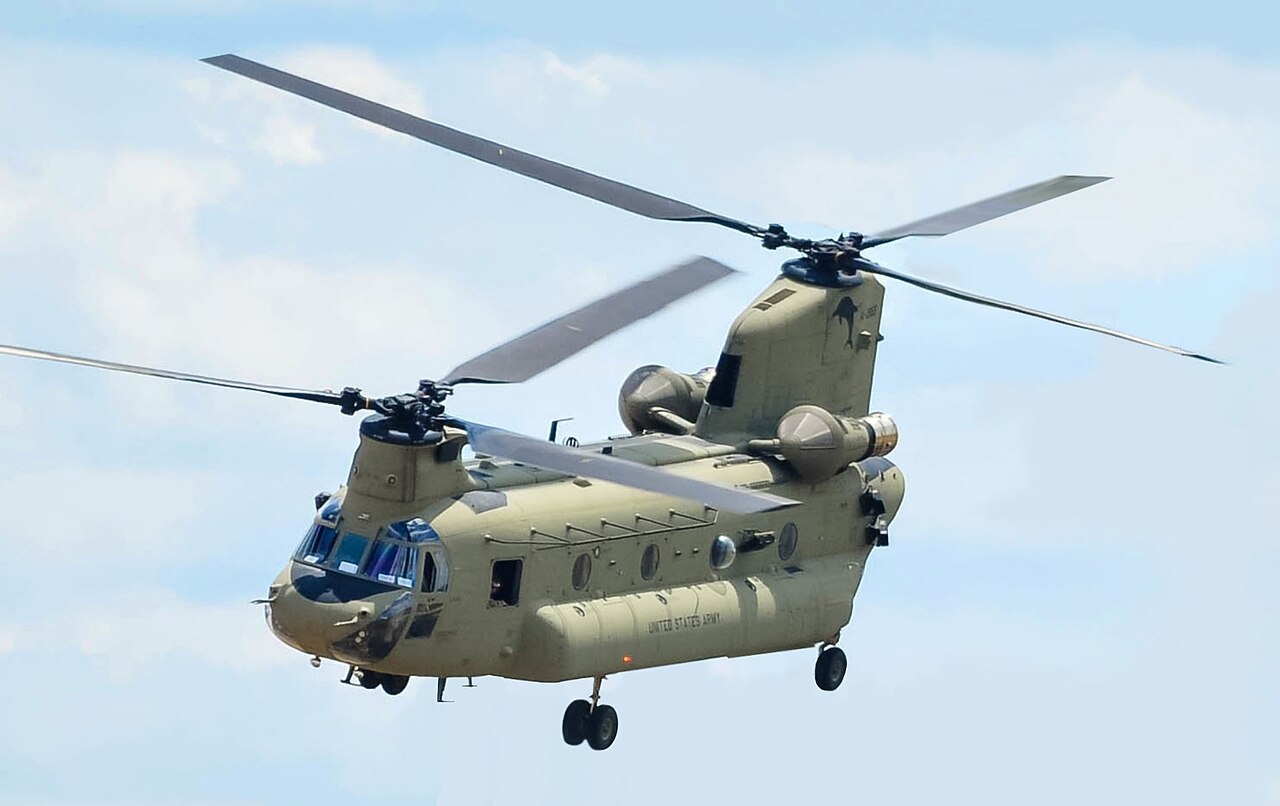
The Boeing CH-47 Chinook is a tandem-rotor, twin-turbine heavy-lift helicopter originally developed by Vertol and now built by Boeing Defense, Space & Security, in continuous production and frontline service since 1962. It is the primary heavy-lift helicopter of the US Army and the Royal Air Force, valued for its combination of speed, payload and the unusual handling qualities that come from having no tail rotor. For a simulator pilot it offers a distinctive flying experience built around twin main rotors, a rear loading ramp and triple cargo hooks rather than the single main/tail rotor layout found on most helicopters.
The CH-47 Chinook is an American tandem-rotor transport helicopter, classed as a heavy-lift type and, by weight lifted, second only to the Sikorsky CH-53 among Western helicopters. It was originally developed by the rotorcraft company Vertol and is now manufactured by Boeing Defense, Space & Security. Introduced in 1962, it remains one of the few aircraft designed in the early 1960s, alongside the fixed-wing Lockheed C-130 Hercules, to have stayed in both production and frontline service for over 60 years. Its name comes from the Chinook people of Oregon and Washington.
The Chinook's origins lie in a 1956 US Department of the Army requirement to replace the piston-engined Sikorsky CH-37 Mojave with a gas-turbine helicopter, mirroring the turbine-engine philosophy behind the smaller UH-1 Huey. In 1957 Vertol began work on a tandem-rotor design, the Model 107 or V-107, and in June 1958 the Army ordered a small batch under the designation YHC-1A. Testing showed the YHC-1A to be too heavy for the assault role but too light for general transport, so the Army instead upgraded the Huey for tactical transport while the YHC-1A itself was refined into the Marine Corps CH-46 Sea Knight. For the heavier transport requirement, Vertol produced an enlarged derivative of the V-107, company-designated the Model 114 and given the military designation HC-1B. The preproduction YHC-1B made its first hovering flight on 21 September 1961, and in 1962 the type was redesignated CH-47A under the new Tri-Service aircraft designation system, taking the name Chinook. Since then the type has been progressively improved, with the CH-47D entering service in 1982 and the CH-47F following in 2009, and it has also been licence-built abroad by Agusta in Italy and Kawasaki in Japan.
The Chinook's defining feature is its tandem-rotor layout, which removes the need for a tail rotor to counter main-rotor torque. The fuselage is fitted with multiple doors, a wide rear loading ramp, and three external ventral cargo hooks for underslung loads, giving the type considerable flexibility in how cargo and troops are loaded and carried. It can lift up to 26,000 pounds. Later variants such as the CH-47D introduced composite rotor blades, a redesigned cockpit intended to reduce pilot workload, improved and redundant electrical systems, and an advanced flight control system. The current-generation CH-47F, introduced in 2009, is powered by two Honeywell engines rated at 4,733 horsepower (3,529 kW) each, and adds digitised flight controls along with a digital automatic flight control system (DAFCS) and a fully integrated cockpit management system for operations in low-visibility and adverse weather. Other cited powerplants for the type include the Honeywell T55-GA-714A turboshaft.
On introduction in 1962 the Chinook had a top speed of 170 knots (200 mph; 310 km/h), making it considerably faster than the utility and attack helicopters of its era, and it remains one of the fastest helicopters in US service. Operational figures cite a maximum speed of up to 170 knots (315 km/h), a maximum operational range of approximately 400 nautical miles, and a service ceiling of up to 20,000 feet. The tandem-rotor configuration is described as giving the aircraft unmatched handling regardless of wind speed and direction, and the type is capable of flying by day or night in almost any weather, with the ability to lift loads of up to 26,000 pounds.
The initial production model was the CH-47A, followed by the CH-47C. The CH-47D, which entered service in 1982, brought upgraded engines, composite rotor blades, a redesigned cockpit, improved and redundant electrical systems and avionics, and an advanced flight control system. The CH-47F, the current mainstream generation introduced in 2009, adds digitised flight controls and is powered by two 4,733-horsepower Honeywell engines. Special-operations and international derivatives include the MH-47G, and the UK operates its own upgraded variant, the HC.4, which first flew on 9 December 2010. A civilian model, the Boeing-Vertol Model 234, has been used worldwide for logging, construction, forest-fire suppression and petroleum-extraction work; Columbia Helicopters Inc. purchased the Model 234 type certificate from Boeing in December 2006. Overseas production has included Agusta-built CH-47Cs in Italy and Kawasaki-built examples in Japan.
The Chinook's largest operators have been the United States Army and the Royal Air Force, and the type serves the defence forces of numerous countries, with roles spanning troop transport, resupply, and the positioning of artillery pieces. Iran was a significant early export customer: the Imperial Iranian Air Force purchased 20 Agusta-built CH-47Cs in 1971, and Iranian Army Aviation acquired 70 more between 1972 and 1976, with a further order placed in 1978 later cancelled after the revolution, though 11 helicopters from that order were eventually delivered. In 1978 four Iranian CH-47Cs were involved in an incident in which they penetrated Soviet airspace over the Turkmenistan Military District and were shot down. The Royal Netherlands Air Force became the first international customer of the CH-47F model in February 2007, expanding its Chinook fleet to 17 aircraft. Beyond military transport, the type and its civilian derivative have supported medical evacuation, search and rescue, disaster relief, aerial firefighting, logging, construction and oil-extraction operations.
Flying the Chinook is defined by its tandem-rotor layout, which does away with the anti-torque tail rotor found on conventional helicopters and instead relies on counter-rotating main rotors, giving handling that is described as consistent regardless of wind speed or direction. Its rear loading ramp, multiple fuselage doors and three external cargo hooks make external and internal load operations a central part of flying the type, reflecting its role lifting loads of up to 26,000 pounds. Combined with a top speed of around 170 knots that outpaced most helicopters of its generation, and a service ceiling of up to 20,000 feet, the Chinook offers a heavy-lift flying experience quite distinct from single-rotor types, which is part of its enduring appeal to pilots exploring rotorcraft with unconventional control characteristics.