Departure
93%
vs 95% ▼ 2
 MY FS FLIGHTS
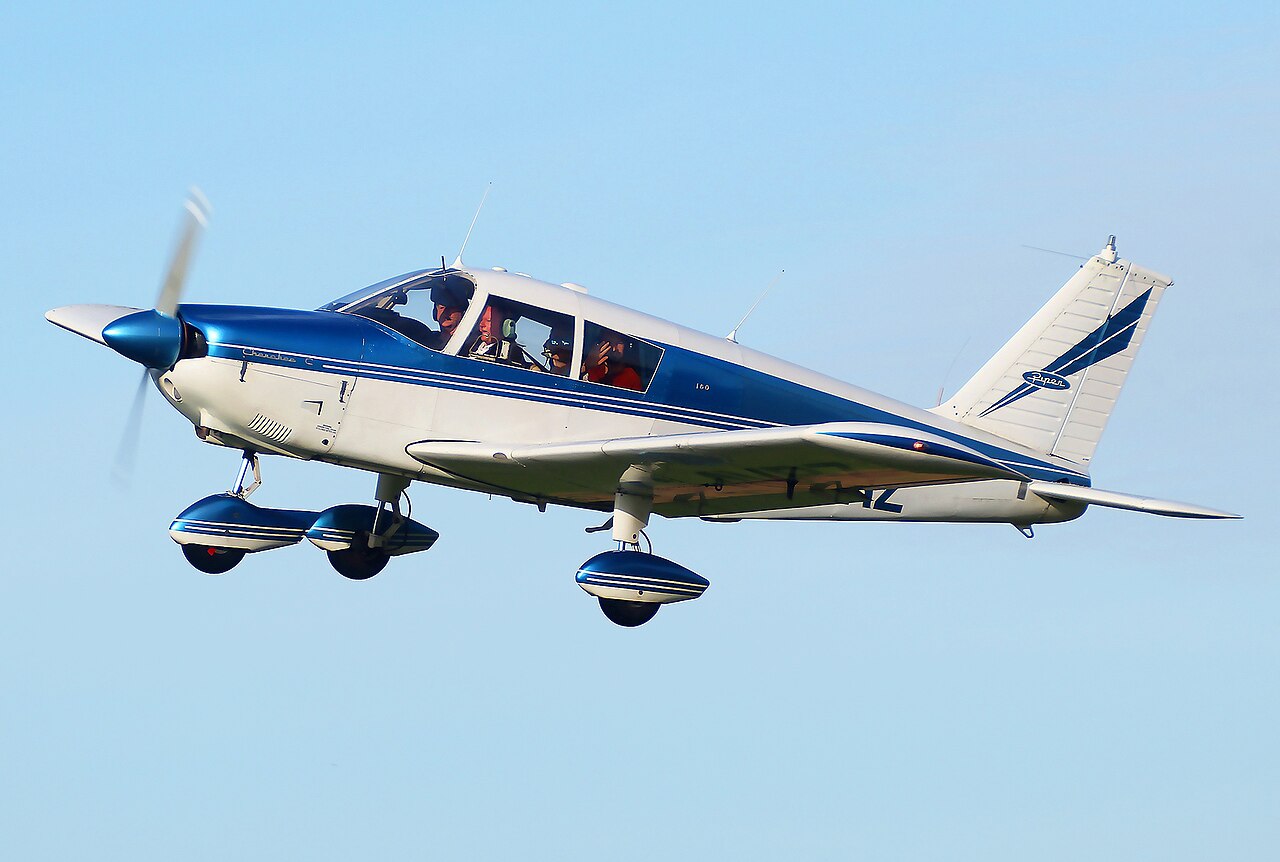
The Piper PA-28 Arrow IV, factory-designated PA-28RT-201 and, in turbocharged form, PA-28RT-201T Turbo Arrow IV, is a four-seat, single-engine, retractable-gear light aircraft built by Piper Aircraft as the T-tailed evolution of the long-running PA-28R Arrow family. Produced only briefly around 1979 to the early 1980s, it is best known among pilots as the Arrow variant with the distinctive T-tail and for the low-speed handling quirks that came with it. It remains of interest to simulator pilots as a classic complex-aircraft trainer, offering retractable gear and a controllable-pitch propeller in a docile Cherokee-derived airframe.
The Arrow IV sits within Piper's PA-28R Arrow series, itself a retractable-gear development of the four-seat, low-wing PA-28 Cherokee family. Like other PA-28 derivatives it is an all-metal, unpressurized, single-engine piston aircraft with tricycle landing gear, seating one pilot and up to three passengers. The Arrow IV is distinguished from earlier Arrows by its T-tail configuration, adopted in 1979 to match the styling of other Piper types of the period, and it was offered in both normally aspirated (PA-28RT-201) and turbocharged (PA-28RT-201T Turbo Arrow IV) forms.
The Arrow line began in 1967 with the PA-28R-180, fitted with a fuel-injected Lycoming IO-360-B1E engine, retractable landing gear and a variable-pitch constant-speed propeller, intended as a stepping stone for pilots moving from simple trainers into complex aircraft. Two years later the PA-28R-200 (Arrow II) added extra horsepower and a hundred pounds of gross weight over the original. The line continued to evolve through the PA-28R-201 Arrow III and its turbocharged PA-28R-201T sibling before Piper introduced the T-tailed Arrow IV in 1979. The T-tail design proved short-lived, lasting only about three years in production, because it brought less than ideal flight control characteristics at low speeds, and the Arrow range subsequently reverted to a conventional empennage.
The Arrow IV retains the all-metal, low-wing, tricycle-gear layout common to the PA-28 family, with retractable main and nose gear operated electromechanically through a simple cockpit lever, a notable point of difference from many contemporaries that used manual gear-extension systems. The normally aspirated version used a 200 hp Lycoming IO-360 engine, while the turbocharged PA-28RT-201T Turbo Arrow IV was powered by a 200 hp Continental TSIO-360-FB and had a maximum gross weight of 2900 lb. A representative normally aspirated example had an empty weight of 1627 lb, a maximum gross weight of 2750 lb, a useful load of 1123 lb, and fuel capacity of 77 gallons (72 usable). The aircraft seats one pilot and three passengers.
A representative Arrow IV cruises at around 134 KIAS at 75 percent power, burning roughly 11 gallons per hour. Turbocharged Turbo Arrow IV models are better suited to higher-altitude cruising, where they move along more effectively than the normally aspirated version, though the type as a whole is not a particularly fast performer. The T-tail configuration introduced with the Arrow IV brought handling characteristics at low speed that were considered less than ideal, a factor that contributed to Piper abandoning the T-tail layout after only a few years of production.
The PA-28R Arrow family progressed through several distinct models: the original PA-28R-180 Arrow, the PA-28R-200 Arrow II with increased power and gross weight, the PA-28R-201 Arrow III and its turbocharged counterpart the PA-28R-201T Turbo Arrow III, and finally the T-tailed PA-28RT-201 Arrow IV and PA-28RT-201T Turbo Arrow IV, the latter fitted with the turbocharged Continental TSIO-360-FB engine and a higher gross weight of 2900 lb.
Arrows of all generations, including the Arrow IV, have served widely in flight training, air taxi work and personal and family travel, valued for their combination of four-seat cabin space and complex-aircraft systems such as retractable gear and a constant-speed propeller. The type has long been used as a transition aircraft for pilots moving up from simple fixed-gear trainers into retractable-gear, higher-performance singles.
For simulator pilots, the Arrow IV offers the appeal of a classic complex trainer: retractable gear worked by an electromechanical lever rather than a manual system, a constant-speed propeller to manage, and the distinctive T-tail silhouette that sets it apart from other Arrow generations. Its documented low-speed handling quirks, a direct result of the T-tail layout, make it a useful type for pilots wanting to experience the handling differences that led Piper to abandon the configuration after only a few production years.