Departure
93%
vs 95% ▼ 2
 MY FS FLIGHTS
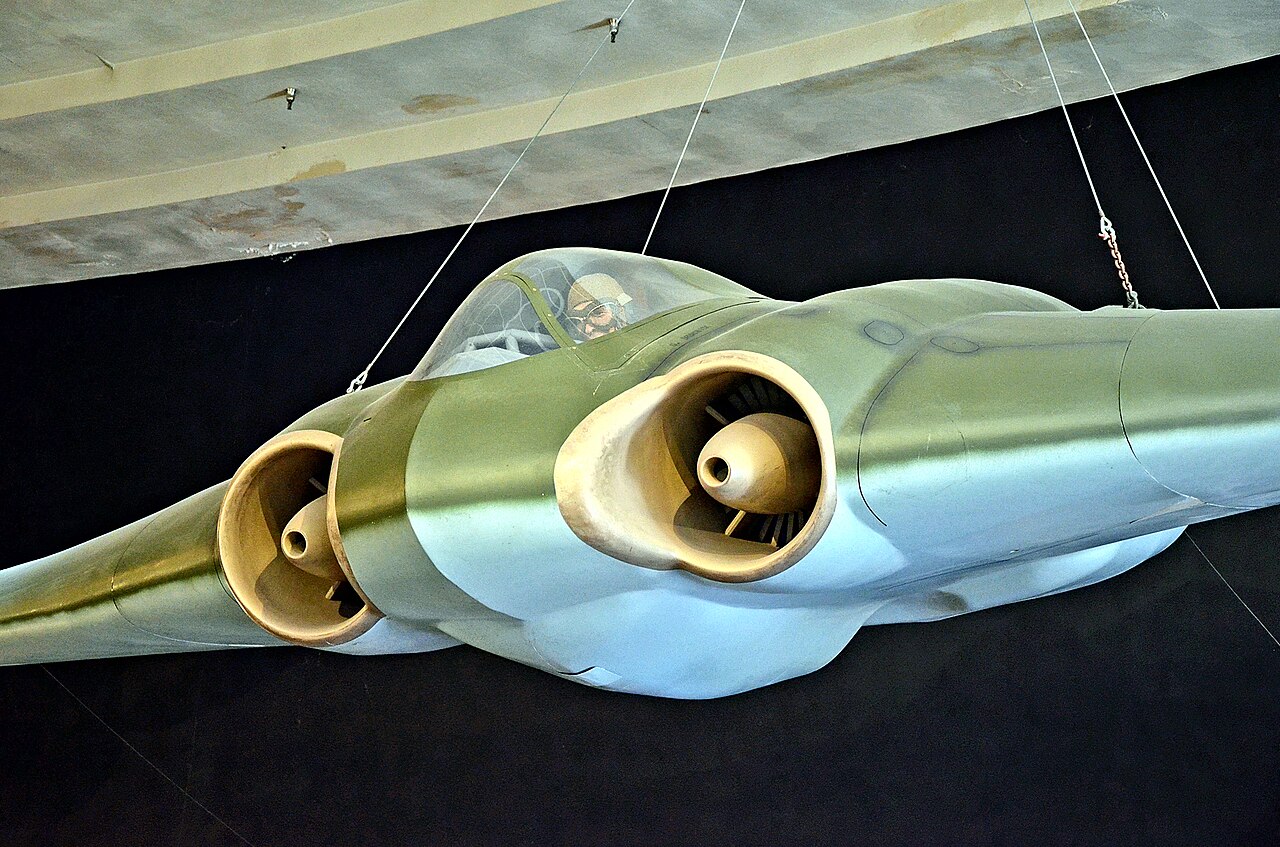
The Horten Ho 229 was a German jet-powered flying wing fighter-bomber designed by brothers Reimar and Walter Horten and built for production by Gothaer Waggonfabrik in the final year of the Second World War. Conceived to meet Hermann Goring's demanding 3x1000 requirement for a bomber able to carry 1,000 kilograms of bombs 1,000 kilometres at 1,000 kilometres per hour, it survives today only as an unfinished prototype airframe in the Smithsonian collection, making it one of the most tantalising might-have-beens of wartime aviation and a favourite subject for flying-wing enthusiasts and simulation modellers alike.
The Ho 229, also referred to as the Horten H.IX or, in its intended production form, the Gotha Go 229, was a single-seat jet-powered flying wing conceived as a fighter-bomber for the Luftwaffe. It was designed by Reimar and Walter Horten, who had been refining the tailless flying wing concept through a series of gliders since the early 1930s, and was one of the earliest flying wing aircraft to be powered by jet engines. Lacking their own production facilities, the Hortens had the aircraft built by the established manufacturer Gothaer Waggonfabrik, which carried out substantial redesign work to prepare it for series manufacture. Only three prototypes were completed in any form, and the type never entered operational service before the war ended.
The Horten brothers' interest in the flying wing configuration dated to the early 1930s, when they applied it to gliders such as the Horten H.IV in pursuit of the lowest possible weight and drag. In 1943 Hermann Goring, head of the Luftwaffe, called for a light bomber design capable of carrying 1,000 kilograms of bombs over 1,000 kilometres at 1,000 kilometres per hour, a requirement known as the 3x1000 project; conventional aircraft could not meet it because the Junkers Jumo 004B turbojets that offered the required speed were too fuel-hungry to also meet the range target. The Hortens argued that a low-drag flying wing could resolve this by needing less cruise power, and put forward their private-venture H.IX design. The Air Ministry approved the proposal, though it insisted on the addition of two 30 mm cannon so the aircraft could also serve as a fighter, and the design was given the official designation Ho 229. Goring personally backed the project and secured funding of half a million Reichsmarks for three prototypes, with a production order initially for 100 aircraft, later reduced to 20. Because the Hortens had no factory of their own, manufacturing was contracted to Gothaer Waggonfabrik, a company that, according to later accounts, sought to favour its own competing flying wing projects with the authorities. The first prototype, the unpowered glider H.IX V1, made its maiden flight on 1 March 1944, flown by test pilot Heinz Schiedhauer. The powered H.IX V2, fitted with two Junkers Jumo 004 turbojets, first flew on 2 February 1945 at Oranienburg with test pilot Erwin Ziller at the controls; Ziller flew it successfully once more before being killed when the aircraft crashed during its third test flight, on 18 February 1945. Gothaer had by then begun work on further prototypes, V3 through V6, redesigning the structure with a steel-framed centre section for production, but none were completed before the war ended. In April 1945 George Patton's Third Army overran the Gothaer works and found four Horten prototypes along with a Horten glider; of the Ho 229 airframes, the V3 was nearest to completion and was shipped to the United States for evaluation. It passed briefly through RAE Farnborough in Britain, where fitting British jet engines was considered but abandoned because the mountings could not accommodate their larger diameter, and it remains uncertain whether the aircraft's original Junkers engines were ever run. The V3 subsequently went into long-term storage before being placed on display, and later undergoing restoration, at the Smithsonian's National Air and Space Museum.
The Ho 229 was a tailless flying wing with a single-seat cockpit, built to combine the aerodynamic efficiency the Horten brothers had already demonstrated in their glider designs with jet propulsion. Its airframe combined a steel structure with a laminated plywood covering, and Gothaer's production redesign introduced a steel centre section built up from tubular members. To minimise drag no vertical stabilizer was fitted, which removed the passive yaw-damping effect a fin normally provides; the Hortens compensated with split ailerons that increased drag differentially on one wing to control yaw, at the cost of requiring more active pilot input and imposing bank-angle restrictions. The aircraft was armed with two 30 mm cannon, added at the Air Ministry's insistence, and was intended in production form to be able to carry a bomb load. Power for the flying prototype came from two Junkers Jumo 004 turbojet engines. The design had a stated ceiling of 15,000 metres.
The whole design was driven by the 3x1000 requirement: a bomb load of 1,000 kilograms carried over a range of 1,000 kilometres at a speed of 1,000 kilometres per hour, a combination conventional airframes of the day could not achieve because early turbojets consumed fuel too quickly to meet the range target at that speed. The Hortens' flying wing was intended to meet this by cutting drag enough to reduce the cruise power needed. The aircraft's stated ceiling was 15,000 metres. Removing the vertical stabilizer to save drag meant that without active correction the aircraft was prone to uncommanded sideslip and, potentially, flat spins, a tendency countered by the split-aileron drag rudders rather than by any passive stabilizing surface.
The H.IX V1 was an unpowered glider prototype used to prove the flying wing airframe before jet power was fitted. The H.IX V2 was the first and only version to fly under jet power, powered by two Junkers Jumo 004 turbojets, and was lost in a fatal crash on its third test flight. The H.IX V3, redesigned by Gothaer with a steel centre section for series production and intended as the pattern for the fighter-bomber production model with twin 30 mm cannon and provision for a bomb load, was the most complete example when captured and is the sole survivor. Further prototypes, V4, V5 and V6, were under construction at the Gothaer works but none was finished before the war ended. A production series, referred to under the designation Gotha Go 229 to reflect Gotha's extensive redesign for manufacture, was ordered in a batch of 100 aircraft, later cut to 20, but no production aircraft were ever completed.
The Ho 229 never entered operational service and saw no combat; only the unpowered V1 glider and the single powered V2 prototype actually flew, with the V2 lost in a fatal accident shortly after its first flights. Its intended role, as approved by the Air Ministry, was as a fast fighter-bomber able to outrun Allied aircraft while also defending against Allied bombers under the wider Emergency Fighter Program. Following capture, the surviving V3 airframe was studied by American and British researchers rather than flown operationally, and it is not clear whether its original engines were ever run during this evaluation. In 2008 Northrop Grumman built a full-scale model of the Ho 229 to measure its radar cross-section; the results showed its frontal signature at the frequencies used by wartime Chain Home radar was only around 4 dB lower than that of a Messerschmitt Bf 109, comparable to other aircraft of similar size, which has been used to temper post-war claims that the design possessed genuine stealth properties. The sole surviving airframe, the V3, remains part of the Smithsonian's collection and has undergone long-term conservation and restoration work.
As it never reached operational service and its only powered example was lost after a handful of flights, there is no substantial wartime pilot testimony on handling the Ho 229 in the air, and its portrayal in simulation is necessarily built on its design data and post-war technical assessment rather than combat experience. In games that model the type, such as the Ho 229 V3 as represented in War Thunder, it is generally treated as a boom-and-zoom jet fighter: acceleration from low speed is slow, since early turbojet efficiency depends heavily on airspeed feeding the intakes, but once above roughly 500 kilometres per hour it can comfortably outrun propeller-driven contemporaries, favouring pilots who trade altitude and energy for speed rather than engaging in sustained turning fights. This tallies with the aircraft's origins as a high-speed, low-drag design built around jet propulsion rather than manoeuvrability, and with the yaw-control compromises imposed by its tailless, rudderless layout.