Departure
90%
vs 95% ▼ 5
 MY FS FLIGHTS
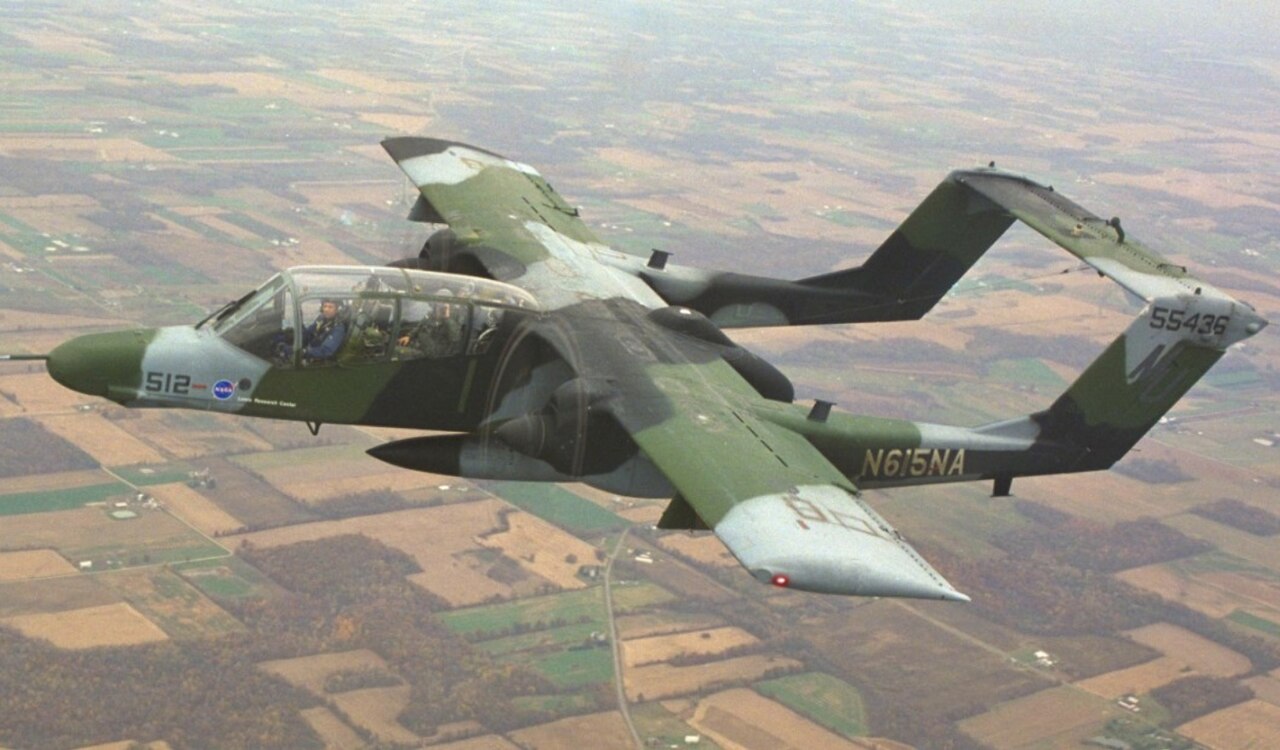
The North American Rockwell OV-10 Bronco is an American twin-turboprop, twin-boom light attack and observation aircraft built for counter-insurgency and forward air control work, combining short take-off and landing performance with the ability to loiter for three hours or more over the battlefield. Conceived by the US Marine Corps and developed under a tri-service programme with the Air Force and Navy, it became one of the definitive COIN aircraft of the Vietnam era and went on to fly with the US military into the 1990s. For a simulator pilot it offers an unusual mix of rugged short-field handling, a distinctive twin-boom silhouette and a genuine combat pedigree stretching from Vietnam to Desert Storm.
The OV-10 Bronco is a twin-turboprop, twin-boom light attack and observation aircraft built by North American Aviation, which became North American Rockwell after Rockwell International's 1967 merger with the company. It was purpose-built for counter-insurgency (COIN) combat and forward air control (FAC) duties, with short take-off and landing (STOL) capability that let it operate from rough or improvised strips close to friendly ground forces. A total of 360 were built between 1965 and 1986, and the type entered service in October 1969, going on to serve the US Air Force, Navy and Marine Corps as well as the Philippine Air Force; a small number remain in limited service, including examples operated by NASA.
The Bronco's origins lie in an informal collaboration in the early 1960s between W.H. Beckett and US Marine Corps Colonel K.P. Rice, who met at Naval Air Weapons Station China Lake and shared a vision for a rugged, simple close-air-support aircraft that could work directly with forward ground troops. At the time the US Army was still experimenting with armed helicopters and the Air Force showed little interest in close air support, so the two men sketched a concept aircraft meant to fly from expedient forward airstrips, even using roads as runways, with weapons mounted on the centreline for unranged aiming and a design that could in principle be broken down and carried in a 6x6 truck. Beckett, having left the Marine Corps, took the idea to North American Aviation. This grassroots concept fed into the tri-service Light Armed Reconnaissance Aircraft (LARA) specification approved by the Navy, Air Force and Army and issued in late 1963, which called for a twin-engined, two-man aircraft able to carry at least 2,400 pounds of cargo or six paratroopers or stretchers, stressed for aerobatic loads of +8 and -3g, capable of carrier operations, a top speed of at least 350 mph, and take-off in 800 feet, along with a range of armament including 7.62 mm machine guns, a 20 mm M197 cannon pod and AIM-9 Sidewinder missiles. Eleven proposals were submitted, including designs from Grumman (a tandem-seat OV-1 Mohawk derivative), Goodyear, Beechcraft, Douglas, Convair, Helio, Lockheed and Martin, alongside North American Aviation's NA-300. The NA-300 was selected in August 1964 and a contract for seven prototypes followed that October. Convair protested the decision and built its own Model 48 Charger prototype regardless, which first flew on 29 November 1964 and could outperform the OV-10 in some respects, but it crashed on 19 October 1965 after 196 test flights, ending Convair's contention. The Bronco itself first flew on 16 July 1965. Production contracts were awarded in 1966, the first production OV-10A was ordered that year, and the first aircraft for service were delivered in early 1968, with production completed in April 1969. Colonel Rice later reflected that the Department of Defense's insistence on a 40-foot wingspan, rather than his originally envisioned 20-foot span for road operations, compromised the aircraft's performance and diluted the original small, austere concept.
The Bronco's most distinctive feature is its twin-boom layout, with a high-mounted wing and a horizontal tail joining the two booms; that tail surface acts as an important stabiliser and contributes to the aircraft's short take-off and landing performance. Early production OV-10A aircraft were powered by two Garrett-AiResearch T76-G turboprops rated at 715 horsepower each, with a wingspan of 40 feet, a length of 41 feet 7 inches and a height of 15 feet 1 inch; empty weight was around 7,190 lb against a maximum weight of 14,500 lb. Armament typically comprised four M60C 7.62 mm machine guns built into the fuselage sponsons, with up to roughly 3,200 to 3,700 lb of external stores depending on configuration, and the airframe could also carry internal loads such as paratroopers (up to four Special Forces troops) or stretchers. The improved second-generation OV-10D, built under the Night Observation Gunship System (NOGS) programme and converted in 17 examples from OV-10A airframes, introduced a forward-looking infrared sensor for night operations along with larger Garrett T76-G-420/421 engines rated at 1,040 shaft horsepower each, driving three-bladed Hamilton Standard constant-speed, fully feathering fibreglass propellers. The OV-10D had an empty weight of 3,127 kg, a gross weight of 4,494 kg and a maximum take-off weight of 6,552 kg, with a maximum payload of 1,679 kg and fuel capacity of 252 US gallons; it carried a single 20 mm M197 electric cannon or four M60C machine guns across seven hardpoints (five on the fuselage, two underwing), able to mount 2.75-inch or 5-inch rocket pods, AIM-9 Sidewinder missiles and up to 227 kg of bombs.
The baseline OV-10A cruised at around 223 mph with a maximum speed of 281 mph, a range of 1,240 miles and a service ceiling of 26,000 feet; published figures also list a maximum cruise speed near 250 knots, a rate of climb of 2,650 feet per minute, take-off distance of around 2,800 feet and landing distance of about 1,250 feet, with an approach speed near 45 knots. The Bronco's defining performance trait was its ability to loiter for three or more hours in the observation and forward air control role while retaining a genuine STOL capability suited to rough or improvised airstrips, in keeping with the original LARA requirement for take-off within 800 feet and an aerobatic-rated structure stressed to +8 and -3g. The uprated OV-10D offered a maximum speed of 250 knots at sea level, a service ceiling of 30,000 feet, a rate of climb of 2,020 feet per minute, a combat radius around 198 nautical miles and a ferry range of 1,200 nautical miles with auxiliary fuel, along with a very short take-off run of around 226 metres and a landing run at maximum weight of just 38 metres.
The OV-10A was the principal production version, powered by 715-horsepower Garrett-AiResearch T76-G turboprops and armed with four M60C machine guns plus external stores, flown by the US Air Force, Navy and Marine Corps. The OV-10D was a second-generation development built under the Night Observation Gunship System programme, converting 17 OV-10A airframes with a forward-looking infrared night-vision system, larger 1,040-shaft-horsepower T76-G-420/421 engines and larger fibreglass propellers, giving improved night attack and observation capability. A target-tug variant, the OV-10B, was also produced for use by the German Luftwaffe.
The Bronco entered combat service with US forces in Vietnam, where it flew forward air control, armed reconnaissance, close air support guidance and interdiction missions against Viet Cong supply routes on the Ho Chi Minh Trail; US Navy light attack squadron VAL-4 flew OV-10s in-country, including rocket attacks with Zuni ordnance. Aircraft were subsequently based with US forces in Thailand, Korea and Germany as well as Vietnam. The type saw further combat with the US Marine Corps during Operation Desert Storm in 1991 and remained in Marine Corps service until 1995. Beyond front-line combat, OV-10s were used for counter-narcotics work, including a US State Department drug-interdiction programme supporting the Colombian Air Force, and the type has also seen historical service with the Philippine Air Force. A small number of OV-10Ds have continued to fly in research roles, including with NASA.
Surviving Broncos are flown today as civilian warbirds, with operators such as California Aerosport carrying out extensive inspection, repair and modernisation work while retaining much of the original cockpit character; panels have been updated with modern glass avionics such as the Garmin G600 TXi and GTN 750 Xi alongside legacy gauges and switches, preserving the look and feel of the original office. For a simulator pilot this points to an aircraft whose appeal lies less in outright performance than in its unusual twin-boom layout, short-field manners and the tactile, workmanlike feel of a purpose-built forward air control platform, offering a distinctly different flying experience from contemporary jet warbirds.