Departure
99%
vs 95% ▲ 3
 MY FS FLIGHTS
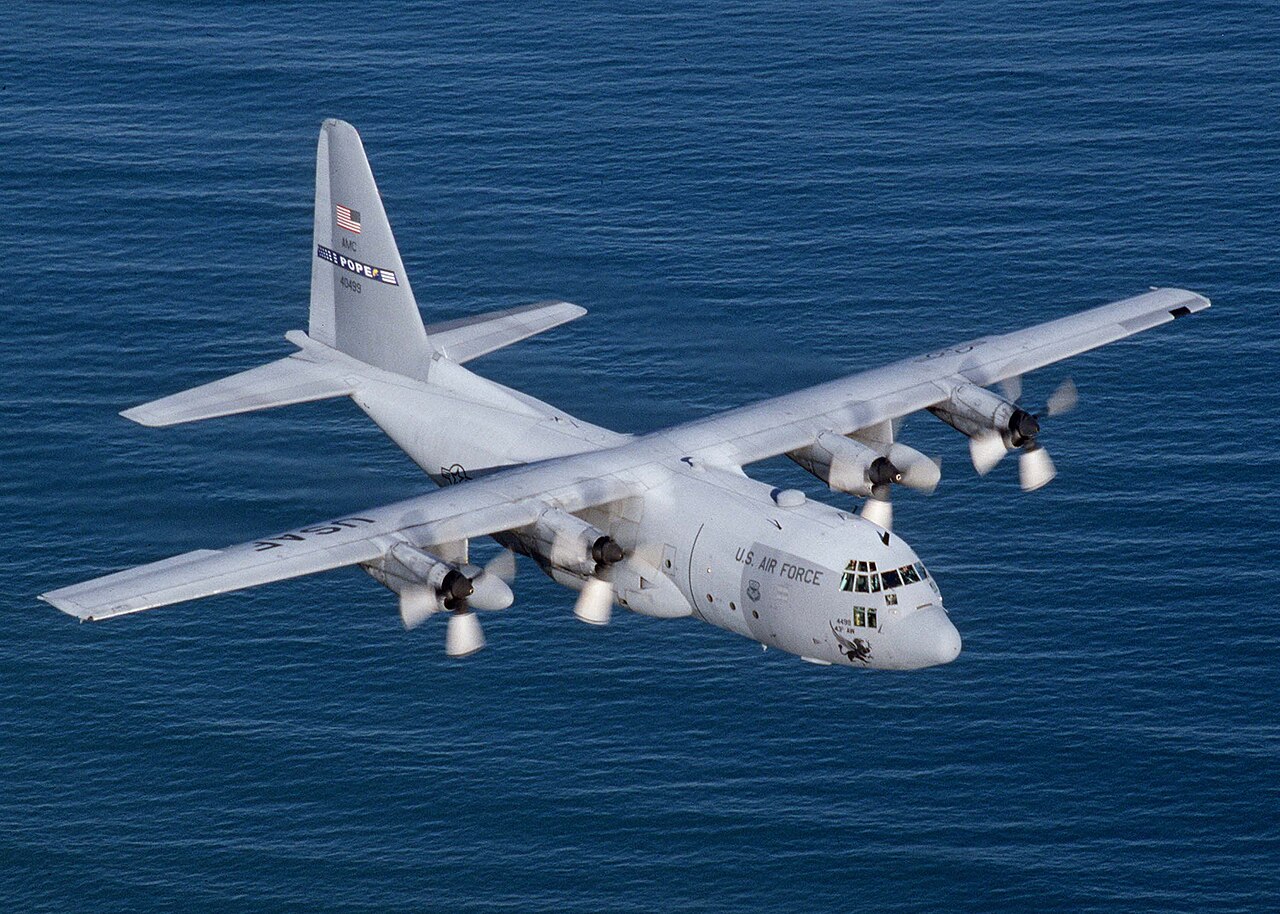
The Lockheed C-130H Hercules is a four-engine turboprop tactical transport built by Lockheed, representing the definitive and longest-produced version of the classic legacy Hercules family before production shifted to the C-130J Super Hercules. Rugged, unprepared-runway capable and adaptable to everything from paratroop drops to gunship conversions, it remains in widespread military service and is of interest to sim pilots as the archetypal analogue-cockpit Herk.
The C-130H is a four-engine turboprop military transport aircraft designed and built by Lockheed, now Lockheed Martin, as part of the long-running C-130 Hercules family. Capable of operating from unprepared runways, it was originally conceived as a troop, medevac and cargo transport, but the type has been adapted for a huge range of secondary roles. The C-130H is the final legacy transport variant produced before Lockheed switched to the digital-cockpit C-130J Super Hercules, and it is best understood as a generational upgrade of the earlier C-130A/B/E models rather than an all-new design.
The origins of the C-130 trace back to 1951, when the United States Air Force issued a General Operating Requirement for a new transport to replace ageing piston-engined types such as the C-47 Skytrain and C-119 Flying Boxcar. The Lockheed design team, led by Willis Hawkins, produced a 130-page proposal for the Lockheed L-206; company vice president and chief engineer Hall Hibbard passed it to Kelly Johnson, who initially disliked the low-speed, unarmed concept but nonetheless signed off on it. Lockheed's design, designated Model 82, won the contract on 2 July 1951, with first flight following in 1954 and entry into service in 1956. The original C-130A was followed by the C-130B in 1959 and the C-130E in 1962, together totalling under 1,000 examples with basic analogue instrumentation and no GPS or modern warning suites. The C-130H entered production in 1964 and continued until 1996, becoming the backbone of the worldwide Hercules fleet. It received continuous upgrades throughout its production run, including a redesigned outer wing offering increased strength and better fatigue life introduced in its final production years between 1992 and 1996. Production of legacy C-130H airframes ended in 1996 as Lockheed Martin moved to the C-130J Super Hercules, though the majority of legacy Herks still flying today are C-130Hs.
The C-130H is powered by Allison T56 turboprop engines rated at 4,590 shaft horsepower, a significant increase over the 3,750 to 4,050 shaft horsepower engines fitted to the original C-130A/B/E models. It uses four-bladed Hamilton Standard 54H60 constant-speed, fully feathering and reversible propellers, replacing the three-bladed propellers of the original C-130A. Over its production life the type's maximum takeoff weight rose to 155,000 lb, and its electrical systems and ferry range were progressively improved. Avionics were upgraded through both factory standard and later retrofit programmes, including the addition of GPS and APN-241 radar to some airframes. The flight deck retains an analogue instrument suite, described by pilots as equipped with steam gauges, including eight gauges per engine, and a dedicated navigator's station, features which some operators have since modified with glass-panel upgrades. The aircraft is designed to operate from unprepared runways, a defining characteristic of the type across all its roles.
The C-130H's more powerful engines and four-bladed propellers give it noticeably better climb performance, hot-and-high capability and payload capacity than the earlier C-130A/B/E models it succeeded. Its ferry range was improved over successive production batches, alongside the maximum takeoff weight increase to 155,000 lb. By comparison, Lockheed marketing material for the succeeding C-130J states that the newer type offers around 21 percent greater maximum speed, about 40 percent more range and a roughly 41 percent shorter takeoff distance than the C-130H, illustrating the scale of the generational gap between the two while underlining the C-130H's still-respectable short-field and load-carrying performance for its era.
The C-130A was the original production model, fitted with Allison T56-A-11/9 engines and three-bladed propellers. The C-130B, introduced in 1959, upgraded to Allison T56-A-7 engines and four-bladed propellers. The C-130E of 1962 used the same engines as the B model but added two 1,290 US gallon external fuel tanks for extended range and had an increased maximum takeoff weight. The C-130H followed as a substantial generational upgrade with more powerful 4,590 shaft horsepower engines, improved propellers and progressively updated avionics and structure, including a redesigned outer wing in its final production years. Ski-equipped LC-130H-2 and LC-130H-3 variants have been operated in Arctic and Antarctic conditions. The C-130H was ultimately superseded in production by the C-130J Super Hercules from 1996, including the stretched C-130J-30 derivative with a 15-foot longer fuselage.
Although designed primarily as a troop, medevac and cargo transport, the C-130H and the wider Hercules family have been adapted to an unusually broad range of roles, including gunship conversions such as the AC-130, aerial refuelling tankers such as the KC-130, electronic warfare platforms such as Compass Call, search and rescue, scientific research support, weather reconnaissance, maritime patrol and aerial firefighting. The type has seen extensive service across NATO air arms and numerous other nations worldwide. Operators recorded flying the C-130H include the United States Air Force, the Portuguese Air Force, Taiwan, and Egypt, among others. Air National Guard units have used the type for demanding missions such as resupply flights to McMurdo Station in Antarctica, while ski-equipped LC-130H variants operated by Air National Guard units support Arctic operations. Preserved examples, such as one held by MAPS Air Museum, reflect the type's long and varied service history spanning transport, gunship, and support roles.
For a sim pilot, the C-130H represents the classic analogue-era Hercules flight deck, with steam-gauge instrumentation including eight gauges per engine and a dedicated navigator's station, rather than the digital glass cockpit of the later C-130J. Its four-bladed, fully feathering and reversible propellers and rugged short-field capability define its handling character, allowing operation from unprepared runways as part of its core tactical airlift role. Flying the type involves managing a workload-heavy analogue cockpit and a genuinely versatile airframe that has been called upon for everything from paratroop and cargo drops to Arctic ski operations, giving the C-130H a distinct, procedural flying character compared with the more automated Super Hercules that succeeded it.