Departure
95%
vs 95% ▼ 1
 MY FS FLIGHTS
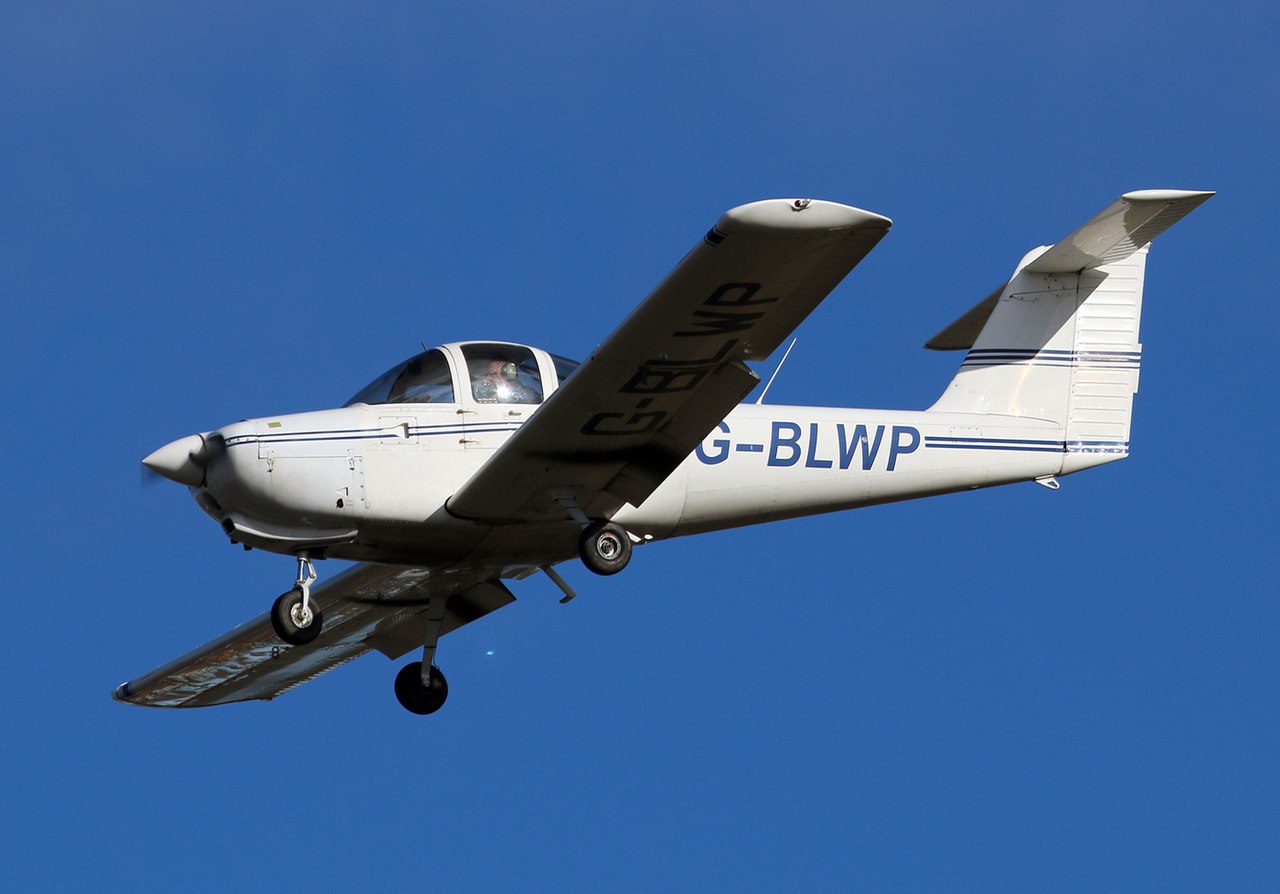
The Piper PA-38 Tomahawk is a two-seat, low-wing, T-tailed trainer built by Piper Aircraft between 1978 and 1982 as a modern rival to the Cessna 150/152. Designed with heavy input from flight instructors and fitted with the NASA GA(W)-1 Whitcomb airfoil, it was deliberately made more spin-responsive than its Cessna competitor, a feature that gave it both a strong reputation as a spin trainer and a controversial safety history. For simmer pilots interested in classic primary trainers, the Tomahawk offers a distinctive T-tail silhouette, roomy cabin and a wing that behaves very differently from the docile Cessnas of its era.
The Piper PA-38-112 Tomahawk is a two-seat, fixed tricycle-gear general aviation light aircraft, designed from the outset as a primary flight trainer, though also suited to touring and personal flying. It is a single-engined, low-wing cantilever monoplane with a distinctive T-tail and an enclosed cabin for two, accessed via front-hinged doors. Manufactured by Piper from 1978 to 1982, it was conceived as a direct, all-new competitor to the long-established Cessna 150/152 trainer line.
In the mid-1970s Piper set out to challenge Cessna's dominance of the primary-trainer market, which the Cessna 150 had held since the late 1950s. Rather than adapt the versatile PA-28 Cherokee airframe, Piper developed an entirely new design, promoting the fact that it had surveyed some ten thousand flight instructors for their views on the ideal trainer. Instructors wanted, among other things, an aircraft that was more resistant to spontaneously recovering from a spin than the Cessna 150/152, so that students could properly learn spin recovery technique; Piper answered this with the NASA GA(W)-1 Whitcomb airfoil, which required deliberate pilot input to recover from a spin. The first Tomahawks appeared in late 1977 as 1978 models, featuring a notably roomier cabin than the Cessna's, larger fuel tanks, and a modern-looking T-tail configuration similar in concept to the contemporary, and similarly styled, Beechcraft Skipper. Production continued until 1982, with 2,484 aircraft built in total, the majority in the first two years, with fewer than 200 built in each of the final three seasons. In service the aircraft was dogged by quality-control issues, with some nineteen Airworthiness Directives issued by the FAA in its first four years, and by unpredictable stall characteristics that led to a series of stall/spin accidents. Piper responded by adding wing leading-edge stall strips (flow strips) in September 1978 and, in 1981, introducing the improved Tomahawk II, which addressed soundproofing, defrosting, door latching, elevator trim, engine thrust vector, nosewheel design and anti-corrosion treatment, along with larger 6-inch wheels and tyres for better ground clearance on unpaved strips.
The Tomahawk is a low-wing cantilever monoplane of constant chord and thickness, built around the NASA GA(W)-1 Whitcomb airfoil, with a T-tail and fixed tricycle landing gear. Power comes from a single Avco Lycoming O-235-L2C air-cooled, four-cylinder, horizontally-opposed piston engine rated at 112 hp (84 kW), driving a two-bladed Sensenich metal fixed-pitch propeller of 6 ft 0 in (1.83 m) diameter. The aircraft measures 23 ft 1.25 in (7.042 m) in length, with a wingspan of 34 ft 0 in (10.36 m), a height of 9 ft 0.75 in (2.762 m), and a wing area of 124.7 sq ft (11.59 sq m), giving an aspect ratio of 9.27:1. Empty weight is 1,128 lb (512 kg) and maximum takeoff weight is 1,670 lb (757 kg), with usable fuel capacity of 30 US gallons (25 imp gal, 110 L). The cabin, entered through front-hinged doors, was designed to be wider than that of the Cherokee, and thus considerably wider than the Cessna 150/152, with extensive glazing giving close to 360 degrees of external visibility. Late production aircraft had leading-edge stall strips added, and an additional pair was mandated on the inboard leading edge under Airworthiness Directive 83-14-08 in September 1983 to standardise and improve stall behaviour.
At sea level the Tomahawk has a maximum speed of 126 mph (203 km/h, 109 kn), cruising at 115 mph (185 km/h, 100 kn) at 10,500 ft on 65% power. Stall speed with flaps down is 56.5 mph (90.9 km/h, 49.1 kn) indicated, and never-exceed speed is 159 mph (256 km/h, 138 kn) indicated. Range is 539 miles (867 km, 468 nm) at 10,500 ft on 65% power, service ceiling is 13,000 ft, and rate of climb is 718 ft/min. Takeoff run to 50 ft is 1,460 ft and landing run from 50 ft is 1,544 ft. In side-by-side comparison testing against the Cessna 152, the Tomahawk cruised similarly at around 100 knots but was faster flat-out, with 114 knots true airspeed observed at 85% power, and it also showed a somewhat better real-world climb rate than the figures on paper suggested, benefiting from its high-aspect-ratio wing; even so, climb performance is regarded as the type's weakest attribute, and gross-weight climb of around 725 fpm deteriorates markedly in hot or high conditions. General handling is considered acceptable but not outstanding, with control harmony that could be crisper and a roll rate on the low side; the manual flap system, operated by a floor-mounted lever with a detent button, has minimal effect on trim. The Tomahawk's defining handling trait, however, is its stall and spin behaviour: the GA(W)-1 airfoil was designed to require deliberate control inputs for spin recovery rather than recovering on its own, making it a more demanding and instructive trainer than the Cessna 150/152, but this same characteristic, combined with wing design changes made after certification testing that were not subsequently retested, produced a stall/spin accident rate the National Transportation Safety Board estimated at three to five times that of the Cessna 150/152.
The baseline PA-38-112 Tomahawk was produced from 1978 through 1980. The improved Tomahawk II, introduced for the 1981 and 1982 model years, incorporated better cabin heating and windshield defroster performance, a revised elevator trim system, improved engine thrust vector, full airframe zinc-chromate anti-corrosion treatment, improved cockpit soundproofing, larger 6-inch wheels and tyres for greater propeller ground clearance and better performance on grass and dirt strips, and improved door latching and nosewheel design.
The Tomahawk was conceived and used principally as a flight training aircraft, competing directly with the Cessna 150/152 and the Grumman AA-1, both of which also used the Lycoming O-235 engine and offered broadly comparable performance and payload. Its safety record proved to be a mixed one: the AOPA Air Safety Foundation found the Tomahawk had a one-third lower overall accident rate per flying hour than the Cessna 150/152, yet it suffered a markedly higher rate of fatal stall/spin accidents, a legacy tied to wing design changes made after certification testing without subsequent retesting. In military and paramilitary use, a handful of Tomahawks have been used since the early 2000s to train Australian Air Force Cadets, operated from RAAF Base Amberley by 211 Squadron AAFC, and the type has also served with the Indonesian Navy.
For a simulator pilot, the Tomahawk's main point of interest is its markedly different stall and spin behaviour compared with the ubiquitous Cessna 150/152: because the GA(W)-1 airfoil does not spontaneously fly itself out of a spin, correct, deliberate recovery inputs are needed, making it a more demanding but also more instructive airframe for practising stall/spin awareness. Expect a roomy, well-glazed cabin with good all-round visibility from the low-wing, T-tail layout, a simple floor-mounted manual flap lever, and flaps that have little effect on trim. Cruise performance sits close to the Cessna 152, with the Tomahawk showing a slight edge in top speed and real-world climb thanks to its higher-aspect-ratio wing, though climb performance in general is modest and degrades further in hot or high conditions. Control harmony is workmanlike rather than sporty, with a roll rate that some pilots find could be crisper, and the type's history of stall-strip modifications and handling quirks make it a useful study in how subtle wing changes can alter an aircraft's behaviour at the edge of the envelope.