Departure
91%
vs 95% ▼ 4
 MY FS FLIGHTS
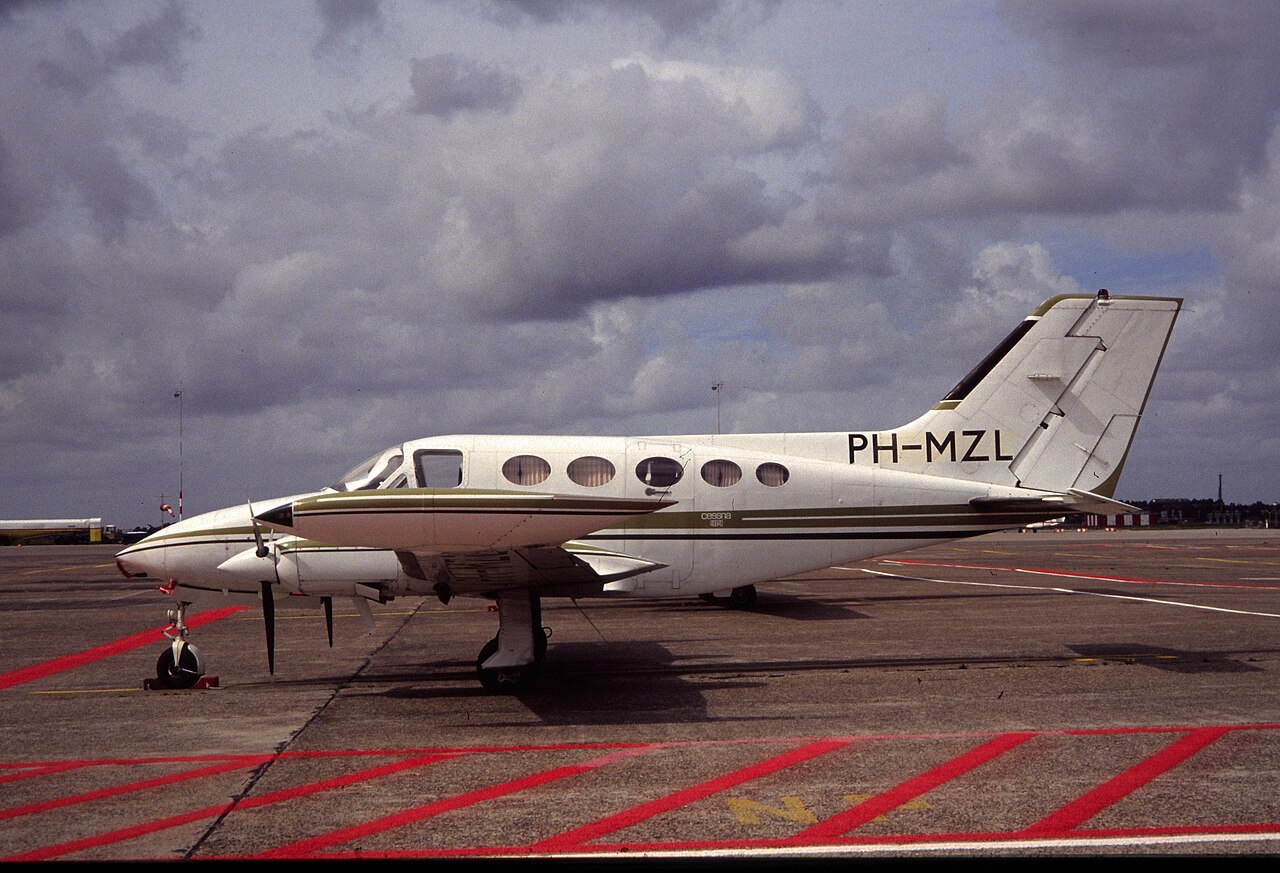
The Cessna 414 is an American light, pressurized, twin-engine transport built by Cessna from 1968, aimed at owners of unpressurized twins who wanted cabin comfort at altitude. The improved 414A Chancellor, introduced in 1978, gave the type a longer wing, extra fuel capacity and a lengthened nose, making it a capable six-to-eight-seat cabin-class piston twin for cross-country business and personal flying.
The Cessna 414 is a six/eight-seat, pressurized, twin-engine light transport aircraft manufactured by Cessna. It is a low-wing cantilever monoplane with a conventional tail unit and retractable tricycle landing gear, built around the fuselage of the larger Cessna 421 combined with the wing design of the Cessna 401. The 414A Chancellor variant, introduced in 1978, represents the definitive and most widely built version of the family, offering owners of unpressurized piston twins a step up into pressurized cabin-class flying.
The prototype 414, registered N7170C, first flew on 1 November 1968, developed to give owners of unpressurized, twin-engined aircraft a pressurized alternative built on proven Cessna components: the 421's fuselage and the 401's wing. Production aircraft were offered with a range of optional seating arrangements and avionics packages, and from 1976 the name Chancellor was applied to models being marketed. In 1978 Cessna introduced the improved 414A Chancellor, whose major change was a redesigned and increased-span wing with integral fuel tanks, along with a narrower vertical tail, redesigned landing gear and an extended nose that provided additional baggage space. Production of the 414 family ran from 1968 to 1985, with 1,070 aircraft built in total, of which 516 were the original 414 and 554 the 414A. The type was developed from the Cessna 401 and, in turn, contributed to the later development of the Cessna 340.
The 414A Chancellor is a low-wing cantilever monoplane with a conventional tail unit and retractable tricycle landing gear, powered by two wing-mounted Continental TSIO-520-NB turbocharged flat-six engines rated at 310 hp (230 kW) each, driving three-bladed McCauley constant-speed propellers of 6 ft 4.2 in (1.94 m) diameter. It has a length of 36 ft 4.5 in (11.09 m), a wingspan of 44 ft 1.5 in (13.45 m), a height of 11 ft 5.5 in (3.49 m) and a wing area of 225.8 sq ft (20.98 m2). Empty weight is 4,368 lb (1,981 kg) against a maximum takeoff weight of 6,750 lb (3,062 kg), with a usable fuel capacity of 213 US gal (177 imp gal; 810 L). Crew requirement is one or two, with a passenger capacity of four to six. Numerous supplemental type certificates exist covering engine and aerodynamic modifications, including winglets, and diesel-engine conversions using FADEC-controlled aviation diesel piston engines running on jet fuel have also been offered.
The 414A Chancellor has a maximum speed of 270 mph (435 km/h, 235 kn) at 20,000 ft (6,100 m) and an economy cruise speed of 211 mph (339 km/h, 183 kn) at 10,000 ft (3,000 m). Its pressurized cabin allows sustained flight at altitude in comfort not available in unpressurized piston twins of similar size, which was the principal design rationale behind the type.
The original 414 was the initial production variant, of which 516 were built. The 414A Chancellor, introduced in 1978, featured a narrower vertical tail, a longer-span bonded wet wing without tip tanks, a lengthened nose, redesigned landing gear and two 310 hp Continental TSIO-520-N engines; 554 were built. A turboprop conversion, the Turbo Star Pressurized 414, was built by American Jet Industries from 1974 using Allison 250-B17B engines, with the design rights later purchased by Scenic Airlines of Las Vegas in 1977. The Riley Rocket 414 is a conversion fitted with two 400 hp Lycoming IO-720 engines.
The 414 family has served primarily as a business and personal cabin-class twin, with a small number pressed into military and government service, including operation by the Bahamas and, in Lebanon, an aircraft donated to the Lebanese Army in 2015 and later passed to the University of Balamand in 2020. The type has also seen use in air ambulance and charter roles. Its operational history includes several notable accidents, among them the July 1982 crash near Garden Valley, Texas that killed musician Keith Green and eleven others, attributed to overloading and a failure to calculate weight and balance; a March 2006 Hawaii air ambulance crash; and an August 2018 crash near John Wayne Airport.
For a simulator pilot, the 414A represents a step into pressurized cabin-class twin flying: a piston twin capable of cruising at altitude with a maximum speed around 235 knots and an economy cruise near 183 knots, offering a realistic training ground for managing turbocharged engines, pressurization and multi-engine systems management on cross-country legs. Its retractable tricycle gear, twin Continental TSIO-520 engines and moderate performance envelope make it representative of the higher end of piston-twin general aviation types, bridging unpressurized light twins and larger cabin-class or early turboprop aircraft.