Departure
93%
vs 95% ▼ 2
 MY FS FLIGHTS
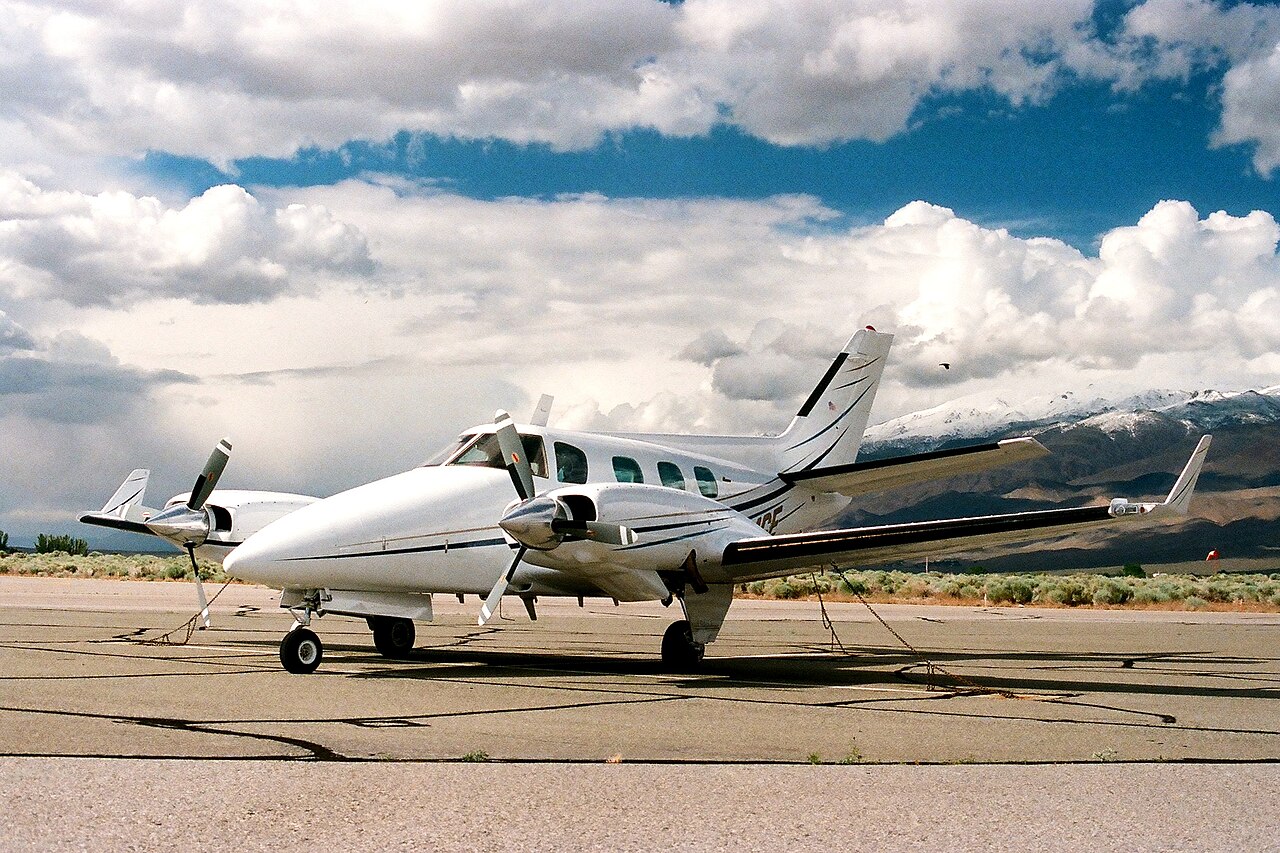
The Beechcraft 60 Duke is a pressurized, twin-engine piston aircraft built by Beechcraft between 1968 and 1983, designed to bridge the gap between the unpressurized Baron and the turboprop King Air. Distinctive for its swept tail styling and cabin pressurization on a piston airframe, it remains a striking but demanding aeroplane for pilots willing to accept King Air-level maintenance costs in exchange for speed, presence and a pressurized cabin.
The Beechcraft 60 Duke is an American twin-engine, piston-driven light aircraft with retractable tricycle landing gear and a pressurized cabin, produced by Beechcraft from 1968 to 1983. It was conceived to fill the gap between the Beechcraft Baron and the Beechcraft Queen Air, offering pressurization and turbocharging in a six-place cabin-class twin. Its swept-back empennage gave it a jet-age look that set it apart from other piston twins of its era.
Development of the Model 60 began in early 1965. The prototype made its first flight on December 29, 1966, and the FAA issued the type certificate on February 1, 1968, with distribution to customers beginning in July 1968; the Duke Flyers Association records the first delivery as August 1968. The design concept called for swept-back empennage styling, luxurious interiors, cabin pressurization, turbocharged engines and optional air conditioning. The Lycoming engines chosen for the Duke had turbochargers built in as an integral part rather than as a bolt-on accessory, intended to give high-altitude performance and maximum reliability, and the landing gear was the same proven design used on the Bonanza and Baron, strengthened for the Model 60. Production techniques included chemical milling of skins, metal bonding and honeycomb stiffening, magnesium skins in the empennage, and extensive flush riveting for a clean airframe. The Beechcraft A60 was introduced in March 1970 at serial number P-127, bringing an improved pressurized cabin using bonded honeycomb construction, lighter and more efficient turbochargers, and improved elevators; from serial P-144 new turbocharger assemblies and exhaust ducting further improved efficiency and service life. Approximately 246 Model 60 and A60 aircraft were delivered. The B60, introduced in October 1973 at serial P-247, brought a new exterior paint stripe, revised cabin sidewall panels with the third and fourth seats moved outboard for a wider aisle, a lower-mounted glare shield for better visibility, lengthened pilot and copilot seat tracks, a lower cabin floor ahead of the fifth and sixth seats, relocated pressurization valves, and new interior appointments. From October 1975 the B60 gained pressurization system developments identical to those of the King Air C90, and from serial P-385 in 1976 a second optional fuel system increased usable fuel to 232 gallons and range by 20 percent at 68 percent power at FL250. Continued refinement through the late 1970s and into 1981 included improved soundproofing, redesigned armrests and seats, longer-life batteries, a two-place couch replacing the fifth and sixth seats in 1980, and improved air conditioning. Despite its sophistication, the Duke was only a moderate seller because its complex technology demanded high maintenance expenditure, and production stopped in 1983 after a total of 596 aircraft.
The Duke is a pressurized, all-metal twin with retractable tricycle landing gear and a swept-back empennage. It is powered by turbocharged Lycoming TIO-541-B4 engines of 380 horsepower (280 kilowatts) each, with the turbochargers also supplying bleed air to pressurize the cabin. Later production B60 aircraft used the Lycoming TIO-541-E1C4, for which the recommended time between overhauls was increased to 1,600 hours following extensive field testing and over 20 significant engine improvements since 1966. The six-place cabin features club seating and a port-side airstair entry door in the rear fuselage. Construction employed chemical milling of skins, metal bonding and honeycomb stiffening for lightweight strength in high-stress areas, magnesium skins in the empennage, and extensive flush riveting for aerodynamic cleanliness. With the optional long-range fuel system introduced in 1976, usable fuel capacity rose to 232 gallons. Typical cross-country fuel planning figures are around 45 gallons per hour in cruise, plus an additional 40 US gallons for each takeoff and climb.
The Duke offers a maximum cruise speed of roughly 230 knots, only marginally slower than a King Air 90 and broadly comparable to a Cessna 421. It shares the pleasant handling qualities associated with the Beechcraft line, but in single-engine operation it demands the highest rudder force of any piston twin, 150 pounds-force at Vmc, which is the maximum permitted by the FAA. Some observers have suggested the aircraft was deliberately limited in speed relative to its available power so as not to outperform the King Air, Beechcraft's flagship at the time. The airframe's assertive lines contributed to both its striking appearance and, according to reviewers, surprisingly high drag for the power installed.
The original Model 60 was produced in 125 examples. The A60, introduced in 1970, brought an improved pressurized cabin with bonded honeycomb construction, lighter and more efficient turbochargers and improved elevators, and 121 were built. The B60, introduced in 1974 (with Duke Flyers Association sources citing October 1973), featured a renewed interior arrangement and further improved turbocharger efficiency, along with the cabin, pressurization and fuel system refinements detailed through its production run; 350 B60s were built, making it by far the most numerous variant. A notable aftermarket modification is the Rocket Engineering Royal Turbine Duke conversion, which replaces the Lycoming piston engines with Pratt & Whitney Canada PT6A-21 or -35 turboprops. This conversion increases fuel capacity by 28 US gallons and maximum useful load by 400 pounds, shortens takeoff distance by over 1,500 feet to 1,000 feet and landing distance by over 2,000 feet to 900 feet, raises maximum rate of climb from 1,600 to 4,000 feet per minute, cuts time to climb to 25,000 feet from 25 to 9 minutes, and increases cruise speed to 290 knots at 29,000 feet. The conversion increases fuel burn from 56 to 66 gallons per hour and lowers certified ceiling from 30,000 to 28,000 feet; its supplemental type certificate was issued on May 12, 2006.
The Duke was purchased primarily by corporate and private pilot owners, with most aircraft registered in the United States and others exported to Argentina, Australia, Brazil, Canada, Croatia, Finland, France, Germany, Honduras, Iceland, Serbia, Slovenia, Sweden, Switzerland, South Africa and the United Kingdom. Military use has included the Angolan armed forces and a single aircraft flown by the Jamaica Defence Force. Many Dukes remain in service in the twenty-first century, with most retaining their original electro-mechanical equipment, though other aircraft, systems, parts and FAA-certified technicians familiar with the type are increasingly hard to find. Owners have compared the Duke to a classic sports car, acknowledging it is not flown to economize, and reviewers have noted that its value is closely tied to engine condition, since a gear-up landing typically necessitates engine teardown and propeller replacement severe enough that insurers often total the airframe.
Pilots who have flown the Duke describe systems that are straightforward and typically Beechcraft, with a spacious cockpit, excellent visibility, and controls that are solid and responsive in the manner of other Beech types, sharing the marque's generally delightful handling. The airframe's high single-engine rudder force, the maximum permitted under FAA rules, is the most notable handling quirk, though pilots flying modified aircraft with vortex generators, aft strakes and winglets report that an engine failure is a benign, stable, low-drama event. Reviewers have noted that despite its purposeful appearance and turbocharged 380-horsepower engines, the Duke's cruise speed is only modestly ahead of lighter twins, and that operating costs and complexity mirror those of a King Air rather than a typical piston twin, a trade-off owners accept for the aircraft's looks, pressurization and presence.