Departure
93%
vs 95% ▼ 2
 MY FS FLIGHTS
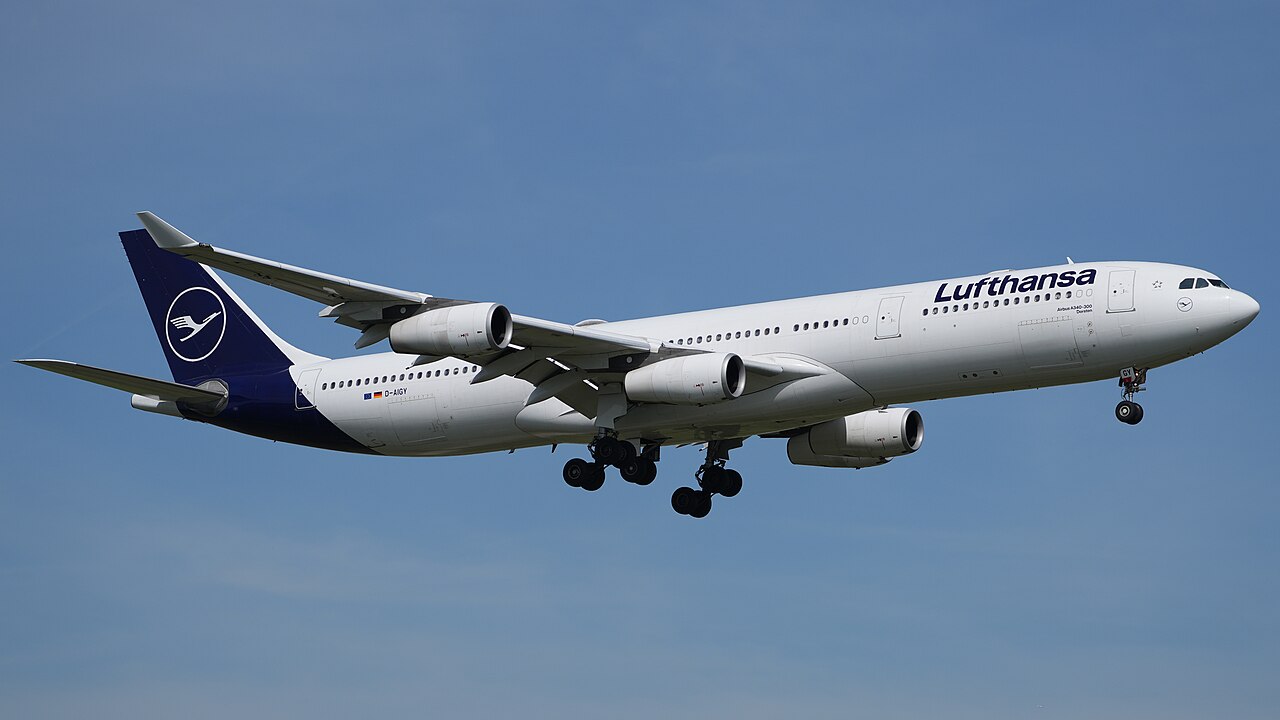
The Airbus A340 is a long-range, wide-body quadjet airliner developed by Airbus alongside its twin-engined sibling the A330, combining a shared fuselage and wing family with four engines to permit unrestricted trans-oceanic operations before ETOPS rules eased for twinjets. It served as a workhorse of ultra-long-haul international travel through the 1990s and 2000s, with the stretched A340-600 becoming, for a time, the longest airliner in the world. For simulator pilots it represents a rare four-engined widebody with fly-by-wire controls and a distinctive three-leg main landing gear, offering a different systems and handling experience to twinjet widebodies.
The Airbus A340 is a long-range, wide-body passenger airliner manufactured by Airbus, developed in the mid-1970s as a derivative family alongside the A300 and produced in parallel with the twin-engined A330. It is a quadjet, powered by four turbofans, and shares much of its airframe and eight-abreast economy cross-section with the A300 and A330. The type occupies a significant place in aviation history as one of the last major four-engined passenger airliners developed for ultra-long-haul routes, before the reliability of twin-engined ETOPS operations made quadjets less economically necessary.
Airbus conceived several derivatives of the A300 from the moment of the manufacturer's formation, and by 1973 had identified up to ten possible variations designated A300B1 through B10, the tenth of which would eventually become the Airbus A310. After focusing initial efforts on the single-aisle A320 programme, Airbus turned back to the wide-body market with two designs: the A300B11, a smaller four-engined derivative of the A310 seating 180 to 200 passengers with a range of 6,000 nautical miles, and the A300B9, a larger stretched derivative of the A300 aimed at high-capacity, medium-range trunk routes as a replacement for the McDonnell Douglas DC-10 and Lockheed L-1011 TriStar while burning between 25 and 38 percent less fuel. These designs were redesignated TA9 and TA11 to distinguish the twin-aisle studies from the single-aisle SA programme, and it was decided the two would share a common wing and airframe to save an estimated 500 million US dollars in development costs. Airbus held discussions with McDonnell Douglas about jointly producing the aircraft under the designation AM 300, combining the wing of what became the A330 with the fuselage of the MD-11, but talks broke down when McDonnell Douglas insisted on continuing its trijet heritage. Although the A340 was from the outset intended to be powered by four CFM56-5 turbofans each rated at 110 kilonewtons, Airbus had also considered a trijet configuration given the limited power of engines available at the time, including the Rolls-Royce RB211-535 and the Pratt & Whitney JT10D-232, later redesignated the PW2000. Airbus formally launched both the A340 and A330 with their first orders in June 1987. The A340-300 made its maiden flight on 25 October 1991, and both the A340-200 and A340-300 were certified on 22 December 1992, entering service in March 1993 with launch customers Lufthansa and Air France. The larger A340-500 and A340-600 were launched on 8 December 1997, with the A340-600 taking its first flight on 23 April 2001 and entering service on 1 August 2002. As engine reliability improved and allowed twin-engined aircraft such as the Boeing 777 to fly ETOPS routes previously restricted to three- or four-engined types, the more economical twinjets gradually displaced the A340 and other quadjets, prompting Airbus to develop the A350 as its successor. Airbus announced the end of A340 production on 10 November 2011, by which point 380 orders had been placed and 377 aircraft delivered from the Toulouse production line.
The A340 retains the eight-abreast economy cross-section of the A300, and the early A340-200 and -300 share a broadly similar airframe with the A330-200 and -300. The principal distinguishing feature is the use of four CFM56 turbofans rated at 151 kilonewtons (34,000 lbf) each, rather than the two high-thrust engines fitted to the A330, a configuration chosen to sidestep ETOPS restrictions on trans-oceanic operations. The aircraft also employs a three-leg main landing gear arrangement, including a centreline bogie, rather than the two-leg gear of the A330, to support a heavier maximum take-off weight of 276 tonnes (608,000 lb) on the A340-200/300. Both the A340 and A330 use fly-by-wire flight controls, a technology first introduced on the Airbus A320, together with a similar glass cockpit. The larger A340-500 and A340-600 are longer, feature a larger wing, and are powered by four Rolls-Royce Trent 500 turbofans rated at 275 kilonewtons (62,000 lbf) each, supporting a heavier maximum take-off weight of 380 tonnes (840,000 lb).
The shortest variant, the A340-200, measured 59.4 metres (194 ft 11 in) in length and offered a range of 15,000 kilometres (8,100 nautical miles) in a three-class configuration seating 210 to 250 passengers. The most widely built variant, the A340-300, reached 63.7 metres (209 ft 0 in) in length, accommodated 250 to 290 passengers, and could cover 13,500 kilometres (7,300 nautical miles). The A340-500 extended to 67.9 metres (222 ft 9 in) in length, seated 270 to 310 passengers, and offered a range of 16,670 kilometres (9,000 nautical miles), making it the longest-range airliner at the time of its introduction. The A340-600 was stretched further to 75.4 metres (247 ft 5 in), making it the longest airliner in the world at that time, with capacity for 320 to 370 passengers over a range of 14,450 kilometres (7,800 nautical miles). A modified A340-200 completed the first non-stop flight between Europe and New Zealand in 1993, flying from Paris to Auckland in 24 hours and 11 minutes.
The A340 family comprises four principal variants. The A340-200 was the shortest model, offering the greatest range of the early versions at 15,000 kilometres. The A340-300 became the most common variant, slightly longer than the -200 with a marginally shorter range but more seating capacity; the first A340-300 off the production line was, notably, the 1,000th Airbus aircraft built. The A340-500 introduced a longer fuselage, a larger wing, and Rolls-Royce Trent 500 engines, becoming the longest-range airliner of its era. The A340-600 was the ultimate stretch of the family, becoming the longest passenger airliner in the world at 75.3 to 75.4 metres, rivalling the Boeing 777-300 in capacity while trading off maximum range for greater passenger capacity.
The A340 entered airline service in March 1993 with launch customers Lufthansa and Air France, and its ultra-long range made it well suited to point-to-point services on routes that would otherwise require refuelling stops or intermediate connections. Its four-engine configuration and ability to complete quick start-up of long-haul operations without ETOPS certification concerns made it attractive to operators establishing new long-haul networks. The type's spacious interior and extended range also suited it to VVIP and government use. The A340 has been used to fly scientists and tourists to Antarctica, taking advantage of its ability to reach some of the world's most challenging destinations. As twin-engined widebodies with improved ETOPS approval became more economical to operate, the A340 was gradually withdrawn from mainline service by many original operators, though a number of aircraft remain active. Lufthansa remains the largest operator of the type, with 16 aircraft still in active service, and the type continues to fly with a number of other airlines worldwide, including Mahan Air, Conviasa, and Edelweiss Air.
For a simulator pilot, the A340 offers a distinctive four-engined widebody experience built around Airbus fly-by-wire flight controls and a glass cockpit shared in concept with the A320, A330 and other Airbus fly-by-wire types, which eases the transition for pilots already familiar with the Airbus philosophy while still presenting the unique systems management of four engines rather than two. The three-leg main landing gear, with its additional centreline bogie, is a visibly distinctive feature during ground handling and taxi compared to twin-engined widebodies. The A340-600 in particular, as one of the longest airliners built, gives a sense of scale during taxi and rotation that differs markedly from the shorter -200 and -300 variants, while the ultra-long range of the -500 and -600 makes them well suited to simulated long-haul sectors that would challenge twin-engined types of the same era.