Departure
96%
vs 95%
 MY FS FLIGHTS
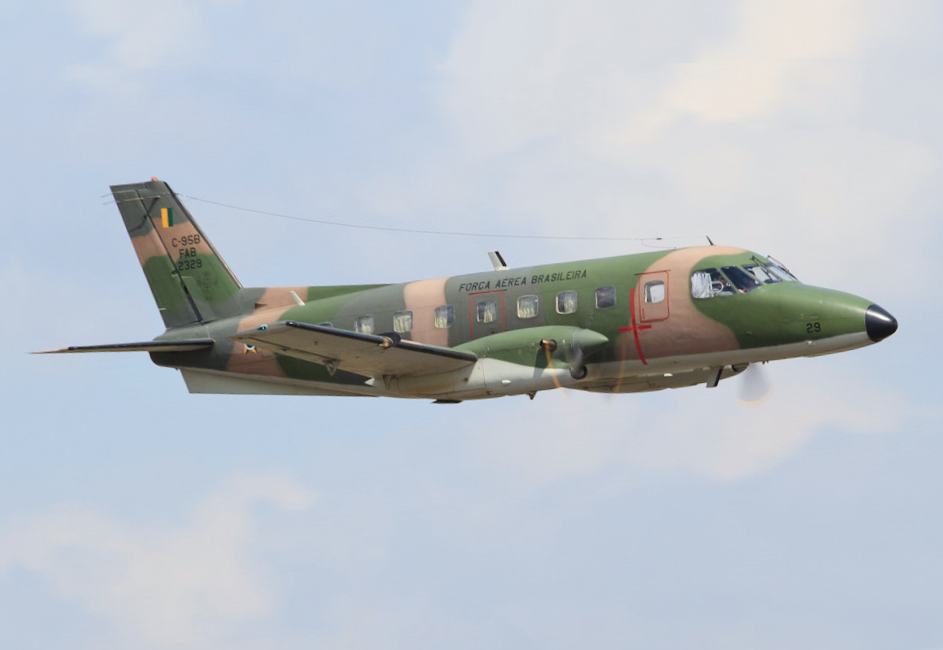
The Embraer EMB 110 Bandeirante is a Brazilian twin-turboprop light transport aircraft, designed by Max Holste and built by Embraer for both military and civilian use, that became the company's first major production success and the foundation of its commercial aviation business. Seating between 15 and 21 passengers depending on variant, it was built for rugged, short-field regional operations and went on to serve air forces and regional airlines across the world, making it a familiar and enduring type for pilots flying short-haul commuter routes.
The EMB 110 Bandeirante is a low-wing, twin-turboprop regional airliner and light transport with fixed tricycle landing gear and a circular-section fuselage, designed by Embraer of Brazil for general-purpose military and civilian use. Conceived as a rugged, multi-role aircraft capable of operating from short and unprepared airstrips, it traded aerodynamic refinement for operational resilience and became Embraer's most successful early commercial programme, serving as the foundation for the company's later regional airliners such as the EMB 120 Brasilia.
The origins of the Bandeirante trace back to a 1965 directive from the Brazilian Ministry of Aeronautics calling for a turboprop transport suitable for both civilian and military operations, with low operating costs, a low-mounted wing and capacity for eight personnel; this specification was developed under the IPD-6504 programme. The lead designer was French engineer Max Holste, with construction of the prototype supervised by Ozires Silva, who also played a key role in founding Embraer. The first prototype, designated YC-95 (also referred to as the EMB 100), made its maiden flight on 26 October 1968 from Sao Jose dos Campos Airport, piloted by Jose Mariotto Ferreira with flight engineer Michel Cury, landing after roughly 50 minutes. A total of 110,000 project hours, 12,000 manufacturing drawings and 22,000 hours of structural and aerodynamic calculations had gone into the design by that point, alongside an estimated 282,000 hours of manufacturing and tooling. A second EMB 100 prototype flew on 19 October 1969 and a third on 29 June 1970. Embraer was formally established in August 1969 following the positive results of prototype testing, assuming responsibility for production on 2 January 1970. As market conditions shifted, the eight-seat EMB 100 design was reworked into the larger-capacity EMB 110 Bandeirante. In May 1970 the Brazilian Air Force (FAB) placed an initial order for 80 production aircraft. The Bandeirante received its Brazilian airworthiness certificate near the end of 1972, with the first production-standard aircraft flying on 9 August 1972. The first delivery to the FAB took place on 9 February 1973, and commercial service began on 16 April 1973 with the Brazilian carrier Transbrasil. By 1977 the type had secured its first export customer, the French regional carrier Air Littoral. Production continued until 1990, with sources citing figures of approximately 498 to 503 aircraft built across civil, military and special-mission configurations, the final examples being delivered to the Brazilian Air Force. During the 1970s Embraer developed the larger, pressurised EMB 120 Brasilia, capable of carrying up to 30 passengers, and chose to focus its resources on that programme, bringing Bandeirante production to a close in 1990. Over one hundred examples continued to serve with the Brazilian Air Force, with numerous aircraft modernised in the twenty-first century, including an upgraded example designated C/P-95 fitted with modern Aeroeletronica avionics and first flown on 15 December 2010.
The Bandeirante is a low-wing monoplane of conventional construction with fixed tricycle landing gear, powered by two Pratt & Whitney Canada PT6A-34 turboprop engines rated at 750 shp (560 kW) each, driving three-blade, fully feathering, reversible-pitch, constant-speed Hartzell propellers of 2.36 metre diameter. The airframe has an exterior length of 15.10 m (49 ft 6 in to 50 ft 4 in depending on variant), a wingspan of 15.33 m (50 ft 3 in to 50 ft 4 in), a tail height of 4.92 m (16 ft 2 in), a fuselage diameter of 1.90 m (6 ft 3 in) and a wing area of 29.1 sq m (313 sq ft). The wheelbase measures 4.68 m. The cabin is 9.50 m long, 1.60 m wide and 1.60 m high, typically configured for 18 passengers three-abreast, with maximum seating for up to 21 at 74 cm (29 in) pitch, flown by a crew of two. Weights vary by variant: the EMB-110P had an empty equipped weight of 3,515 kg (7,751 lb) and a maximum takeoff weight of 5,700 kg (12,500 lb), while the EMB-110P2A/41 had an operating empty weight of 3,590 kg (7,915 lb) and a maximum takeoff weight of 5,900 kg (13,010 lb). Maximum landing weight is quoted at 5,700 kg (12,600 lb), maximum payload at around 1,550 to 1,560 kg (3,450 lb), and fuel capacity at 450 US gallons (1,700 litres).
Performance figures vary by variant. For the EMB-110P, maximum speed was 460 km/h (248 kt), maximum cruising speed 417 km/h (225 kt), and economical cruising speed 326 km/h (176 kt), with an initial rate of climb of 1,788 ft/min and a service ceiling of 22,500 ft; range at long-range cruise with reserves was 2,000 km (1,080 nm). The EMB-110P2A/41 had a maximum cruising speed of 413 km/h (222 kt), economical cruising speed of 341 km/h (184 kt), and a range with maximum fuel of 1,964 km (1,060 nm). Other published figures give a maximum cruise speed of 248 kt (459 km/h), an approach speed of 100 kt (185 km/h), a service ceiling of 21,490 ft, a rate of climb of 1,640 ft/min, and takeoff and landing distances of 460 m and 530 m respectively. The type was built to operate reliably from short and unprepared airstrips, reflecting its origins as a rugged general-purpose transport for Brazil's interior.
The initial production variant was the military transport EMB 110, followed by the EMB 110A radio calibration aircraft and EC-95B calibration variant, both for the FAB. The EMB 110B was an aerial photography/survey variant, and the EMB 111A Patrulha a maritime patrol version for the FAB. The EMB 110C was the first commercial model, seating 15, with the EMB 110C(N) as a navalised derivative. The EMB 110E was a seven-seat executive transport, with the EMB 110E(J) a modified version. The EMB 110K was a stretched variant, and the EMB 110K1 a cargo transport with a rear fuselage cargo door. The EMB 110P was an enlarged 18-seat commuter derived from the EMB 110C, superseded from 1983 by the EMB 110PA, which introduced dihedral to the tailplane among other minor improvements. The EMB 110P1, based on the EMB 110K1, was a quick-change civil cargo/passenger transport with a larger cargo door, while the EMB 110P2 was a civil passenger variant without the cargo door, offering commuter seating for up to 21. The EMB 110P1K and EMB 110K were SAR and military equivalents of the P1A. The EMB 110P1A/41 and EMB 110P2A/41 were versions of the P1A and P2A recertificated to US FAA SFAR41 standards with higher operating weights. Military designations for the FAB included the C-95B, a quick-change cargo/passenger variant, and the C-95C, the FAB equivalent of the EMB 110P2.
The Bandeirante entered military service with the Brazilian Air Force on 9 February 1973 and commercial service with Transbrasil on 16 April 1973. Over one hundred examples served with the Brazilian Air Force, which modernised numerous aircraft in the twenty-first century to extend their service life, including an upgraded variant designated C/P-95 fitted with new Aeroeletronica avionics. In the civil sector the type proved popular with regional and commuter operators worldwide, including operators such as Wiggins Airways, Transportes Aereos Guatemaltecos and Air Rarotonga, and by 1977 had secured its first export customer in the French regional carrier Air Littoral. Its versatility allowed it to be adapted for specialist military and government roles including aerial observation, maritime patrol and search and rescue. The type's reliability and favourable operating economics kept it in demand long after production ended, with a substantial number of aircraft remaining in airline and government service for many years afterward.
The Bandeirante is represented in Microsoft Flight Simulator by third-party developer NextGen Simulations, whose model covers three variants: the EMB-110P, EMB-110P1 and the EMB-110P1K freighter derivative of the P1. The product is built with modern development standards, featuring PBR textures, native rain effects and detailed windshield and airframe weathering effects, alongside a detailed virtual cockpit and cabin, custom-coded door and window animations, and interactive in-sim checklists, with twelve liveries spanning various historical and current Bandeirante operators. As a STOL-capable twin-turboprop with a simple, traditional cockpit layout, it offers simulator pilots a classic regional airliner experience suited to short-field commuter flying, reflecting the type's real-world role connecting smaller communities on short-to-medium stage lengths.