Departure
94%
vs 95% ▼ 1
 MY FS FLIGHTS
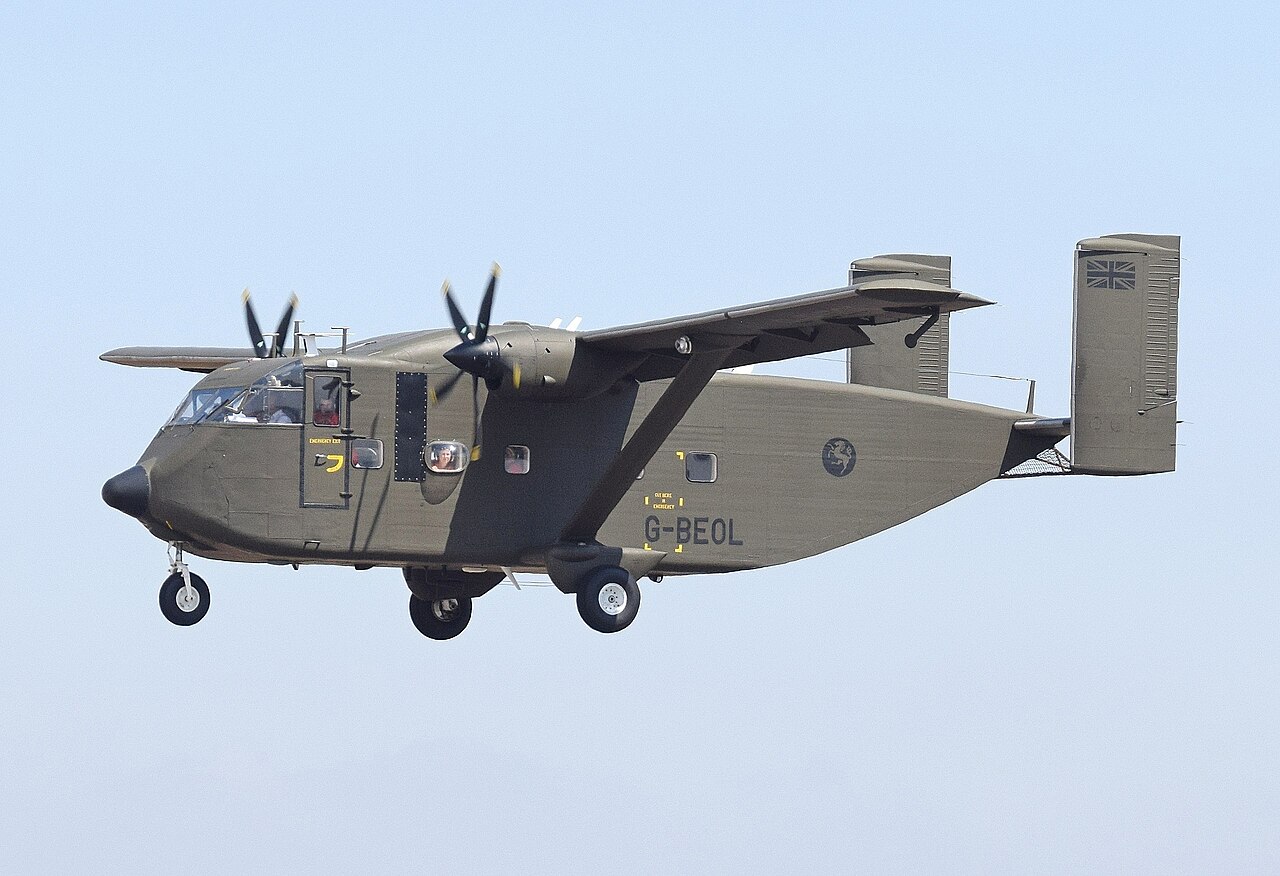
The Short SC.7 Skyvan is a British 19-seat twin-turboprop utility aircraft designed and built by Short Brothers of Belfast, Northern Ireland, first flown in 1963. Nicknamed the "Flying Shoebox" for its boxy, high-wing airframe and enormous rear cargo door, it was built for rugged short-field freight and troop work rather than speed or comfort, and it went on to father the larger Short 330, Short 360 and C-23 Sherpa. For a simmer it offers a genuinely different kind of flying: a slow, stable, unpressurised load-hauler that rewards careful STOL technique into rough or improvised strips.
The Skyvan is a twin-engined, all-metal, high-wing monoplane with a braced, high aspect ratio wing and an unpressurised, square-section fuselage carried on twin fins and rudders. Designed by Short Brothers of Belfast as a utility transport, its boxcar-shaped fuselage and large rear loading door made it especially attractive to freight operators, and it went on to be used by airlines, air forces and, in later life, skydiving operations around the world. It sits at the root of a small family of Short Brothers designs, having been developed into the larger Short 330 and Short 360 regional airliners and, ultimately, the military C-23 Sherpa.
The origins of the Skyvan lie in 1958, when F.G. Miles Ltd approached Short seeking backing for a development of the Hurel-Dubois-influenced Miles HDM.106 Caravan, a design with a high aspect ratio wing similar to the Hurel-Dubois HD.31. Short acquired the design and the data gathered from trials of the Miles Aerovan-based HDM.105 prototype, but after evaluating the Caravan proposal it was rejected in favour of an original Short design for a utility all-metal aircraft, designated the SC.7 Skyvan. Construction began at Sydenham Airport in 1960, and the first prototype made its maiden flight on 17 January 1963 powered by two Continental piston engines. Later that year the prototype was re-engined with Turbomeca Astazou II turboprops of 520 shp (390 kW). The second prototype, the first Series 2 aircraft, initially carried Turbomeca Astazou X engines of 666 shp (497 kW), before the initial production version settled on the Turbomeca Astazou XII of 690 shp (510 kW). In 1967 the Astazou XII was found to be temperature limited at high altitude, and in 1968 production switched to the Skyvan Series 3, which replaced the Astazou with the Garrett AiResearch TPE331 turboprop of 715 shp (533 kW). A total of 149 Skyvans, including the two prototypes, were built before production ended in 1986.
The Skyvan is of all-metal construction, with a strut-braced, high aspect ratio wing mounted high on an unpressurised, square-section fuselage that deliberately echoes the shape of a railroad boxcar for simplicity and efficient use of internal volume. Twin fins and rudders sit at the tips of the tailplane, and fixed tricycle landing gear is fitted for operation from rough or improvised airfields. The large rear cargo door and integrated ramp allow fast loading and unloading of freight, paratroops or bulky equipment. Production Series 3 aircraft were powered by two Garrett AiResearch TPE331-2-201A turboprops, each rated at 715 shp (533 kW) and driving Hartzell three-blade variable-pitch propellers. Typical dimensions are an overall length of 40 ft 1 in (12.21 m), a tail height of 15 ft 1 in (4.60 m) and a wingspan of 64 ft 11 in (19.79 m); the fuselage is 5 ft 7 in (1.70 m) wide, with a cabin measuring 29 ft 2 in (8.90 m) long, 4 ft 11 in (1.50 m) wide and 5 ft 11 in (1.80 m) high. The aircraft seats up to 19 passengers, or can carry cargo payloads quoted at around 5,150 to 5,157 lb (2,350 kg). Maximum take-off and landing weight is given as 12,500 lb (5,650 kg), and fuel capacity is 290 US gal (1,100 litres, about 900 kg of Jet A).
The Skyvan is a modest performer in terms of raw speed but a capable one in terms of short-field ability. Maximum cruise speed is quoted at 150 kt (173 mph, 278 km/h), with a top speed around 201 mph and a stall speed of about 69 mph. Approach speed is given as 60 kt (69 mph, 111 km/h). Range figures vary with configuration, with one source quoting 602 nm (690 mi, 1,110 km) and another 693 miles. Service ceiling is quoted at either 20,000 ft or 22,500 ft depending on source, and the aircraft climbs at around 1,640 ft/min (8 m/s). Take-off distance is around 1,580 to 1,581 ft (480 m), with a landing distance of about 1,860 ft (570 m), figures that underline the type's STOL credentials and its ability to operate from grass, gravel and improvised strips using its rugged, fixed tricycle gear.
The original Skyvan 1 prototype was powered by two Continental GTSIO-520 piston engines; a single example was built before it was re-engined as the Skyvan 1A with Turbomeca Astazou II turboprops. The Turbomeca Astazou-powered Skyvan 2 production version followed, with eight examples built including the second prototype. The bulk of production was the Garrett TPE331-powered Skyvan 3, of which 140 were produced across all Series 3 versions, with two Series 2 airframes also converted to Series 3 standard. The Skyvan 3A was a higher gross weight version with a maximum take-off weight of 6,214 kg (13,700 lb). Military transport versions were built as the Skyvan 3M-100, 3M-200 and 3M-400, with the 3M-200 rated at 6,804 kg (15,000 lb) MTOW and the 3M-400 matching the 3A; these military variants were used for supply dropping, assault transport, paratroop dropping, troop transport, cargo transport, casualty evacuation and search and rescue. A deluxe all-passenger derivative, the Skyliner 3A-100, removed the large cargo door in favour of a standard-size side door. A single maritime patrol conversion, the Seavan, was produced for the Sultan of Oman's Air Force/Royal Air Force of Oman from a basic 3M-400 airframe.
Skyvans served widely with both civilian and military operators, remaining in service as late as 2009 with a number of civil operators and militarily in Guyana and Oman. Civil operators over the decades included BEA/British Airways Scottish Division, Busy Bee/Air Executive Norway, Gulf Aviation/Gulf Air, Loganair, Olympic Airways, Papuan Airlines, Wien Consolidated of Alaska and Oman Aviation/Oman Air, several of which operated small fleets of three to six aircraft on regional and freight routes. In 1970 Questor Surveys of Toronto converted the first of two Skyvan 3s for aerial geological survey work, and the Collier Mosquito Control District has used Skyvans for aerial spraying. NASA operated a single Skyvan at the Wallops Island Flight Facility between 1979 and 1995 to recover parachute-borne payloads ejected from high-altitude balloons and sounding rockets. Militarily the type was used by nearly two dozen nations for logistical support, and two examples flown by the Argentine Naval Prefecture saw action in the 1982 Falklands War, both being lost by the end of the conflict. In more recent decades surviving Skyvans have gravitated towards short-haul freight and, especially, skydiving operations, valued for their large stable cabin and rear ramp.
The Skyvan was recreated for Microsoft Flight Simulator as Local Legend 16, released with sixteen liveries spanning airliner, military, skydive and survey schemes. It is presented as a tough, multi-role machine suited to landing on remote beaches, taking off from mountainsides in Alaska or Borneo, or exploring desert airstrips, reflecting its real-world reputation for operating into short, austere strips on grass, gravel or improvised surfaces. Crewed by one or two pilots, it can carry up to 19 passengers or around 5,157 lb of cargo, and its high aspect ratio wing and twin turboprops give it strong STOL performance, with published figures of a 1,581 ft take-off distance, 1,860 ft landing distance and a 1,640 ft/min climb rate. In the sim it is flown less for outright speed, cruising around 173 mph, than for the character of hauling awkward loads into demanding strips, making it a natural fit for bush-flying and freight-style missions.