Departure
89%
vs 95% ▼ 6
 MY FS FLIGHTS
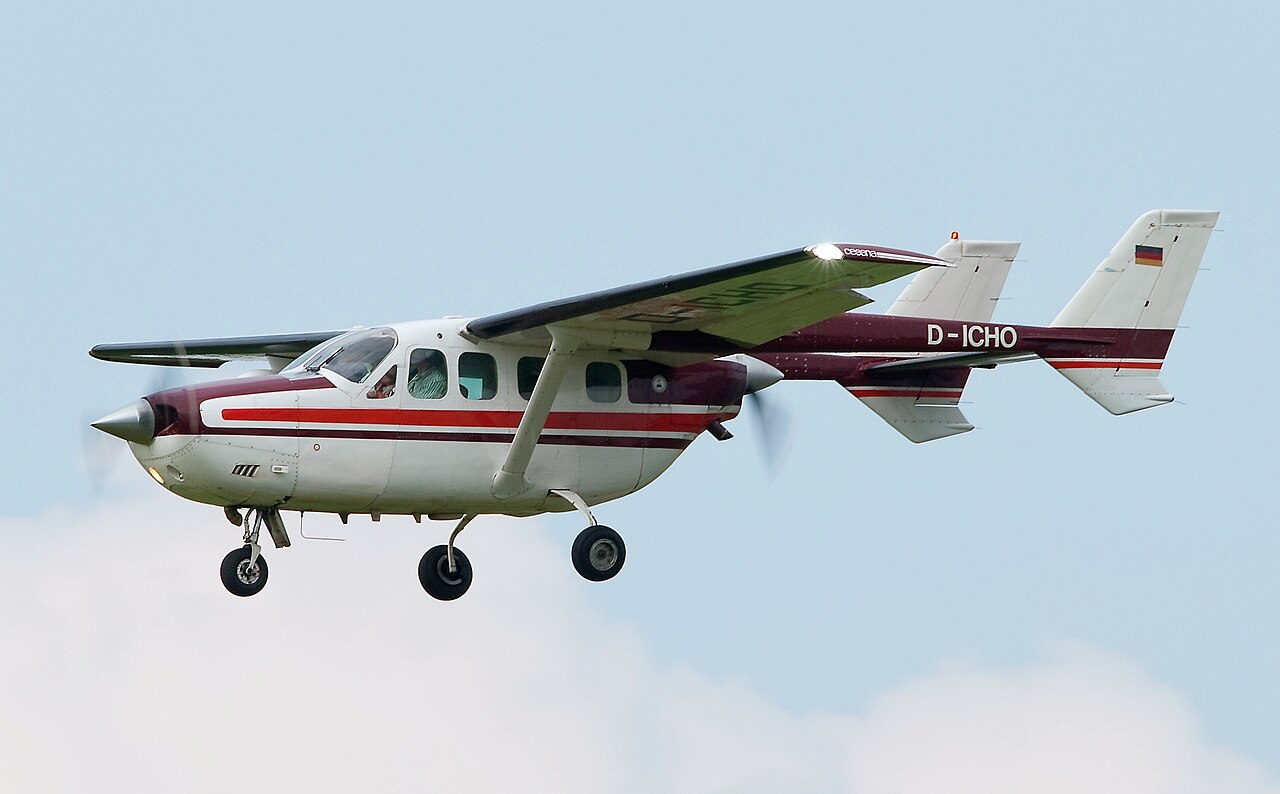
The Cessna Skymaster is an American twin-engine push-pull utility aircraft built by Cessna, with its two engines mounted in the nose and tail of a pod-and-boom fuselage to give centerline thrust rather than the wing-mounted engines of a conventional twin. Produced from 1963 to 1982 in civilian and military (O-2) forms, it became the most commercially successful push-pull design ever built, valued for removing the asymmetric-thrust hazard of engine failure while retaining twin-engine redundancy. Its unusual layout, distinctive sound and forward air control heritage in Vietnam make it a curiosity worth understanding for any simmer exploring unconventional light twins.
The Skymaster is a twin-engine civil utility aircraft manufactured by Cessna, and later under licence by Reims Aviation in France, built in a push-pull configuration with one engine in the nose and one in the tail of a pod-style fuselage. Twin booms run aft from the wings to the vertical stabilizers, with the horizontal stabilizer mounted between them aft of the rear pusher propeller. The arrangement gives centerline thrust, meaning the aircraft does not suffer the adverse yaw of a conventional twin if one engine fails. A high-wing layout was chosen partly to give clear observation below and behind the aircraft, a feature exploited to the full in the military O-2 forward air control variant.
The first Skymaster, the Model 336, flew on 28 February 1961 and entered production in May 1963, with 195 built through mid-1964. In February 1965 Cessna introduced the larger Model 337 Super Skymaster, with more powerful engines, retractable landing gear similar to that of the Cessna 210 Centurion sitting four inches lower for easier entry and exit, and a dorsal air scoop to improve rear-engine cooling; the
: TheContinental IO-360-A engine. Wait