Departure
96%
vs 95% ▲ 1
 MY FS FLIGHTS
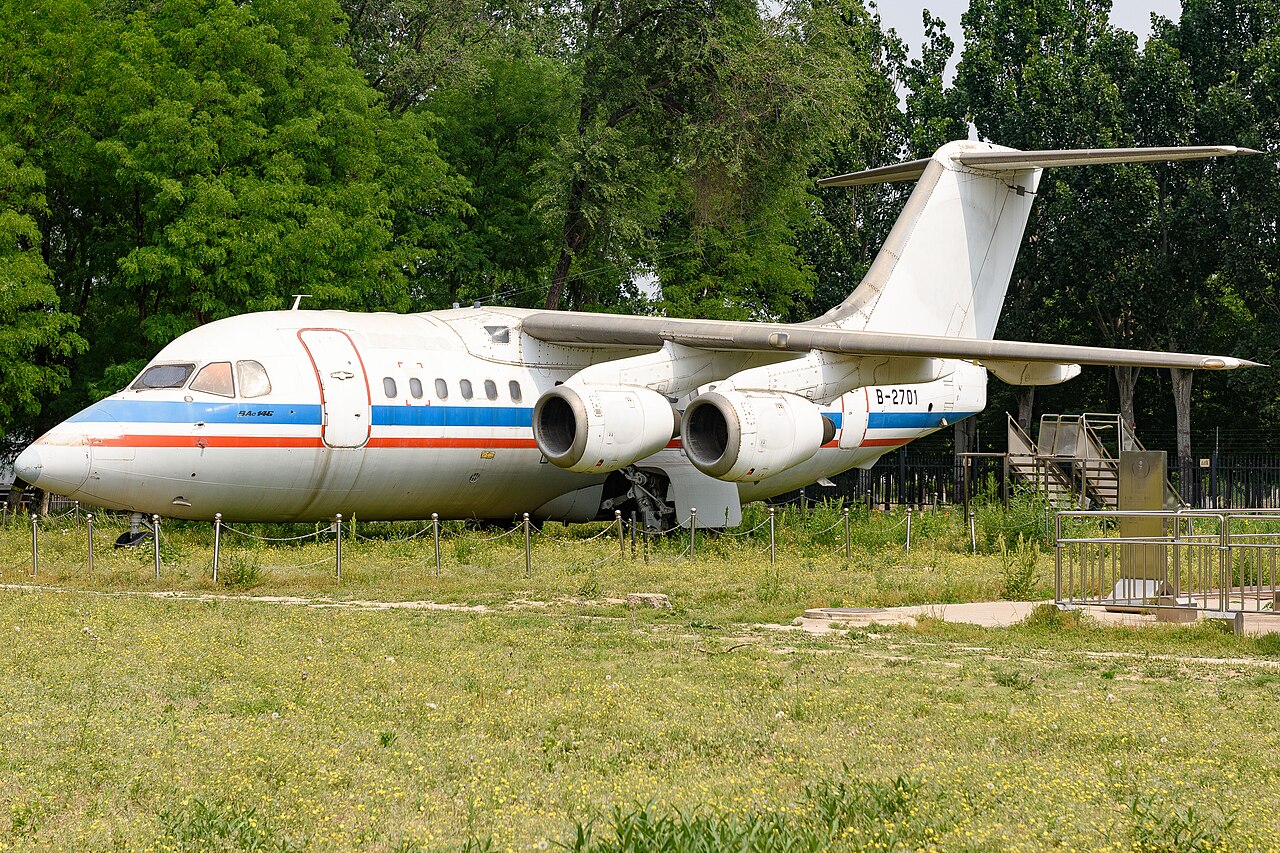
The British Aerospace 146-300 is the largest and longest-fuselage member of the BAe 146 family of short-haul regional jets, a four-engined, high-wing airliner built by British Aerospace and later BAE Systems. Marketed as the "Whisperjet" for its remarkably quiet operation, it was designed to replace turboprop feeder aircraft while offering the ability to use short, poor-grade or noise-restricted airfields such as London City Airport. For a simulator pilot it represents an unusual four-engine regional jet with strong short-field manners rather than sheer speed or range.
The BAe 146-300 is a high-wing, T-tailed regional airliner powered by four wing-mounted turbofan engines, the largest of the three BAe 146 fuselage lengths alongside the -100 and -200. It shares its family's retractable tricycle landing gear and was built to serve the short-haul and regional airliner market, filling the gap between turboprop types such as the Hawker Siddeley HS.748 and Fokker F27 Friendship and small jets like the BAC One-Eleven and Boeing 737. Beyond passenger work, the type has also been produced as the QT "Quiet Trader" freighter and the QC "Quick Change" convertible passenger/freight model, and could be fitted with a gravel kit for operation from rough, unprepared strips.
The BAe 146 family originated with Hawker Siddeley's HS.146 project, launched in August 1973, though the idea of a small feeder jet had circulated on British drawing boards as far back as 1958. The chosen configuration used a high wing and T-tail for good short-field performance, powered by four 6,500 lbf Avco Lycoming ALF 502H turbofans; a four-engine layout was preferred over a twin for its exceptional three-engine performance in the event of a single engine failure, an advantage British Aerospace believed would appeal to operators in mountainous regions or from high, hot or poor-grade airfields. The programme received UK government backing covering 50 per cent of development costs in exchange for a share of revenue from sales, but was halted in October 1974 amid the downturn following the 1973 oil crisis. Low-key work continued, and British Aerospace relaunched the project in 1978, marketing it as a quiet, fuel-efficient turbofan replacement for ageing turboprop feeder aircraft. The first order came from Lineas Aereas Privadas Argentinas in June 1981, and the prototype made its first flight on 3 September 1981 from the large new assembly line at Hatfield, followed quickly by two further prototypes. Contrary to British Aerospace's pre-launch forecast that the smaller -100 would outsell the -200, airline interest favoured the larger variant. By 1981 the -200's unit cost stood at 11 million pounds against a total programme cost of 350 million pounds, and initial flight testing showed better-than-predicted takeoff and climb performance. In 1982 British Aerospace stated that 250 aircraft needed to be sold for the programme to break even, and the type received its Certificate of Airworthiness on 8 February 1983, entering service that May billed as the world's quietest jetliner. British Aerospace announced its initial proposals for the stretched -300 variant at the 1984 Farnborough Air Show as a further development of the -200. Production of the wider BAe 146/Avro RJ family, including the -300, continued alongside the improved Avro RJ series from 1992, and the equivalent RJ100 became the -300's re-engined successor.
The 146-300 retains the family's high-wing cantilever monoplane layout with T-tail, four turbofan engines carried on underwing pylons, and retractable tricycle landing gear. Early BAe 146 aircraft used the Avco Lycoming ALF 502H turbofan, while the improved Avro RJ derivatives switched to the more efficient LF 507 engine; the RJ series also introduced an EFIS glass cockpit from 1993. Production of the airframe was spread across several British Aerospace sites, with the rear fuselage built at Chadderton, the centre fuselage at Filton, the vertical stabiliser at Brough, engine pylons at Prestwick, and the nose section, along with early final assembly, at Hatfield; later Avro RJ family assembly moved to Woodford Aerodrome in Greater Manchester. Quiet operation was a deliberate design goal, driving both engine choice and overall configuration, and the type could be fitted with a gravel kit for use from unprepared airstrips.
The high-wing, T-tailed configuration was chosen specifically to deliver good short-field performance, and initial flight testing of the family showed better-than-predicted takeoff and climb performance. The four-engine layout was valued for giving exceptional three-engine performance in the event of an engine failure, a characteristic British Aerospace promoted as particularly useful for operators flying from high, hot or poor-grade airfields and mountainous regions. The aircraft's defining handling characteristic in service is its exceptionally quiet operation, which earned it the nickname Whisperjet and allowed it to be marketed as the world's quietest jetliner at its 1983 introduction.
The BAe 146 family comprised the -100, -200 and -300 fuselage lengths, with the -300 being the longest and largest of the three; British Aerospace announced its initial proposals for the -300 at the 1984 Farnborough Air Show as a stretch of the -200. These correspond to the later, re-engined Avro RJ70, RJ85 and RJ100 respectively, with the RJ85 introducing an improved cabin and LF 507 engines and entering deliveries in April 1993, seating up to 112 passengers; the RJ100 represented the equivalent development of the -300 airframe. Freight-carrying aircraft were designated QT (Quiet Trader) and convertible passenger-or-freight aircraft QC (Quick Change), and a gravel kit could be fitted for rough-field operations. A further-improved Avro RJX, announced in 1997 with new engines, saw only two prototypes and one production aircraft built before all production ceased in 2001.
The quiet operation of the BAe 146 family, including the -300, made it well suited to small, city-based airports with strict noise limits, such as London City Airport, and it has been used widely as a regional jet and short-haul airliner as well as, in some cases, a private jet. Freighter examples in QT configuration extended the type's use into cargo operations. Across the whole BAe 146/Avro RJ programme, 394 aircraft were built in total, comprising 221 BAe 146s, 170 Avro RJs and 3 Avro RJXs, making it the most successful British civil jet airliner programme by production numbers.
For a simulator pilot, the 146-300's appeal lies in its unusual four-engine regional jet layout combined with genuine short-field capability, a rarity among airliners of comparable size. The high-wing, T-tailed design and the emphasis placed on strong three-engine performance in the event of an engine failure suggest an aircraft with reassuring multi-engine redundancy and benign low-speed handling, while its renowned quietness and history of operating into noise-sensitive, tightly constrained airports such as London City point to approach and short-runway work as a defining part of flying the type.