Departure
69%
vs 95% ▼ 26
 MY FS FLIGHTS
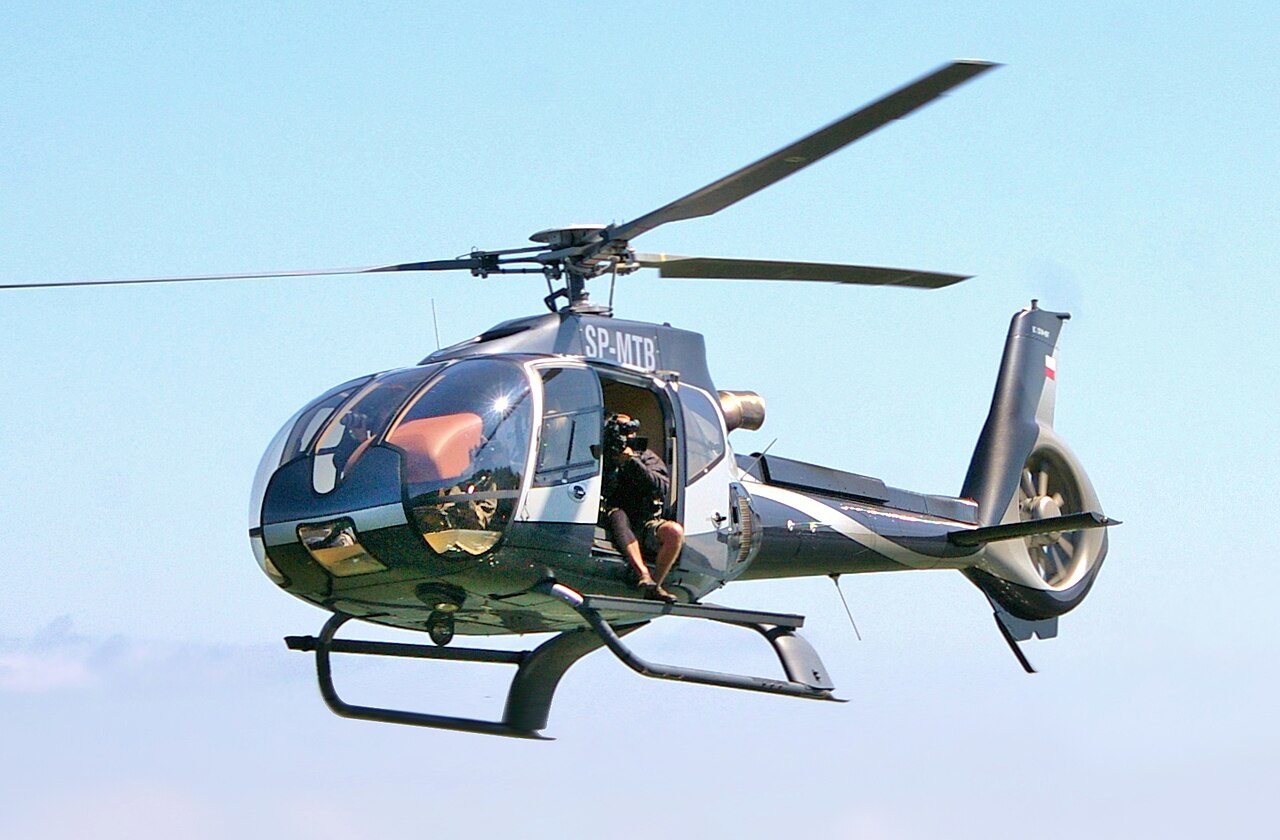
The Airbus H130, originally launched as the Eurocopter EC130, is a single-engine light utility helicopter developed from the AS350 Ecureuil, distinguished chiefly by its enclosed Fenestron tail rotor in place of a conventional tail rotor. Built by Airbus Helicopters (formerly Eurocopter), it is widely used for aerial sightseeing, passenger and VIP transport, air medical work and surveillance, and is popular with tour operators for its spacious, quiet cabin. For a simulator pilot it offers a modern, glass-cockpit single-engine type with a distinctive fan-in-fin tail rotor and a strong presence in the aerial-tour and EMS markets.
The H130 is a single-engine light utility helicopter produced by Airbus Helicopters, having originally been marketed as the Eurocopter EC130. It was developed from the earlier Eurocopter AS350 Ecureuil, with the primary distinguishing feature being the adoption of an enclosed Fenestron anti-torque device in place of the AS350's conventional tail rotor. The type occupies a multi-role niche within the light helicopter market, serving as a passenger and VIP transport, an aerial sightseeing platform, a medical evacuation aircraft and a surveillance tool, and it is particularly associated with high-volume tour operations such as those over the Grand Canyon and Hawaii.
Interest within French manufacturer Aerospatiale in further developing the AS350 series dated back to the early 1970s origins of that family. On 6 February 1987 a modified AS350, designated AS350 Z, flew for the first time fitted with a Fenestron tail rotor in place of the conventional unit, a test programme that ran across several years and included a new air intake based on that of the Eurocopter EC120; this programme underpinned the later Fenestron development. Following Aerospatiale's merger into the multinational Eurocopter organisation, development of the new rotorcraft continued into the 1990s, and the first prototype EC130 made its first flight on 24 June 1999, flown from a French airfield by Australian test pilot Steven Page. Compared with the AS350, the EC130 introduced a dual-hydraulic system, the enclosed Fenestron anti-torque device, and a wider main body giving considerably greater cabin space. The type was designed in close cooperation with tour operators, with Blue Hawaiian Helicopters serving as launch operator, and it entered service in 2001 flying scenic tours over Hawaii and the Grand Canyon. Unlike the AS350, which continued in production for utility roles, the EC130 was aimed principally at commercial passenger transport operators. In February 2012 Eurocopter unveiled the EC130 T2, an upgraded variant fitted with the more powerful Turbomeca Arriel 2D turboshaft; more than 70 percent of the T2's airframe differed from the original EC130, and the update brought an active vibration control system, improved air conditioning and a claimed 14 percent reduction in fuel consumption. That year Eurocopter received an order for 50 EC130 T2s from Maverick Helicopters, with further orders from operators including Papillon and Blue Hawaiian bringing the total on order to 105; the T2 entered service in 2012. Production was reported at 50 T2s in 2013, expected to rise to 65 per year in 2014, and Airbus Helicopters' Brazilian subsidiary Helibras assembled its first EC130 T2 in August 2013, followed by the first Australian-assembled example in December 2013. The type was rebranded as the H130 in 2014. By 2015 the H130/EC130 family was in service with 279 operators and had accumulated more than 1,177,000 flight hours worldwide, with more than 1,000 examples built. In February 2016 Indonesian developer Jababeka signed a memorandum of understanding for up to 12 H130s for a proposed intercity shuttle service between Jakarta and Cikarang. In 2021 Airbus trialled a hybrid electric assist system on an H130 intended to extend the reaction time available before entering autorotation following an engine failure to up to 30 seconds. On 9 April 2025 Airbus signed a contract with Mahindra Aerostructures under which the Indian firm will produce the main fuselage assembly of the H130, with the first fuselage due for delivery to Airbus Helicopters' European facilities in March 2027.
The H130 is a single-engine helicopter fitted with a three-bladed Starflex main rotor matched to an enclosed tail fan anti-torque device, the Fenestron, which replaces the conventional tail rotor of the earlier AS350. The Fenestron's unevenly spaced blades cut noise generation by 50 percent compared with a conventional tail rotor, giving an FAA Appendix H fly-over noise signature of 84.3 EPNdB, 8.5 dB below stage two limits. Power comes from a single Safran Helicopter Engines (formerly Turbomeca) Arriel 2D turboshaft producing 952 shaft horsepower; on the EC130 T2 this engine is fitted with Full Authority Digital Engine Control, and the aircraft also carries a dual hydraulic system derived from the Eurocopter AS355. The cabin, widened relative to the AS350, offers a volume of 130.7 cubic feet and can seat up to seven passengers with either one or two pilots, the pilot normally occupying the left-hand seat in single-pilot operations. Standard equipment includes flight data recorders, crash-worthy seats and redundant flight systems, with the T2 adding further safety features. The cockpit instrumentation has been described as straightforward, and piloting aids such as the Vehicle and Engine Multifunction Display are intended to reduce pilot workload; tactical instrumentation and equipment consoles can be fitted according to role. Maximum take-off weight with an external load is 6,724 lb, while maximum take-off weight and useful load with standard internal fuel are 4,512 lb and 2,306 lb respectively, with a standard fuel tank capacity of 937 lb.
The H130 has a maximum operating altitude of 23,000 feet and a cruise speed of 128 knots, with a sea-level range of 327 nautical miles on full standard fuel tanks. The Arriel 2D powerplant has been credited with giving the type better power margins and range than competing models, particularly in hot and high conditions. Control response has been described as tight and pleasant, complementing cockpit instrumentation characterised as straightforward.
The base production version is known as the EC130 B4. The EC130 T2, unveiled in February 2012, introduced the more powerful Arriel 2D engine with FADEC, an active vibration control system, improved air conditioning and reduced fuel consumption, with more than 70 percent of its airframe differing from the original EC130; this variant was later marketed as the H130 T2 following the 2014 rebranding. Operators such as Papillon market their aircraft under the name H130 ECO-Star, a configuration built around stadium-style forward-facing seating and 180-degree wraparound windows for sightseeing and photography work, with climate control and headset communication between pilot and passengers.
Blue Hawaiian Helicopters was the launch operator, introducing the EC130 into scenic tour service over Hawaii and the Grand Canyon from 2001, and the type has since become closely associated with high-volume aerial tour operations. Papillon Helicopters operates the H130 ECO-Star for sightseeing and photography flights over the Grand Canyon, flying from bases in Las Vegas, Boulder City, Grand Canyon National Park, Grand Canyon West and Page, Arizona, with the design specifically intended to reduce noise over the natural environment. The type has also become a significant platform in air medical service, having been described as one of the most highly successful single-engine helicopters in that role. Maverick Helicopters was among the major early customers for the EC130 T2, ordering 50 examples in 2012. In a business aviation context the H130 serves as a passenger and VIP transport, a medical evacuation platform and a surveillance tool. In February 2016 Indonesian developer Jababeka signed a memorandum of understanding for up to 12 H130s intended for an intercity shuttle service between Jakarta and Cikarang.
For a simulator pilot the H130 represents a modern, glass-cockpit single-engine helicopter whose defining handling characteristic is the absence of a conventional tail rotor, replaced by the enclosed Fenestron, which pilots have described as giving tight and pleasant control response. Cockpit instrumentation has been characterised as straightforward, with the Vehicle and Engine Multifunction Display intended to ease workload during single-pilot operation from the left-hand seat. Its widespread real-world use in aerial touring and air ambulance work makes it a natural type for scenic-flight and EMS-style simulator operations, where its quiet Fenestron and spacious cabin are notable features to represent.