Departure
90%
vs 95% ▼ 6
 MY FS FLIGHTS
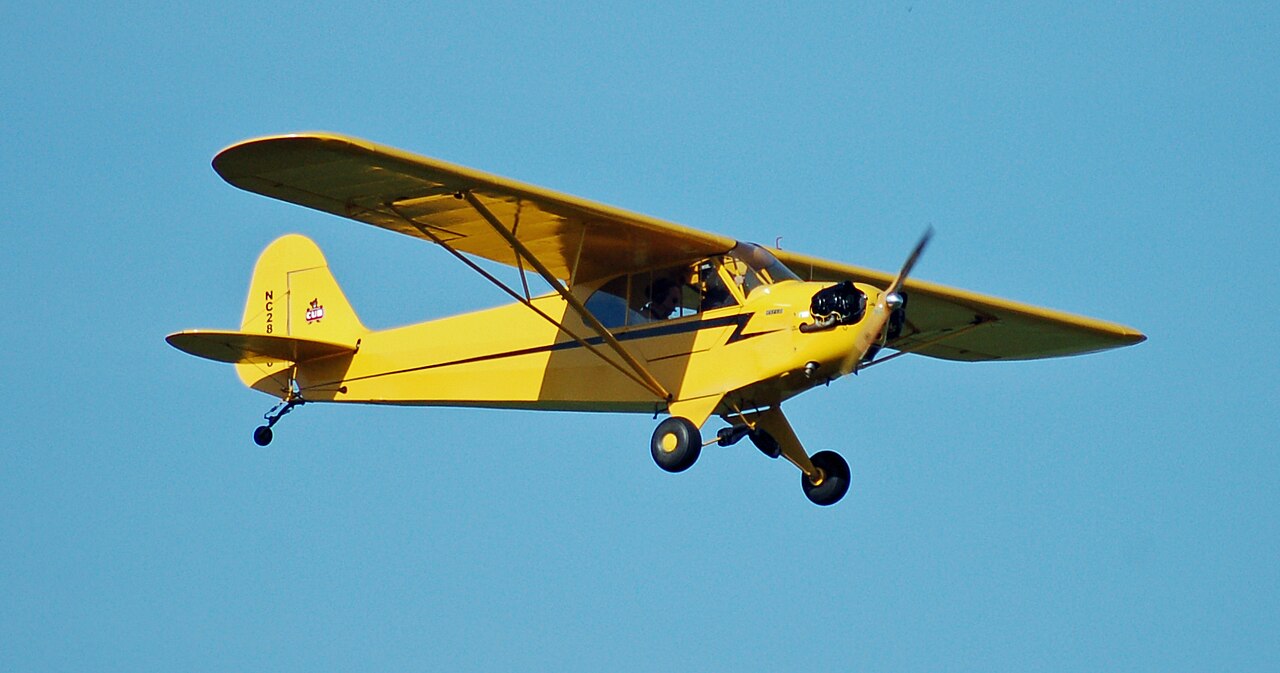
The Piper J-3 Cub is an American light aircraft built by Piper Aircraft between 1938 and 1947, a simple, fabric-covered, tandem two-seat high-wing monoplane that became the definitive trainer of its era. Cheap, forgiving and easy to fly, it trained the vast majority of pilots under the wartime Civilian Pilot Training Program and went on to serve as the militarised L-4 Grasshopper, making it one of the most recognisable and best-loved light aircraft in aviation history.
The J-3 Cub is a high-wing, strut-braced monoplane of simple, lightweight construction, built by Piper Aircraft as a trainer and general aviation aircraft. It seats two people in tandem beneath a large-area rectangular wing, with a welded steel tube fuselage covered in fabric, and is most often powered by an air-cooled flat-four piston engine driving a fixed-pitch propeller. It is Piper's second most-produced model after the PA-28 Cherokee series, with over 20,000 built in the United States, and its simplicity, affordability and popularity have drawn comparisons with the Ford Model T. Finished in its familiar chrome yellow paint, known as "Cub Yellow" or "Lock Haven Yellow", the J-3 remains an icon of general aviation and is still flown and highly prized today, particularly as a bush aircraft.
The Cub lineage began with the Taylor E-2, first tested in 1930 by the Taylor Aircraft Company of Bradford, Pennsylvania, sponsored by industrialist William T. Piper. The E-2 was originally fitted with a two-cylinder Brownbach "Tiger Kitten" engine, which gave the type its name after Taylor's accountant remarked that an aircraft with a kitten engine should be called a Cub. Taylor Aircraft went bankrupt later in 1930, and Piper bought the company's assets for $761, retaining Gilbert Taylor as president. In 1935 Piper hired designer Walter Jamouneau to refine the aircraft, and in 1936, while Taylor was on sick leave, Jamouneau reworked the design into the J-2, revising the cowling and adding the rounded lines that came to define the Cub shape; Taylor was reportedly furious at the changes and fired Jamouneau, only for Piper to hire him back and later buy out Taylor's remaining share of the company. About 1,200 J-2s were built before a fire at the Bradford factory, a former silk mill, ended production in 1938. Piper then moved the company to another former silk mill in Lock Haven, Pennsylvania, and renamed it the Piper Aircraft Corporation, introducing the J-3 Cub the same year with further Jamouneau refinements: upholstered seating in place of the J-2's plywood seats, a vertical fin integrated into a stronger steel fuselage structure, a curved half-oval rear window, and a steerable tailwheel. The original J-3 was powered by a 40 hp Continental A-40 engine with a 9-gallon fuel capacity and sold for just over $1,000 in 1938. Piper built 736 J-3s in its first year of production. The outbreak of war in Europe in 1939 and the formation of the Civilian Pilot Training Program created enormous demand: production rose from around 1,300 J-3s in 1939 to over 3,016 in 1940, and at its wartime peak a new Cub was completed every 20 minutes, later every 10 minutes as post-war civilian demand surged. Production of the J-3 ran until 1947, by which time Piper had built 19,888 examples in the United States, plus 150 built in Canada and 253 TG-8 glider variants, with Piper then turning its attention to more advanced designs such as the PA-11 Cub Special and the PA-18 Super Cub.
The J-3 Cub is a strut-braced high-wing monoplane with a large-area rectangular wing and a fuselage built as a welded steel tube frame covered in fabric, seating two occupants in tandem. It was most commonly fitted with air-cooled flat-four engines: aircraft with the Continental A series were designated J3C, those with the Franklin 4AC as J3F, and those with the Lycoming O-145 as J3L; a small number, designated J3P, used Lenape Papoose three-cylinder radial engines, and at least one rare example was fitted with a Rolls-Royce 100 hp engine. The original engine was the 40 hp Continental A-40 with a 9-gallon fuel capacity, later superseded by more powerful units offering greater fuel capacity as the type evolved. Early production aircraft had all four engine cylinders exposed to the airflow for cooling, with later models adopting a cowling that fully enclosed the engine. A steerable tailwheel and brakes were added as the design matured. The aircraft's standard bright yellow finish, applied with a bold black lightning streak, became known as "Cub Yellow" or "Lock Haven Yellow" and is inseparable from the type's identity.
The J-3 Cub's simple, lightweight design gives it good low-speed handling qualities and short-field performance, characteristics that made it exceptionally well suited to both civilian training and a range of wartime military roles such as reconnaissance, liaison and ground control. Its combination of a large wing area and low wing loading gives it gentle, forgiving handling at low airspeeds, and it remains regarded as a good introduction to taildragger flying, with plenty of enjoyment to be had despite its modest power.
The J-3 was produced with several engine-driven sub-designations: the J3C with Continental A-series engines, the J3F with the Franklin 4AC, the J3L with the Lycoming O-145, and the rare J3P fitted with Lenape Papoose radial engines. Militarised versions built for the US armed forces during the Second World War were known as the L-4, O-59 and NE-1, collectively nicknamed "Grasshoppers"; 253 examples were built as the TG-8 training glider. Piper also produced 150 Canadian-built examples. Following the J-3, Piper developed the type further into the PA-11 Cub Special, the PA-15 Vagabond, the PA-16 Clipper and, most enduringly, the PA-18 Super Cub, which remained in production into the 1990s and continued afterward under CubCrafters.
Designed as a trainer, the J-3 Cub achieved legendary status as the primary aircraft of the US Civilian Pilot Training Program, in which roughly 75 percent of all new pilots, out of 435,165 graduates, learned to fly in Cubs; by the end of the Second World War, some 80 percent of all United States military pilots had received their initial flight training in Piper Cubs. Before America's entry into the war, J-3s were also used in the Flitfire fund-raising campaign, in which 48 Cubs bearing Royal Air Force insignia, one for each state, were donated to the RAF Benevolent Fund and flown into La Guardia Field in April 1941 as part of a war-bond and charity effort. Once the United States entered the war, the Army purchased 5,677 modified Cubs as the L-4, O-59 and NE-1 Grasshoppers, painted in nondescript olive green and used for reconnaissance, aerial ambulance and supply transport work close to the front lines. Cubs also formed the backbone of the Civil Air Patrol, flying short-range coastal surveillance missions to spot enemy submarines or sailors in distress, and in 1944 a Cub, nicknamed Glimpy, was used in trials at Naval Air Station Lakehurst to test launching light aircraft from airships. After the war, many ex-military Grasshoppers were registered as civilian J-3s, and the type went on to become the standard trainer of choice through the 1940s and 1950s before Piper redirected production toward newer designs. Long afterward, Cubs found continuing favour as bush aircraft thanks to their light weight and short-field capability, and more than 5,000 of the original 19,888 US-built J-3s remain on the FAA registry today.
For a simulator pilot, the J-3 Cub represents stick-and-rudder flying reduced to its essentials: a light, low-powered, tandem two-seat taildragger with a big wing and forgiving low-speed manners that reward smooth, coordinated handling rather than raw performance. Its status as one of the most recognisable light aircraft in history, combined with its simplicity and its long association with training and bush flying, has kept it a popular choice for pilots wanting an approachable, characterful taildragger to master crosswind landings, short-field work and basic airmanship, much as generations of real-world pilots first learned to fly in exactly this aircraft.