Departure
79%
vs 95% ▼ 16
 MY FS FLIGHTS
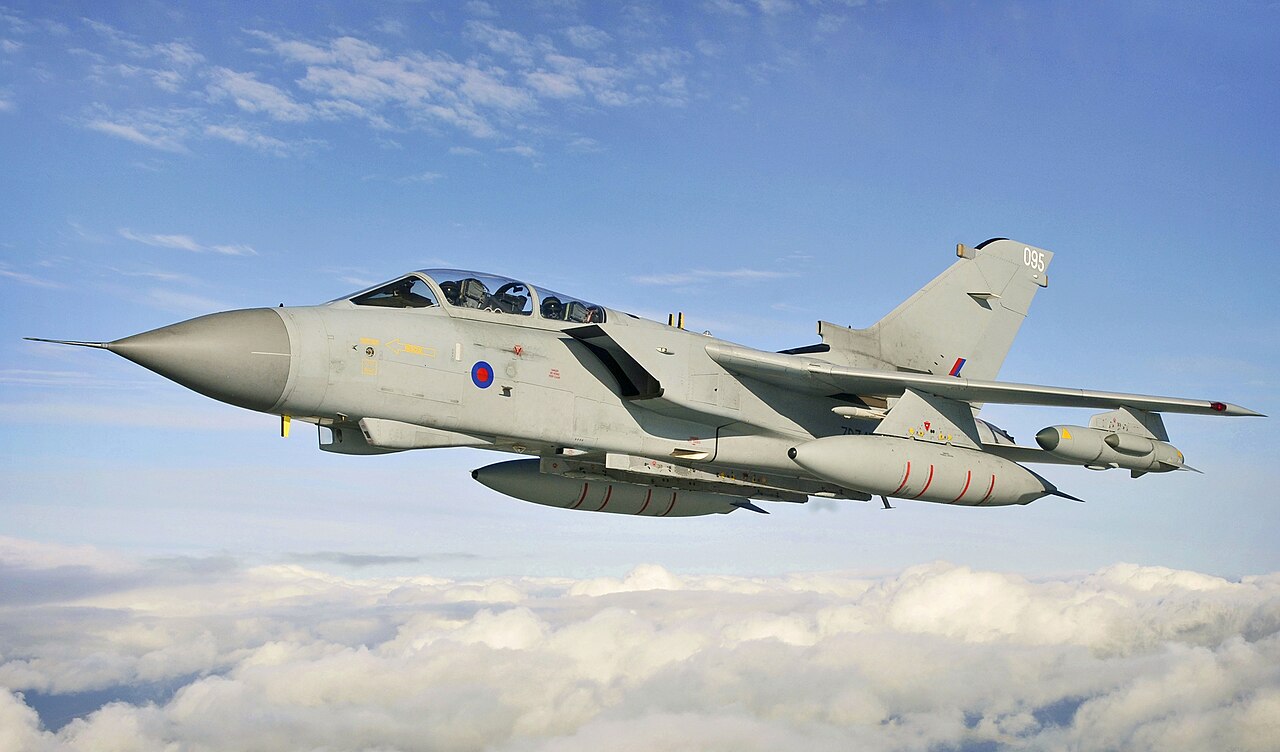
The Panavia Tornado GR.4 was the mid-life update of the RAF's variable-geometry strike aircraft, developed jointly by the United Kingdom, Germany and Italy, and it formed the backbone of British low-level and precision strike operations until its retirement in March 2019. Optimised for both low-level penetration and medium-level precision attack, the GR.4 carried a wide range of guided weapons and reconnaissance sensors, making it one of the most capable strike platforms the RAF has operated.
The Tornado GR.4 was the definitive strike/attack version of the Panavia Tornado, a variable-geometry (swing-wing) combat aircraft built by the multinational Panavia consortium of the United Kingdom, Germany and Italy. It represented a comprehensive mid-life update of the original GR.1 interdictor-strike aircraft, adding new sensors, avionics and weapons while retaining the type's core low-level penetration capability. A parallel reconnaissance-optimised variant, the GR.4A, carried a dedicated pod system for tactical imagery. The Tornado GR.4 served as the mainstay of RAF fast-jet strike operations for over two decades before the type's withdrawal from service.
The Tornado programme began on 26 March 1969, when the United Kingdom, Germany, Italy and the Netherlands formed the multinational Panavia Aircraft GmbH to develop a Multi-Role Combat Aircraft. The Netherlands withdrew from the project in 1970, after which the remaining three nations established Turbo Union to design and build the RB199 engine that would power the aircraft. The first prototype flew from Manching in Germany on 14 August 1974, with the second prototype, XX946, following from BAe Warton on 30 October 1974; in total 19 development aircraft flew, of which two were lost in accidents and one badly damaged. The RAF took delivery of the first of an eventual 228 Tornado GR.Mk1 aircraft on 1 July 1980 at RAF Cottesmore, and No IX(B) Squadron became the first front-line Tornado squadron in the world on 1 June 1982, a role it fulfilled until the squadron's disbandment on 14 March 2019, shortly before the type's retirement from RAF service on 31 March 2019. A second squadron, No 31, followed and was deployed to RAF Germany bases at Laarbruch and Bruggen as Tornados progressively replaced Harrier and Jaguar aircraft in these units. In 1984 the UK Ministry of Defence began studies into a Mid-Life Update of the aircraft to address shortcomings identified in the GR.1 and to improve its capability in the medium-level role while preserving its exceptional low-level penetration performance; this programme produced the Tornado GR.4 standard.
The Tornado GR.4 retained the swing-wing configuration and twin RB199 turbofan installation of the earlier GR.1, but introduced substantially updated systems. Navigation was provided by an integrated Global Positioning Inertial Navigation System together with a Laser Ranger and Marked Target Seeker, which could be used to locate laser-designated targets or to provide accurate range information against ground targets. Internal armament comprised a 27mm Mauser cannon capable of firing 1700 rounds per minute, supplemented by a wide weapons fit that could include up to five Paveway IV smart bombs or two Storm Shadow cruise missiles, along with Dual Mode Seeker Brimstone, the ALARM Mk2 anti-radiation missile, and targeting or reconnaissance pods such as Litening III and the Reconnaissance Airborne Pod Tornado (RAPTOR), all of which could be carried simultaneously in various combinations. Legacy weapons including 1000lb unguided bombs, Paveway II and III laser-guided bombs and the AIM-9L remained in the training and operational inventory. Self-protection was provided by a BOZ-107 chaff and flare dispenser pod on the right wing and a Sky Shadow-2 electronic countermeasures pod on the left, later augmented by integration of the ASRAAM short-range air-to-air missile. The GR.4A reconnaissance variant carried the RAPTOR pod, an advanced sensor able to transmit real-time Long Range Oblique Photography to commanders or display it in the cockpit during a mission. From late 2006 the GR.4 fleet began receiving a new 12.8-inch active-matrix liquid crystal Multi-function display, the BAE Systems Tornado Advanced Radar Display Information System (TARDIS), replacing the earlier circular Combined Radar and Projected Map Display, initially fitted to aircraft of the Fast Jet and Weapons Operational Evaluation Unit before wider fleet rollout. The aircraft was fitted with eight hardpoints for external stores.
The GR.4 upgrade was specifically intended to improve the aircraft's effectiveness in the medium-level role while retaining the Tornado's renowned low-level penetration capability, reflecting the type's core design strength as a fast, stable strike platform able to operate at very low altitude and high speed in poor weather.
The principal RAF strike variant was the Tornado GR.4, the mid-life-updated derivative of the original GR.1 interdictor-strike aircraft. A dedicated reconnaissance version, the GR.4A, was optimised for all-weather, day and night tactical reconnaissance and was equipped with the RAPTOR pod system. During the 1991 Gulf War the RAF also operated the earlier GR.Mk1 alongside the Tornado F.3 interceptor variant, deploying 49 GR.Mk1 and 18 F.3 aircraft.
The Tornado entered front-line RAF service with No IX(B) Squadron from 1 June 1982, the first Tornado squadron to become operational anywhere in the world, and the type subsequently equipped further squadrons including No 31, based at RAF Germany stations Laarbruch and Bruggen, where it replaced Harrier and Jaguar aircraft. The aircraft saw combat in the 1991 Gulf War, when 49 GR.Mk1 and 18 F.3 aircraft were committed to the conflict. Following its mid-life update, the GR.4 carried an expanded and increasingly precision-guided weapons fit, including Paveway IV, Storm Shadow and Brimstone, reflecting a shift toward medium-level precision strike operations. The type remained in front-line service until the RAF ceased all Tornado operations at the end of March 2019, with No IX(B) Squadron, the RAF's first Tornado unit, disbanding on 14 March 2019 shortly before the aircraft's formal retirement on 31 March 2019.