Departure
95%
vs 96% ▼ 2
 MY FS FLIGHTS
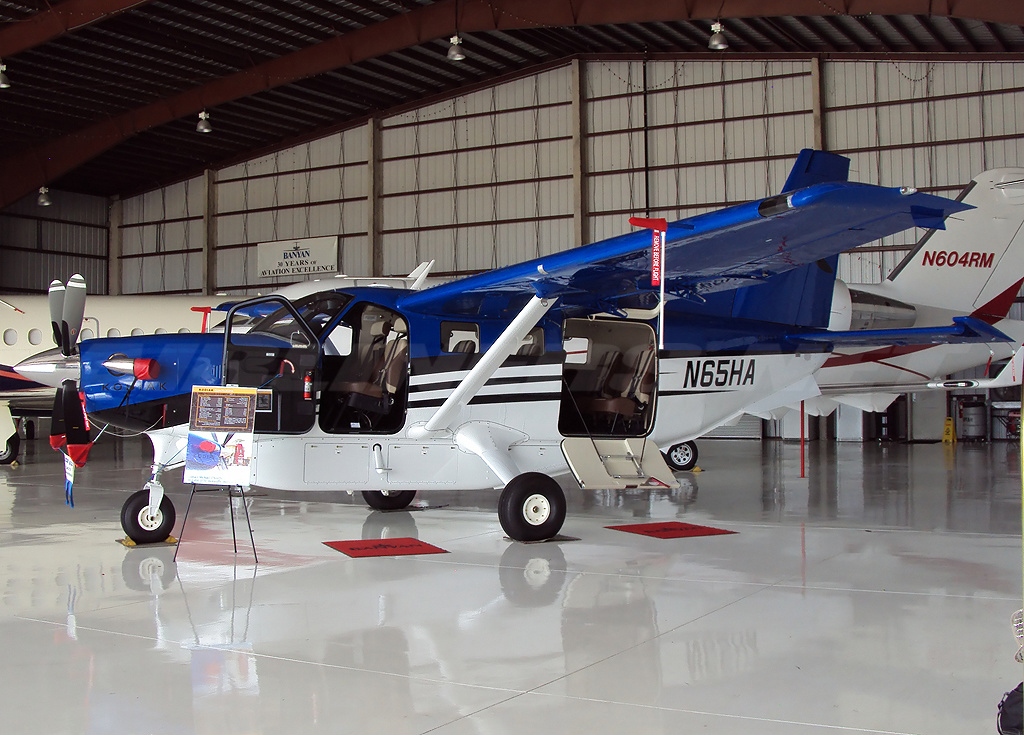
The Daher Kodiak 100, originally designed and built by Quest Aircraft of Sandpoint, Idaho, is a high-wing, single-engine turboprop utility aircraft built for short takeoff and landing operations from unimproved airfields. Powered by a 750 hp Pratt & Whitney Canada PT6A-34, it blends rugged bushplane capability with modern Garmin avionics, making it a popular choice for missionary, cargo and utility flying as well as private and light commercial use. For a simmer it offers a satisfying mix of STOL performance, glass-cockpit systems and floatplane operations in one airframe.
The Kodiak 100 is an American utility turboprop of high-wing, unpressurized configuration with fixed tricycle landing gear, designed for STOL operations from unimproved airfields. It was designed and originally manufactured by Quest Aircraft in Sandpoint, Idaho, with production taken over by the French group Daher in 2019 following its acquisition of Quest Aircraft. The type sits between the de Havilland Beaver and the larger de Havilland Otter or Cessna Caravan in size, offering more power than the older de Havilland types and a shorter takeoff distance than the Caravan.
Engineering design of the Kodiak began in 1999 while the Quest Aircraft company organisation was still being finalised. The aircraft made its maiden flight on October 16, 2004, and was type certified by the US Federal Aviation Administration on 31 May 2007, with first delivery to launch customer Spirit Air in January 2008. In June 2010 Wipaire, Inc. received Supplemental Type Certification to fit Wipline 7000 amphibious floats, and in November of that year the Kodiak was certified for flight into known icing following installation of a TKS glycol-based ice protection system. An executive Summit interior with club seating was introduced in 2014. By September 2013, 100 Kodiaks had been built, with the 100th delivered to US operator Sunstate Aviation. In April 2017 the Kodiak 100 received its EASA type certificate. In May 2018 Quest Aircraft introduced the Series II, priced at $2.15 million, with an improved cargo door step mechanism, wing-root sealing, new crew-door stays, optional single-point refuelling, new paint schemes and a faster Garmin G1000 NXi avionics suite. The 200th aircraft was delivered in December 2016, a record production year of 36 aircraft, prompting a 25 percent expansion of the production facility. The 250th aircraft was delivered in 2018, by which point the highest-time example had passed 5,000 flight hours. In 2019 Daher acquired Quest Aircraft from Setouchi Holdings. The Series III was unveiled in March 2021, and by December 2021 the 300th aircraft had been delivered, with the fleet having logged over 278,700 flight hours. A stretched derivative, the Kodiak 900, received its European type certificate in April 2023.
The Kodiak 100 is built around an aluminium fuselage that can be repaired in the field and features a large 54 in x 57 in cargo door, with an aft clamshell door and automatic steps for cargo loading or boarding of up to eight passengers. Its STOL performance derives from a fixed, discontinuous leading edge on the outboard wing and a 750 hp Pratt & Whitney Canada PT6A-34 turboprop, driving a constant-speed, feathering, reversible propeller of 96 in diameter. Fixed, faired-leg landing gear uses Cleveland main wheels (8.5 x 10, spring steel) and a Cleveland nose wheel (6.5 x 8, air-oleo steel), with no wheel fairings fitted. The wing spans 45 ft with 240 sq ft of area, 3 degrees of dihedral and single-slotted Fowler flaps; overall aircraft length is 33 ft 10 in and overall height 14.7 ft. The cabin measures 4 ft 6 in wide, 4 ft 9 in high and 15 ft 10 in long, with 248 cu ft of cargo volume excluding the cockpit, and the aircraft seats between one and ten occupants across three doors. Maximum ramp weight is 7,305 lb (3,313 kg), maximum takeoff weight 7,255 lb (3,290 kg), basic empty weight 3,775 lb (1,712 kg) and useful load 3,530 lb (1,601 kg), with fuel capacity of 320 US gallons (1,211 L). Optional Aerocet carbon-fibre floats, usable in 18-20 in waves, weigh 700 lb with wheels or 400 lb without, some 380 lb lighter than equivalent aluminium floats while cruising 8 kn faster and offering better watertightness; every Kodiak leaves the factory floats-ready. The type is certified under FAA Part 23 in the Normal Category for day, night, VFR and IFR operations, and for flight into known icing when fitted with the optional TKS system. Passenger seats are track-mounted and removable, and an optional cargo pod can be fitted for extra storage. The Series II introduced Garmin G1000 NXi avionics with three 10 in screens, a Flight Stream 510 tablet connection, an angle-of-attack indexer and a digital standby four-instrument group, along with improved door and wing-root seals to cut wind noise and exhaust odour in the cabin. The Series III, introduced in March 2021, added a GFC 700 autopilot, SurfaceWatch runway monitoring, a synthetic vision system, an optional Garmin GWX 75 Doppler weather radar and an eight-seat Executive Edition VIP cabin with club seating, increased oxygen volume and separate cockpit and cabin air conditioning controls. In March 2023 an optional 96 in, five-bladed Hartzell composite propeller became available, said to be six dB(A) quieter, to shorten takeoff roll by five percent and to be lighter than the standard unit.
Maximum cruise speed is quoted at 183 ktas, with a certified ceiling of 25,000 ft. At max cruise power (174 ktas at 12,000 ft, burning 48 gph) range is 1,005 nm over 5.8 hours; at max range cruise (135 ktas at 12,000 ft, burning 33 gph) range extends to 1,132 nm over 8.4 hours, and at max endurance (95 ktas at 12,000 ft, burning 28 gph) endurance reaches 9.9 hours over 944 nm, all figures with a 45-minute reserve and without a cargo pod fitted. Stall speed is 77 kcas flaps-up (Vs1) and 60 kcas flaps-down (Vs0). Rate of climb at maximum continuous power at sea level is 1,340 ft/min, falling to 867 ft/min at 10,000 ft. Takeoff ground roll is 934 ft and landing ground roll 765 ft. Take off power is 750 hp at 2,200 rpm, with 700 hp available for maximum continuous power.
The base Kodiak 100 was FAA certificated on 31 May 2007. The Kodiak 100 Series II, introduced in May 2018, added Garmin G1000 NXi avionics, a Flight Stream 510 tablet connection, an angle-of-attack indicator and a digital standby four-instrument group. The Kodiak 100 Series III, introduced in March 2021, added a Garmin G1000 NXi panel with GFC 700 autopilot, SurfaceWatch, synthetic vision, an optional Garmin GWX 75 weather radar and an eight-seat Executive Edition VIP interior. A stretched derivative, the Kodiak 900, was introduced at EAA AirVenture Oshkosh in 2022, featuring a fuselage 3.9 ft longer and powered by a 900-shp Pratt & Whitney Canada PT6A-140A, with deliveries expected from around January 2023 and its European type certificate awarded in April 2023; the 900 was intended to supplement rather than replace the Kodiak 100.
The Kodiak was designed with mission societies and remote-area operators in mind, and has been delivered to organisations including Mission Aviation Fellowship and JAARS, though one MAF Kodiak was lost in a crash in 2020. Quest Aircraft's Quest Mission Team (QMT) program aims to sell one of every 11 Kodiaks built to a mission organisation at cost price. Beyond humanitarian and bush flying roles, the aircraft has found use in private and light commercial operations, easily converting between passenger and cargo configurations, and it is amphibious-float capable without structural upgrades, making it suitable for float operations. The type's combination of STOL performance and useful load has made it attractive for operations into narrow or unimproved airstrips.
In the simulator, the Kodiak 100 is presented as a high-wing, single-engine turboprop capable of carrying up to nine passengers or cargo over distances up to 1,132 nm, faithful to the Series II specification with Garmin G1000 NXi avionics, an ESI 500 electronic standby instrument and improved cabin sealing. The panel includes full integrated checklists accessible via a Checklist softkey on the multifunction display, and the Series II's SCc angle-of-attack indexer is modelled, giving pilots the same STOL-focused feedback tools found in the real aircraft. The type's appeal for simmers mirrors its real-world role: a rugged, capable single-engine turboprop equally suited to short backcountry strips, floatplane work and longer cross-country legs under a modern glass cockpit.