Departure
97%
vs 95% ▲ 2
 MY FS FLIGHTS
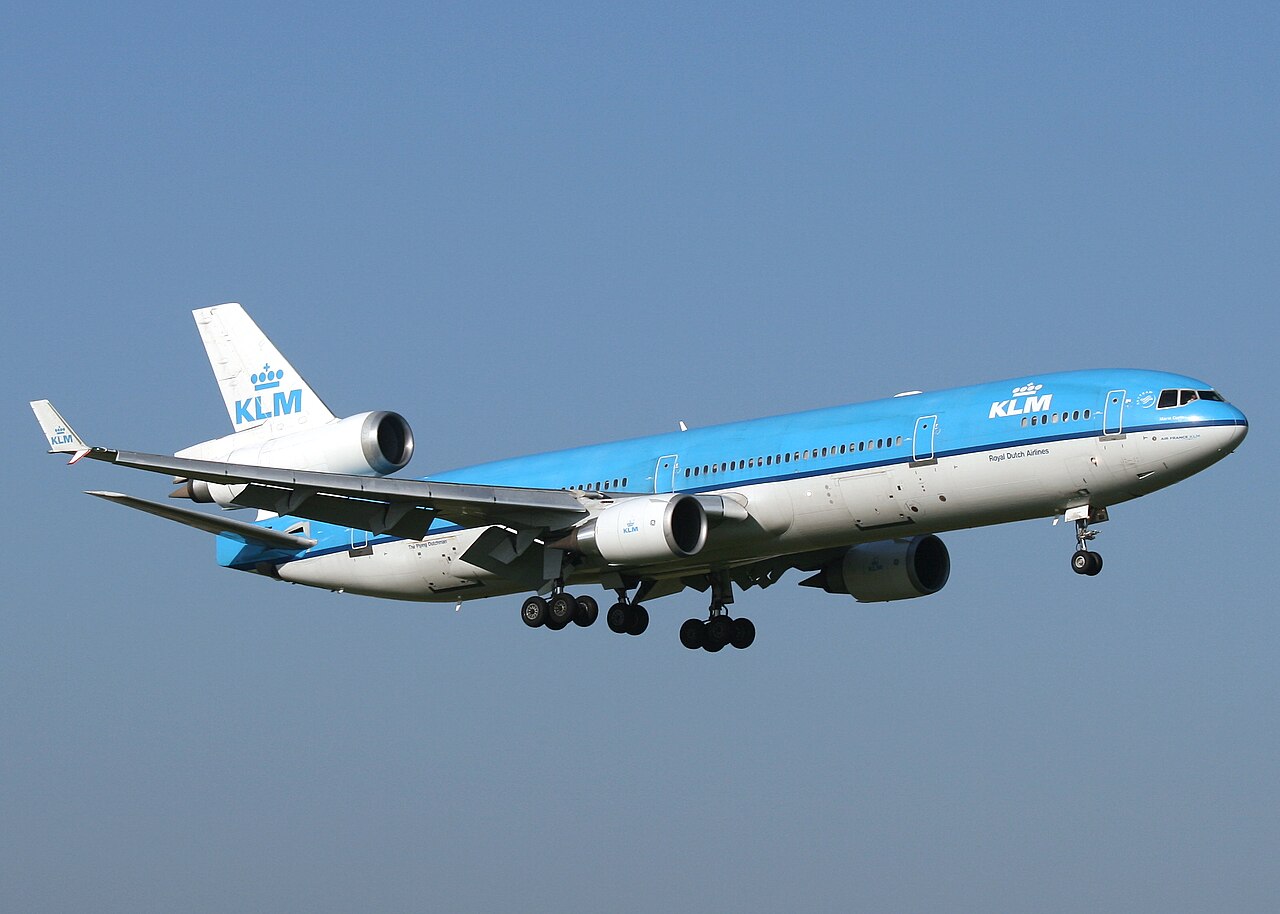
The McDonnell Douglas MD-11 is an American trijet wide-body airliner, developed from the DC-10 and built first by McDonnell Douglas and later by Boeing between 1988 and 2000. Conceived as a longer-range, re-engined and aerodynamically refined successor to the DC-10, it became the largest trijet ever built and today survives mainly as a dedicated freighter with operators such as FedEx Express. For a simulator pilot it offers a rare chance to fly a three-engined, glass-cockpit widebody descended directly from one of the classic 1970s wide-bodies.
The MD-11 is a wide-body trijet airliner manufactured by McDonnell Douglas from 1988 and, following the 1997 merger, by Boeing Commercial Airplanes until production ended in October 2000. It is a direct derivative of the McDonnell Douglas DC-10, retaining the same basic three-engine, underwing-and-tail configuration but with a stretched fuselage, a new wing with winglets, a smaller tailplane and a modern glass cockpit that dispensed with the flight engineer's position. It is the largest trijet ever built, and 200 examples were produced before the type gave way to twinjet competitors.
McDonnell Douglas had been examining DC-10 derivatives as far back as 1976, initially considering a DC-10-10 stretched by 40 feet (12 m) and a DC-10-30 stretched by 30 feet (9 m), the latter capable of carrying up to 340 passengers in a multi-class layout or 277 passengers and luggage over 5,300 nautical miles (9,800 km). A parallel study, the 'DC-10 global', added extra fuel tanks to counter the range advantage of the Boeing 747SP. These efforts were consolidated into the DC-10 Super 60 programme (briefly known as the Super 50), envisaging an intercontinental aircraft with a fuselage lengthened by 26 feet 8 inches (8.13 m) and seating for up to 350 passengers in mixed class, against 275 on the standard DC-10. By 1979 this had split into three proposed variants: the DC-10-61, a high-capacity medium-range aircraft stretched by 40 feet (12 m) for up to 390 passengers mixed-class or 550 all-economy; the DC-10-62, a longer-range version with a more modest 26 ft 7 in (8.10 m) stretch, greater wingspan and fuel capacity, for up to 350 mixed-class or 440 all-economy passengers; and the DC-10-63, combining the -61 fuselage with the -62 wing. Work on the Super 60 family was halted following high-profile accidents in the 1970s, including Turkish Airlines Flight 981 and American Airlines Flight 191, which damaged confidence in the trijet's structural integrity, compounded by an industry downturn. Research continued nonetheless: in August 1981 a Continental Airlines DC-10-10 was leased to test winglet designs with NASA at McDonnell Douglas's Yuma, Arizona flight test facility and at Edwards Air Force Base, while the manufacturer also studied more efficient engines then in development, the Pratt & Whitney PW2037 and Rolls-Royce RB.211-535E4. These strands of research were eventually rationalised into the MD-11 programme, formally launched on 30 December 1986. Assembly of the first prototype began on 9 March 1988, and the aircraft made its maiden flight on 10 January 1990. FAA certification followed on 8 November 1990, with first delivery to Finnair on 7 December and entry into service on 20 December 1990. The MD-11 was originally positioned as a longer-range alternative to twinjets such as the existing Boeing 767 and the then-upcoming Boeing 777 and Airbus A330, but it initially failed to meet its range and fuel-burn targets, hurting sales despite a subsequent performance improvement programme. McDonnell Douglas's financial difficulties prevented further development before Boeing's acquisition of the company in 1997, after which the merged business decided to close out the programme once outstanding orders were filled, owing to internal competition from Boeing's own 767 and 777. Only 200 aircraft were built, roughly a quarter of them as freighters, with production ending in October 2000.
The MD-11 retains the DC-10's basic trijet layout, with one engine under each wing and a third mounted in the tail, but introduces a fuselage stretched by 11 percent to 202 feet (61.6 m) and a wing of slightly greater span than the DC-10's, fitted with winglets. The winglets are credited with improving fuel efficiency by about 2.5 percent. The tailplane is considerably smaller than that of the DC-10: horizontal tail area is reduced from 1,338 square feet (120 square metres) on the DC-10 to 920 square feet (82.8 square metres) on the MD-11. Power is provided by either General Electric CF6-80C2 or Pratt & Whitney PW4000 turbofans. Maximum takeoff weight is increased by 14 percent over the DC-10 to 630,500 lb (286 t). The cabin was designed to accommodate up to 298 passengers in a three-class layout. A glass cockpit with electronic displays eliminated the need for a flight engineer, reducing the flight crew to two.
The MD-11 was designed with a range of up to 7,130 nautical miles (13,200 km; 8,210 mi), an increase intended to let it compete with long-range twinjets. In practice the aircraft initially fell short of its projected range and fuel-burn figures, a shortfall that was only partly addressed by a later performance improvement programme and which affected the type's commercial appeal against rivals such as the Boeing 777 and Airbus A330.
The MD-11 was built in both passenger and freighter configurations; of the 200 aircraft produced, roughly a quarter were built as freight aircraft. Many of the passenger examples were subsequently converted to freighter specification, and a substantial number of these conversions remain in cargo service.
Finnair was the launch operator, taking delivery of the first MD-11 on 7 December 1990 and introducing it to service on 20 December 1990. The type went on to serve as a long-range widebody with several airlines before passenger operations wound down; KLM was the last operator to fly MD-11s in scheduled passenger service, ending the world's last MD-11 passenger flights in November 2014, with the type's final passenger service recorded on 26 October 2014. In its later career the MD-11 became established primarily as a freighter, with operators including FedEx Express and Western Global Airlines continuing to fly it, and Lufthansa Cargo and UPS Airlines among its historical cargo operators.
For simulator pilots, the MD-11 stands out as one of the last widebody trijets and one of McDonnell Douglas's final airliner designs, combining the classic three-engine DC-10 layout with a modern glass cockpit that removed the flight engineer's station and reduced the crew to two. Its distinctive silhouette, with winglets and a noticeably smaller tailplane than the DC-10 from which it descends, together with its transition from airline flagship to long-serving freighter, make it a type of particular interest to those wanting to fly a trijet from the twilight of that configuration's commercial use.