Departure
96%
vs 95%
 MY FS FLIGHTS
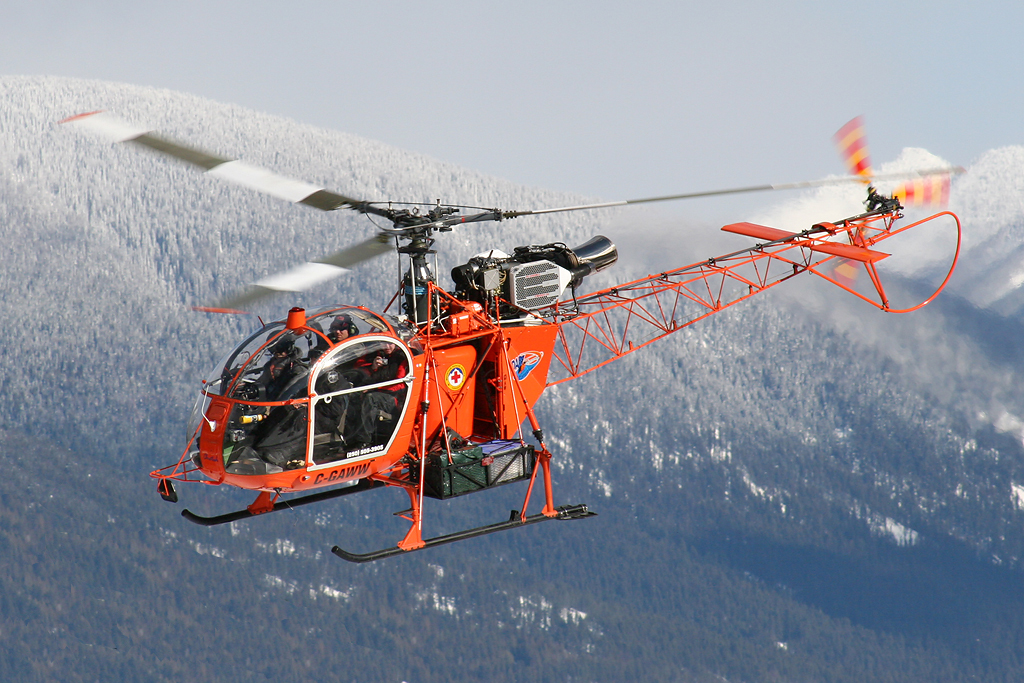
The Aérospatiale SA 315B Lama is a French single-engined light utility helicopter created by combining the airframe of the Alouette II with the powerful engine and dynamic components of the Alouette III, giving it exceptional performance at high altitude and in hot conditions. Developed to satisfy Indian and Nepalese requirements for operations in the Himalayas, it became renowned for mountain work worldwide and still holds the absolute helicopter altitude record. For a simulator pilot, it represents one of the purest examples of a high-altitude mountain specialist, prized for decades by rescue, survey and utility operators.
The SA 315B Lama is a single-turboshaft-engine, five-seat light utility helicopter built by the French manufacturer Aérospatiale (originally SNIAS) specifically for hot-and-high operations. It was created by marrying the lightweight airframe of the Aérospatiale Alouette II with the Turbomeca Artouste turboshaft engine and dynamic systems taken from the larger Alouette III, producing a rotorcraft with an unusually favourable power-to-weight ratio for its class. The type has been license-built in India by Hindustan Aeronautics Limited as the Cheetah and in Brazil by Helibras as the Gavião, and it has served both civilian and military operators across mountainous regions of the world.
The Lama was originally designed to meet a requirement from the Nepalese Army Air Service and the Indian Air Force for a helicopter capable of operating effectively in the extreme altitudes of the Himalayas, where existing medium helicopters struggled. Aérospatiale's solution was to combine the reinforced airframe of the Alouette II with the Turbomeca Artouste turboshaft engine and dynamic systems of the Alouette III. The first SA 315B, powered by an Artouste IIB engine, made its maiden flight on 17 March 1969, flown by test pilot Roland Coffignot with flight engineer Gerard Boutin. The type received its airworthiness certificate on 30 September 1970 and entered operational service in July 1971. During 1969, early demonstration flights in the Himalayas saw a Lama carrying a crew of two and 120 kg of fuel land and take off at 7,500 m (24,605 ft), then the highest altitude recorded for such an operation. On 21 June 1972, Aérospatiale test pilot Jean Boulet set the absolute helicopter altitude record of 12,442 m (40,814 ft) flying a Lama solo, a record that still stood as of June 2022; at the peak of the flight the engine flamed out, resulting in the longest autorotation ever performed, from which Boulet brought the aircraft to a safe unpowered landing. Days earlier, the same pilot and aircraft had set a similar record at a higher weight. Following the publicity generated by these records, the Indian government placed a major order in 1971 that included indefinite licence production by Hindustan Aeronautics Limited at Bangalore; the first Indian-assembled aircraft flew on 6 October 1972 (recorded elsewhere as 1973), with deliveries beginning in December 1973. By December 1976, 191 Lamas had been ordered by 68 operators worldwide. By 1981, ten years into series production, Aérospatiale had built 285 units in France while HAL had produced 133 in India, out of an initial Indian programme of 140 aircraft, the first 40 of which were assembled from French-supplied parts. In 1978, an export agreement was reached with the Brazilian manufacturer Helibras for domestic assembly, with Helibras-built aircraft marketed as the Gavião and several exported to Bolivia.
The SA 315B Lama is a light, five-seat, single-turboshaft helicopter of conventional configuration. Its main rotor has a diameter of 11.02 m, giving a disc area of 95 square metres, while the tail rotor has a diameter of 1.91 m and a disc area of 2.87 square metres. The fuselage is 10.23 m long, and the aircraft stands 2.97 m high measured to the top of the rotor mast. Standard empty weight is around 1,100 kg, against a maximum take-off weight of 1,950 kg. Power comes from a Turbomeca Artouste turboshaft engine derived from the Alouette III installation, quoted in one account as an Artouste IIIB derated to 550 shaft horsepower. The aircraft retains analogue instrumentation reflecting its 1960s origins. The Lama is capable of lifting underslung loads of up to 1,000 kg (2,205 lb), a capability that, combined with its light structure and strong engine, underpinned its reputation for hot-and-high work.
The Lama's defining characteristic is its exceptional performance at high altitude, a quality that set it apart from contemporaries and, for a time, from later types as well. It demonstrated the ability to land and take off at 7,500 m (24,605 ft) with a crew of two and a modest fuel load during early Himalayan trials. Its most famous achievement remains the absolute helicopter altitude record of 12,442 m (40,814 ft), set on 21 June 1972 by test pilot Jean Boulet, a record still standing as of June 2022. That same flight also produced the longest recorded autorotation, after the engine flamed out at peak altitude, from which the aircraft was landed safely without power, a testament to its favourable autorotative handling qualities at extreme altitude. Pilots and operators who flew the type over long careers regarded it as reliable and capable for its intended mountain role, though its light airframe and dated cockpit reflected its late-1960s design origins.
The baseline production version is the SA 315B Lama itself, built in France by Aérospatiale. Hindustan Aeronautics Limited in India produced the type under licence as the Cheetah, and later developed the Cheetal, a modernised variant powered by a Turbomeca TM 333-2M2 engine offering greater power for high-altitude operations such as on the Siachen Glacier, along with updated avionics including new warning indicators, a cockpit voice recorder, flight monitoring system and artificial horizon; an initial ten Cheetals were ordered by the Indian Air Force in 2006, with a further 20 ordered jointly by India and Nepal in February 2013 under a contract worth around 300 crore (roughly US$55 million). HAL also developed an armed light attack derivative of the Cheetah during the 1990s, marketed as the Lancer. In Brazil, Helibras built the type under licence from 1978 as the Gavião (Hawk), with several examples exported to Bolivia.
The Lama has been used extensively in both civilian and military roles, with military applications including liaison, observation, photography, air/sea rescue, transport and ambulance duties, and civilian applications spanning light passenger transport, agricultural work, oil-and-gas exploration and aerial firefighting. Its favourable high-altitude performance made it especially popular in mountainous regions, notably in South America and India, as well as across Europe, particularly France, Switzerland, Italy and Austria, where it was widely used for air transportation in the Alps. Military operators beyond India have included Pakistan, Angola, Morocco and Togo. In India, the licence-built Cheetah became a key HAL product alongside the Alouette III, and experience gained from its manufacture contributed to the later development of the indigenous HAL Dhruv helicopter. Swiss operator Air-Glaciers obtained its first SA 315B Lama in 1971 and at one point operated as many as 16 Lamas alongside five Alouettes, before eventually retiring its last example. Over time, the emergence of more capable types such as the Airbus AS350 B3 and H125 AStar, which matched and then exceeded the Lama's hot-and-high performance, led to a decline in civilian use, and Airbus Helicopters has since considered withdrawing the type certificate for the Lama and its Alouette predecessor, prompting remaining operators to plan for its eventual retirement after more than half a century of service.
Pilots who flew the Lama over long careers describe an aircraft that, despite its 1960s analogue cockpit, remained fully capable of demanding mountain work right up to the end of its service life, prized above all for its light airframe paired with a strong engine. Long-time operators noted that while the Lama could still do the job asked of it, customer demand gradually shifted toward newer types offering similar or better hot-and-high performance with modern systems. For a simulator pilot, the appeal lies in experiencing a purpose-built mountain specialist whose handling at extreme altitude was proven in the most demanding circumstances imaginable, including the record-setting flight during which an engine flame-out at over 12,000 metres was survived through a long, controlled autorotation.