Departure
97%
vs 95% ▲ 2
 MY FS FLIGHTS
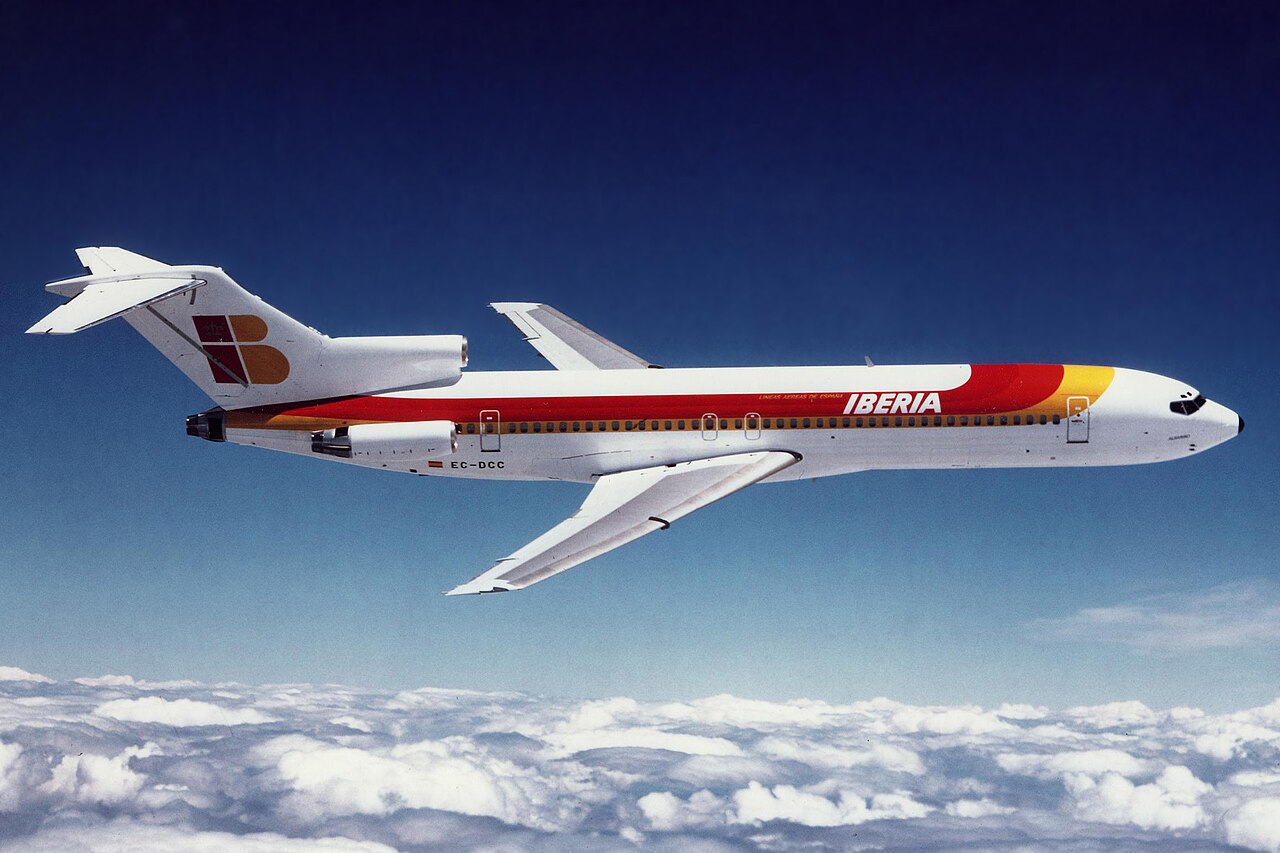
The Boeing 727-200 is a stretched, higher-capacity development of Boeing's pioneering trijet, distinguished by its T-tail and three rear-mounted Pratt & Whitney JT8D turbofans. Introduced in the late 1960s, it became the definitive version of the 727 family and, for a long period, the best-selling jet airliner in the world, forming the backbone of short- to medium-haul domestic route networks. For the sim pilot it represents the golden age of three-crew, hand-flown narrowbody jet operations, with a distinctive rear-engined layout and handling reputation that made it a favourite among the pilots who flew it.
The Boeing 727-200 is a short- to medium-range narrowbody airliner of American origin, built by Boeing as a stretched, higher-capacity derivative of the original 727-100. It retains the classic 727 layout of a low, swept wing, a T-tail and three rear-mounted turbofan engines, with the centre engine fed via an S-duct through the rear fuselage. The type became Boeing's dominant trijet product and a mainstay of domestic and regional airline fleets through the 1970s, 1980s and beyond.
Barely a year after the 727-100 entered service, Boeing began serious consideration of a stretched, greater-capacity development, and announced it was developing the 727-200 in August 1965. The change was essentially a minimum-change development of the -100, achieved by inserting two 3.05m (10ft) fuselage plugs, one forward and one aft of the wing, for a total stretch of 6.10m (20ft) and maximum seating increased to 189 passengers. The 727-200 otherwise shared its engines, fuel tank capacity and maximum takeoff weight with the -100. The type first flew on 27 July 1967 and was certificated in late November that year, entering service with launch customer Northeast Airlines the following month, by which time combined 727-100/-200 orders had already exceeded 500. Northeast was later absorbed into Delta Air Lines, which took on Northeast's 727-100s and early 727-200s following their merger on 1 August 1972; Delta went on to place its first 727 order in March 1972 for 14 of the 'advanced stretch' -232 models, and by 1981 its 727-200 fleet had grown to 129 aircraft, then the largest fleet of the type in the world, with its final -200 delivered on 12 November 1981. Northwest Airlines put its first -200 into service on 27 October 1968 and operated the type until it was finally phased out in 2003. The original 727-200 was limited by having the same fuel capacity as the -100, so Boeing developed the Advanced 727-200, first flown in March 1972, with increased fuel capacity and range, the option of more powerful engines, quieter engine nacelles and a strengthened structure. The Advanced model became the primary production version and remained in production until 1984, by which time it had also become Boeing's best-selling design of the era, underpinning the hub-and-spoke route networks that developed across the United States after airline deregulation.
The 727-200 carries a T-tail and three rear-mounted Pratt & Whitney JT8D turbofans; powerplant options across the production run included the 64.5kN (14,500lb) JT8D-9, 67.2kN (15,000lb) JT8D-11, 68.9kN (15,500lb) JT8D-15, and, on Advanced models only, the 71.1kN (16,000lb) JT8D-17 and 77.3kN (17,400lb) JT8D-17R. Wing span is 32.92m (108ft 0in), overall length 46.69m (153ft 2in), height 10.36m (34ft 0in) and wing area 157.9 sq m (1,700 sq ft). Advanced 727-200 operating empty weight is 45,360kg (100,000lb) and maximum takeoff weight 95,030kg (209,500lb). Maximum passenger seating is 189 at six abreast with 76cm (30in) pitch, with a typical two-class layout of 14 premium and 131 economy seats. The 727-200F freighter variant is typically configured for eleven 2.23m x 3.17m (7ft 4in x 10ft 5in) pallets, and freighter cabin dimensions are quoted as 27.12m (89.2ft) long, 3.51m (11.5ft) wide and 2.13m (7ft) high, with a cabin volume of 144 cubic metres (5,085 cu ft).
For the Advanced 727-200, maximum speed is 1,017km/h (549kt), maximum cruising speed 953km/h (515kt) and economical cruising speed 865km/h (467kt). Range with maximum payload is 3,965km (2,140nm), extending to 4,450km (2,400nm) with maximum fuel. The type retained a reputation for being popular with the pilots who flew it, even as it fell short of later Stage 3 noise requirements, prompting a range of hushkit programmes; Valsan's Quiet 727 conversion, fitting JT8D-217 engines on the outer pylons with acoustic treatment of the centre engine, brought a number of aircraft into compliance before that company ceased operations. Some 727-200s were also retrofitted with winglets to improve performance.
The baseline 727-200 was a minimum-change stretch of the 727-100, sharing its engines, fuel capacity and maximum takeoff weight. The Advanced 727-200, first flown in March 1972, became the primary production version, offering increased fuel capacity and range, a choice of more powerful JT8D-17 and JT8D-17R engines, quieter engine nacelles and a strengthened structure; it remained in production until 1984. A dedicated 727-200F freighter variant was also operated, configured for palletised cargo. Post-service, a number of aircraft were modified with hushkits, including the Valsan Quiet 727 conversion, to meet later noise regulations.
Northeast Airlines was the launch operator of the 727-200 from December 1967, with its fleet passing to Delta Air Lines following their merger in 1972; Delta subsequently built up a large fleet of Advanced-model 727-200s, reaching 129 aircraft by 1981, the largest fleet of the type in the world at that time, before its last -200 was delivered in November 1981. Northwest Airlines operated the type from October 1968 through to 2003, using it across both short-haul shuttle routes and longer hub-to-coast domestic services. The 727-200's blend of passenger capacity, operational flexibility and interchangeability of parts and crews with the 727-100 made it, in the 1970s and 1980s, the principal domestic workhorse of the American airline industry, and it is credited with enabling the hub-and-spoke network structures adopted after deregulation. A total of 1,831 727s of all models were built before production ended in 1984, of which 1,249 were -200s; around 940 -200s remained in commercial service by late 1998, with a further 15 in use as corporate transports.
Even late in its career the 727-200 retained a strong reputation among the pilots who flew it, reflecting handling qualities that made it popular in day-to-day airline operations despite the aircraft's failure to meet later Stage 3 noise standards without hushkit modification. Its T-tail configuration and centre engine fed by an S-duct give it a distinctive rear-engined character quite different from later twin-engine narrowbodies, and its role flying short-haul shuttle sectors as well as longer hub-to-coast domestic routes makes it a natural type for exploring the classic three-crew, hand-flown jet-age operating environment.