Departure
95%
vs 95%
 MY FS FLIGHTS
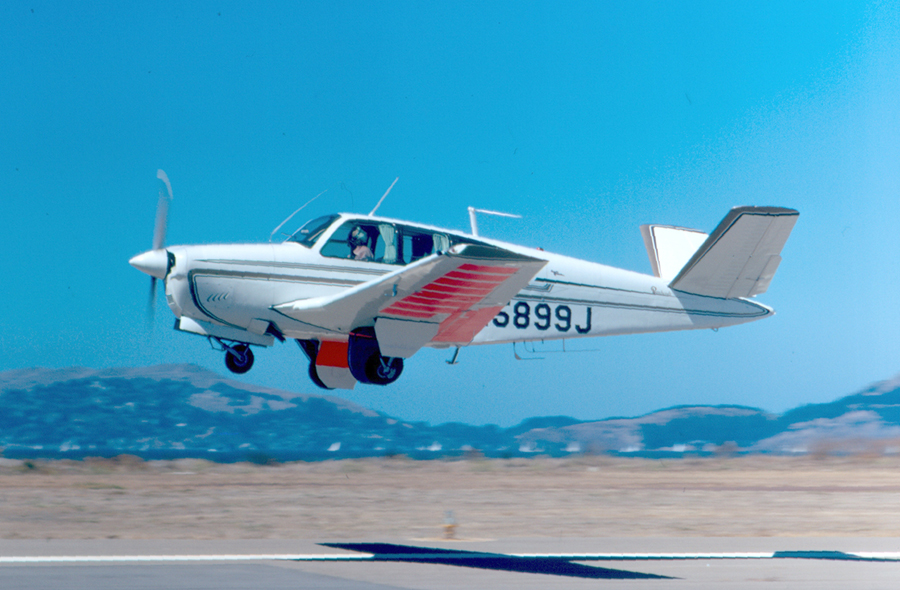
The Beechcraft V35B is the final and most refined production version of the classic V-tail Bonanza, built by Beech Aircraft Corporation of Wichita, Kansas, as a fast, comfortable single-engine light aircraft for the business and personal-transport market. It combines the Bonanza family's all-metal, low-wing, retractable-gear design with the model's signature V-tail ruddervators, and remains one of the most recognisable and enduring shapes in general aviation.
The V35B belongs to the Beechcraft Bonanza family, the four-to-six seat, single-engined, all-metal light aircraft introduced by Beech Aircraft Corporation of Wichita, Kansas, in 1947. It is a member of the original Model 35 line, distinguished from the later conventional-tailed Model 33 and Model 36 Bonanzas by its distinctive V-tail, in which combined elevator-rudder surfaces known as ruddervators replace a separate horizontal and vertical tail. As one of the last V-tail variants built, the V35B represents the mature, fully developed form of a design that helped define the postwar premium end of the light-aircraft market.
The Bonanza design traces back to the prototype Model 35, which first flew on 22 December 1945 and received its airworthiness certificate on 25 March 1947, with production beginning that year. Designed by a team led by Ralph Harmon, it was notable for its all-aluminium, low-wing construction and retractable tricycle undercarriage at a time when many light aircraft were still built with wood and fabric, and for adopting the V-tail as its signature feature. The V-tail Model 35 line continued in production from 1947 until 1982, with the V35B representing one of the later refinements of that basic airframe before V-tail production ended. The type remained in the public eye through incidents such as the fatal crash on 14 February 1975 near Cherry Valley, California, in which US Congressman Jerry Pettis was killed while piloting a Beechcraft V35B Bonanza after encountering adverse weather.
The V35B retains the Bonanza's all-metal, low-wing airframe with retractable tricycle undercarriage and the family's distinctive V-tail, in which ruddervators combine elevator and rudder function. It is powered by a Continental IO-520-BA engine. Typical figures quoted for the type give an empty weight of around 2,125 lb and a maximum gross weight of around 3,400 lb. A turbocharged derivative, the V35B-TC Turbo Bonanza, was also offered, seating up to five passengers plus a pilot, compared with the standard V35B's typical four-seat cabin arrangement.
The V35B cruises at around 172 knots, with a stall speed of about 51 knots and a range in the region of 716 to 717 nautical miles, and fuel consumption of roughly 15.7 gallons per hour at cruise. Some sources quote cruise performance as high as 175 knots (about 203 mph). The turbocharged V35B-TC variant offered notably higher performance at altitude, with a best cruise figure of around 200 knots indicated airspeed, though at a reduced range of about 600 nautical miles compared with the naturally aspirated version.
The V35B sits within the broader Model 35 V-tail Bonanza lineage, which ran in production from 1947 to 1982 alongside the later conventional-tailed Model 33 (originally marketed as the Debonair) and the stretched Model 36. Within the V35 family, Beechcraft also offered the turbocharged V35B-TC Turbo Bonanza, which used the same basic airframe but delivered higher cruise speeds at altitude at the cost of range, and could accommodate up to five passengers plus a pilot rather than the standard model's smaller cabin capacity.
Like other Bonanzas, the V35B served principally as a business and personal transport aircraft for the executive and professional market, prized for its speed, all-metal construction and distinctive appearance. The V-tail Bonanza family, including the V35B, became known informally as the