Departure
90%
vs 95% ▼ 5
 MY FS FLIGHTS
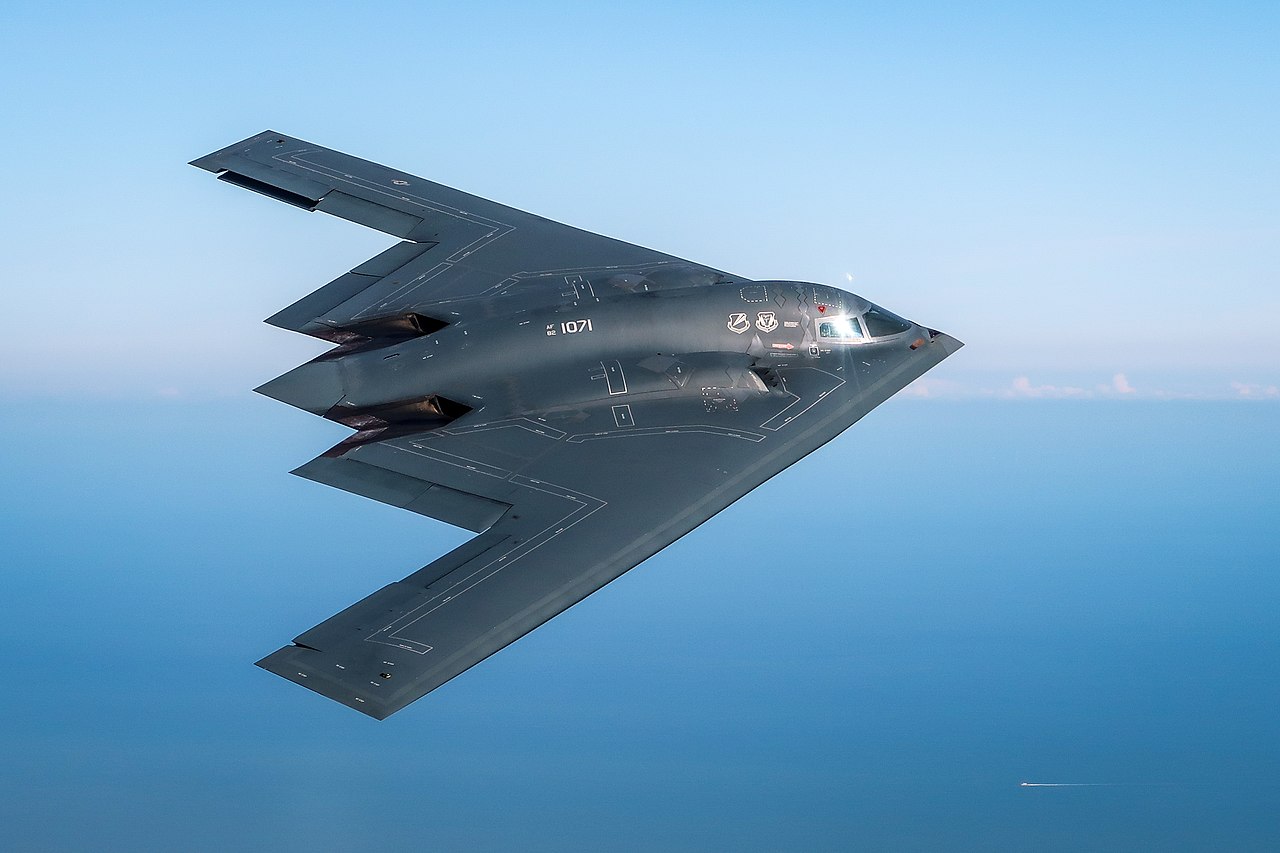
The Northrop B-2 Spirit is an American nuclear-capable subsonic stealth strategic bomber built as a flying wing, developed by Northrop (later Northrop Grumman) for the United States Air Force. Conceived under the secret Advanced Technology Bomber programme to penetrate the densest air defences undetected, it remains one of the most expensive and technologically ambitious combat aircraft ever built. For a simmer it represents the archetypal stealth heavy bomber: a tailless flying wing with a two-to-three man crew capable of delivering both conventional precision munitions and thermonuclear weapons across intercontinental distances.
The B-2 Spirit is a four-engined flying wing with a lambda wing planform, crewed by two to three personnel, and built with radar-evading stealth shaping to penetrate sophisticated air defences. It is solely operated by the United States Air Force and was designed by Northrop, later Northrop Grumman, as prime contractor, with Boeing, Hughes Aircraft Company and Vought as principal subcontractors. It is considered the second operational stealth aircraft after the Lockheed F-117 Nighthawk, and stands as the backbone of American long-range stealth strike capability, a role it will progressively hand over to the Northrop Grumman B-21 Raider.
The roots of the B-2 lie in stealth research from the mid-1970s, when DARPA began investigating how to minimise an aircraft's radar cross-section. Northrop and Lockheed were both involved in early testbed programmes; Lockheed's work led to Have Blue and ultimately the F-117, while Northrop separately developed the classified Tacit Blue demonstrator at Area 51, which advanced low-observable technology, fly-by-wire control, curved stealth surfaces and composite materials that later fed into the B-2 design. President Jimmy Carter became aware of these stealth developments during 1977, and this appears to have been a major factor in the cancellation of the Mach 2-capable B-1A bomber. Development of a long-range stealth bomber formally began in 1979 as the Advanced Technology Bomber programme. The Northrop team's ATB design was selected over a rival Lockheed/Rockwell proposal on 20 October 1981, receiving the designation B-2 and the name Spirit. The aircraft first flew on 17 July 1989, and production ran from 1988 to 2000, with Northrop Grumman manufacturing airframes at its Pico Rivera and Palmdale facilities in California. The programme, originally intended to deliver up to 132 or even 165 bombers, was cut back sharply by Congress as costs rose and the end of the Cold War reduced the perceived need for a fleet of this size; only 21 B-2s were ultimately built. Total programme cost through 1996 reached $44.7 billion, equivalent to roughly $91.8 billion in 2025 terms, with an average unit cost of about $2.13 billion per aircraft in 2025 dollars, or $737 million per aircraft quoted in 1997 dollars. The type entered Air Force service in the 1990s, with sources citing delivery to operational units from 1993 and a formal introduction date of 1 January 1997, and it went on to achieve full operational capability in December 2003 after a decade of service development.
The B-2 is a tailless flying wing of lambda-wing planform with a double-W shaped trailing edge, built with extensive use of low-observable shaping and materials to defeat radar detection. It is powered by four engines buried within the wing structure, and carries a crew of two to three in a shared cockpit. Maximum takeoff weight is classified, though Northrop Grumman has stated the aircraft's payload capacity is at least 40,000 lb. Weapons carriage includes up to eighty 500-pound class Mk 82 JDAM GPS-guided bombs for conventional strike, or nuclear options cited as sixteen 400 kiloton B61 bombs or, in an alternative loadout, sixteen 2,400 lb B83 nuclear bombs. In-flight refuelling receptacle is fitted along the top centreline of the airframe just behind the cockpit. Defensive equipment includes a Lockheed Martin radar warning receiver, a Northrop Grumman defensive aids system and a Lockheed Martin AN/APR-50 defensive management system, all intended to give the crew situational awareness of the threat environment while relying primarily on stealth shaping rather than active countermeasures for survivability.
The B-2 is a subsonic aircraft with an estimated flight ceiling of 50,000 feet. Unrefuelled range exceeds 6,900 miles, and with a single mid-air refuelling the aircraft can fly more than 12,000 miles, giving it genuine intercontinental strike reach from its home base. In its first three years of operational service the B-2 fleet achieved a sortie reliability rate of 90 percent. An Air Force assessment found that two B-2s armed with precision-guided weaponry could achieve what would otherwise require 75 conventional aircraft, reflecting the type's combination of survivability, payload and precision. One of its longest recorded missions flew from Whiteman Air Force Base to targets in Afghanistan and back in support of Operation Enduring Freedom, illustrating the long-endurance, long-range nature of typical B-2 sorties.
The B-2 was produced in a single operational configuration, the B-2A, of which 21 airframes were built between 1988 and 2000. One aircraft, later restored and displayed with its nose wheel door bearing the hand-painted and signed "Fire and Ice" artwork from its temperature testing programme, is preserved at the National Museum of the United States Air Force as the Spirit of Ohio test aircraft, illustrating the flight test heritage behind the production fleet.
The B-2 fleet is based at Whiteman Air Force Base, Missouri, and its climate-controlled hangars there support the specialised maintenance the stealth coatings require. Forward deployment has taken B-2s to NSF Diego Garcia in the Indian Ocean, Andersen Air Force Base on Guam in the Pacific, and RAF Fairford in the United Kingdom. Although designed primarily as a nuclear bomber, the B-2 first saw combat dropping conventional ordnance during the 1999 Kosovo War, and has since been used over Iraq, Afghanistan, Libya and Yemen. In the early hours of 22 June 2025, seven B-2s carried out Operation Midnight Hammer, striking Iran's Fordow and Natanz nuclear sites with 30,000-pound GBU-57 bunker-busting bombs, in the first operational use of that weapon, in a mission that involved 125 aircraft in total once supporting fighters and tankers are counted, the largest B-2 mission in the type's history. The Air Force reported nineteen B-2s remaining in service as of 2024; one aircraft was destroyed in a 2008 crash shortly after takeoff from Andersen Air Force Base, Guam, with both crew ejecting safely, and another was effectively retired after being damaged in a 2022 fire. The Air Force intends to keep the B-2 flying until 2032, as the fleet is incrementally replaced by the Northrop Grumman B-21 Raider.