Departure
96%
vs 95% ▲ 1
 MY FS FLIGHTS
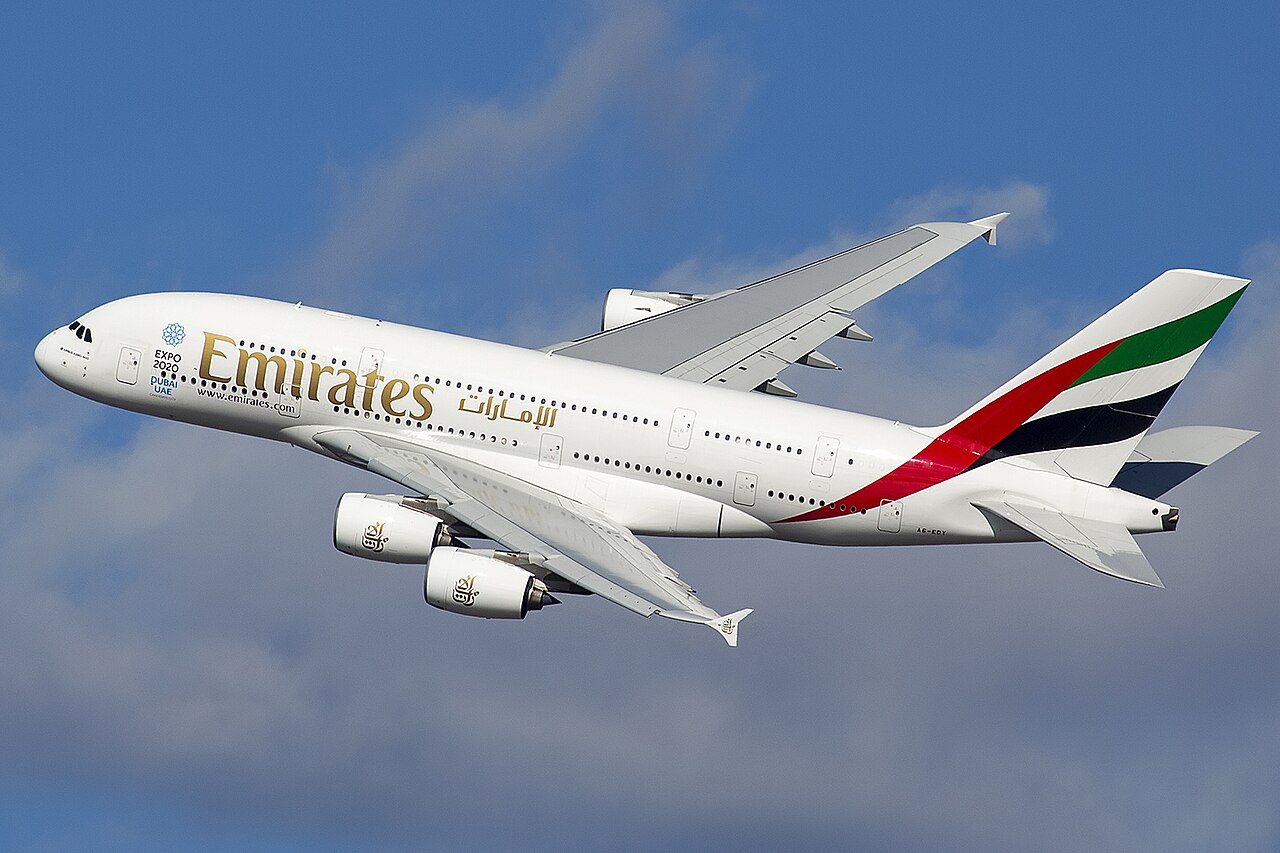
The Airbus A380 is a large wide-body, four-engined airliner built by Airbus between 2003 and 2021, and it remains the world's largest passenger aircraft and the only full-length double-deck jet airliner ever produced. Conceived to challenge Boeing's long-standing dominance of the very large aircraft market with the 747, it combines enormous passenger capacity with a range suited to ultra-long-haul flying. For a simmer, it represents the pinnacle of scale and systems complexity among modern Airbus types, flown as the flagship of a small number of major long-haul carriers.
The A380 is a large wide-body airliner developed and produced by Airbus from 2003 to 2021, occupying a class of its own as the world's largest passenger airliner and the only full-length double-deck jet airliner in service. It is a quadjet, powered by four turbofans, and was designed from the outset to compete directly with the Boeing 747 on high-density, long-haul trunk routes. Airbus built 254 examples, including three test aircraft, before ending production in 2021.
Work on what became the A380 began in secret in mid-1988, when Airbus engineers led by Jean Roeder started studying an ultra-high-capacity airliner (UHCA), partly to complete the Airbus product range and partly to break the dominance Boeing had held in the very large aircraft segment since the early 1970s with the 747. The megaproject was announced publicly at the 1990 Farnborough Airshow, with a stated goal of 15 percent lower operating costs than the Boeing 747-400. Four design teams, drawn from the Airbus partner companies Aerospatiale, British Aerospace, Deutsche Aerospace AG and CASA, proposed competing configurations, and the strongest ideas were carried forward from 1992. In January 1993 Airbus and Boeing began a joint feasibility study into a Very Large Commercial Transport, but this collaboration was abandoned in July 1995 after Boeing's interest cooled over the projected 15 billion dollar development cost and doubts about market size. Airbus pressed on alone, and in June 1994 announced its own very large airliner project under the designation A3XX. Between 1997 and 2000, against the backdrop of the Asian financial crisis, Airbus refined the design, targeting a 15 to 20 percent reduction in operating costs against the 747-400, and the concept converged on a double-deck layout that offered more cabin volume than a conventional single-deck design of similar length. On 19 December 2000 the Airbus supervisory board voted to launch the programme, valued at 9.5 billion euros (10.7 billion dollars), with 50 firm orders from six launch customers; the aircraft was redesignated A380, the number 8 chosen partly because it echoes the double-deck cross-section and is regarded as lucky in several East Asian markets being targeted. The first prototype was unveiled in Toulouse on 18 January 2005 and made its maiden flight on 27 April 2005. It received type certification from the European Aviation Safety Agency and the US Federal Aviation Administration on 12 December 2006. Difficulties with the electrical wiring pushed the initial production programme back by around two years and saw development costs almost double, with estimates of the total development bill reaching around 25 billion dollars, a sum Airbus had not recouped by the time production ended. The first aircraft was delivered to Singapore Airlines on 15 October 2007 and entered commercial service on 25 October 2007. Production peaked at 30 aircraft per year in both 2012 and 2014 before manufacturing ceased in 2021.
The A380 is built around a full-length double-deck fuselage, with the upper deck running the entire length of the aircraft rather than covering only part of it as on the 747. Typical two- or three-class layouts seat around 525 passengers, while the type is certified for a maximum of 853 passengers in a high-density arrangement. The airframe measures 73 metres in length with a wingspan of nearly 80 metres, and Lufthansa's A380-800 has an overall height of 24 metres and a maximum take-off weight of up to 560 tonnes. Construction makes extensive use of modern materials to control weight, including carbon fibre reinforced plastic in the wings and tail structure and aluminium-lithium alloys in the fuselage, the first Airbus programme to combine these on this scale. The aircraft was also the first designed entirely around a full digital mock-up. Power is provided by four large turbofans, either the Engine Alliance GP7200 or the Rolls-Royce Trent 900; on Lufthansa's aircraft, the four Trent engines each produce around 70,000 lb of thrust. Flight deck and systems architecture centres on an Integrated Modular Avionics system that allows the aircraft's computers to monitor and control multiple aircraft systems from shared processing resources, supported by an Enhanced Ground Proximity Warning System and Traffic Collision Avoidance System for terrain and traffic awareness. The wing uses a supercritical aerofoil shape to reduce drag and improve fuel efficiency, together with high-lift devices and slats to aid takeoff and landing performance, and advanced surface control systems to smooth airflow. More than 380 patents were filed in connection with the aircraft, covering areas from noise-reducing acoustic panelling to weight-saving, safety-improving hydraulic systems, several of which went on to become standard practice on later Airbus programmes.
The A380 is designed for very long-haul operation, with a range of 8,000 nautical miles (14,800 km; 9,200 mi) on its four turbofans. Its aerodynamic refinements, including the supercritical wing and advanced high-lift devices, were developed specifically to deliver operating costs significantly below those of the Boeing 747-400 that it was designed to challenge, with an original target of a 15 to 20 percent reduction. The aircraft's operational safety record has been notable: as of December 2021 the global A380 fleet had completed more than 800,000 flights over 7.3 million block hours without a single fatality or hull loss.
The A380 was produced in a single passenger production model, the A380-800, referenced in airline fleet documentation and carrying the ICAO type code A388. Individual operators configure the cabin differently within this one airframe: Qantas fits 14 First, 70 Business, 60 Premium Economy and 341 Economy seats for a total of 485, while Lufthansa's A380 seats 509 passengers across its own class mix. These differences reflect cabin layout choices by each airline rather than distinct structural variants, and the aircraft's flexible interior allowed configurations ranging from dense all-economy layouts of over 800 seats to more spacious premium-heavy arrangements.
Singapore Airlines was the launch operator, taking delivery of the first aircraft on 15 October 2007 and beginning commercial service ten days later. The type went on to become the flagship long-haul aircraft for a select group of major carriers, with Emirates, British Airways, Singapore Airlines and Qantas listed among its primary users. Airbus states the worldwide fleet has flown more than 800,000 flights and carried over 300 million passengers since entry into service. As of April 2024 there were 189 A380s in service with ten operators worldwide; of fifteen airlines that have operated the type, five have since fully retired it from their fleets. The aircraft's scale and cabin flexibility have made it particularly suited to high-demand, slot-constrained long-haul trunk routes, where its large capacity per slot and quiet, smooth-riding cabin have been marketed as key advantages for both airlines and passengers.
In the simulator, the A380 stands out chiefly for its sheer scale: at 73 metres long with a wingspan approaching 80 metres, ground handling, taxiing at large hub airports and managing a four-engine powerplant demand a different level of situational awareness compared with twin-engine wide-bodies. Its Integrated Modular Avionics architecture, which centralises monitoring and control of multiple aircraft systems, gives the flight deck a highly systems-driven character, while the long range of 8,000 nautical miles makes it a natural choice for simmers planning ultra-long-haul sectors between major hub airports. Because it was built in only one production variant, flying the A380 in the simulator generally means flying the same essential airframe under the livery of whichever flagship carrier operated it, with cabin configuration rather than airframe differences defining the variety between operators.