Departure
90%
vs 96% ▼ 6
 MY FS FLIGHTS
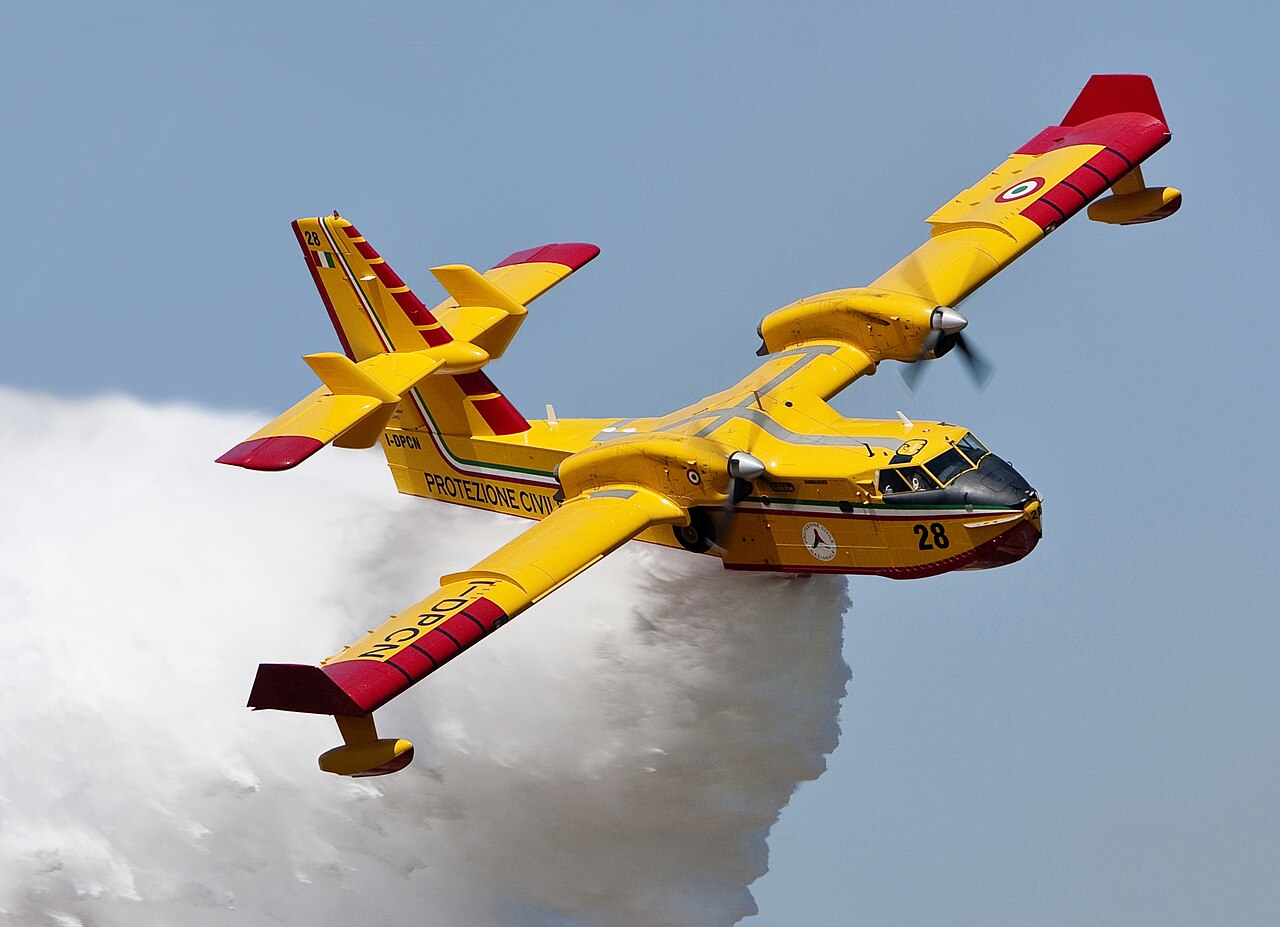
The Canadair CL-415 is a twin-turboprop amphibious aircraft built by Canadair and later Bombardier, developed specifically as a purpose-built water bomber for aerial firefighting. Derived from the piston-engined CL-215, it introduced turbine power, a modernised glass cockpit and aerodynamic refinements, and it remains one of the most recognisable dedicated firefighting aircraft in service with government agencies worldwide. Its ability to scoop water directly from lakes and rivers, combined with search-and-rescue and utility roles, makes it a distinctive and operationally unusual type of interest to simulator pilots.
The Canadair CL-415, later marketed as the Bombardier 415, is a high-wing amphibious twin-turboprop aircraft designed specifically for aerial firefighting, though it is also employed in search and rescue, maritime patrol and utility transport roles. It was built originally by Canadair and subsequently by Bombardier, with the programme later acquired by Viking Air and production of a further-developed successor, the De Havilland Canadair DHC-515, undertaken by De Havilland Canada. The CL-415 is a direct descendant of the earlier Canadair CL-215, from which it inherits its amphibious hull and general configuration while adding turbine engines and modern avionics.
The CL-415 traces its origins to the Canadair CL-215, introduced in 1966 as the first aircraft specifically designed to be a water bomber; a total of 125 CL-215s were built before the last was delivered in May 1990. In 1987, in response to demand for more efficient and reliable powerplants, Canadair retrofitted 17 CL-215 airframes with Pratt & Whitney Canada PW123AF turboprop engines, giving a 15 percent power increase over the original piston engines along with powered flight controls, cockpit air conditioning and upgraded electrical and avionics systems; these became the CL-215T, the first conversion flying on 8 June 1989. Judging the market for further CL-215T conversions to be marginal, Canadair instead developed the CL-415 as a new production series. The CL-415 first flew on 6 December 1993, with deliveries beginning in November 1994. A 180-day sales tour covering 21 countries followed in 1995 using a CL-415 owned by the Quebec Government, and by July 1996 some 37 examples were in service with operators in Canada, France, Italy and Spain. From 1998 the aircraft was assembled at Bombardier Aerospace's facility near North Bay/Jack Garland Airport in North Bay, Ontario, with flight testing conducted on Lake Nipissing. Following a downturn in sales during the 2010s, Bombardier closed the CL-415 production line in October 2015 after completing a total of 95 aircraft, though it continued to market and support the type. In June 2016 Viking Air announced it was purchasing the CL-415 type certificate from Bombardier, along with those for the CL-215 and CL-215T, with the acquisition finalised on 3 October 2016; Viking subsequently began work on a modernised CL-515, since renamed the De Havilland Canadair 515, to be produced by De Havilland Canada in Victoria and Calgary. In May 2018, Bridger Aerospace of Bozeman, Montana became the launch customer for the CL-415EAF Enhanced Aerial Firefighter conversion, under a contract worth 204 million US dollars for up to six aircraft. In December 2018 a full-flight CL-415 simulator capable of replicating water scoop and bombing operations received European Aviation Safety Agency certification, following an earlier full-flight simulator established at Sault Ste Marie, Ontario in May 2013 and certified to FTD Level 6 by Transport Canada.
The CL-415 retains the high-wing, twin-engine amphibious hull configuration of the CL-215 but is powered by two Pratt & Whitney Canada PW123AF turboprop engines rated at 1775 kW (2380 shp) each, driving four-blade constant-speed Hamilton Standard propellers, in place of the earlier aircraft's Pratt & Whitney R-2800 radial piston engines. Compared with the CL-215T, the CL-415 introduced an EFIS avionics suite (Honeywell EFIS and Primus II navigation and communication equipment), together with winglets and finlets, higher operating weights and an increased-capacity firebombing system. The wing spans 28.60 m (93 ft 10 in), or 28.63 m (93 ft 11 in) over the wingtips, with the aircraft measuring 19.82 m (65 ft 1 in) in length and 8.98 m (29 ft 6 in) in height, and a wing area of 100.3 sq m (1080 sq ft). As a firebomber, operating empty weight is 12,333 kg (28,353 lb), with a maximum takeoff weight of 19,890 kg (43,850 lb) from land and 17,168 kg (37,850 lb) from water. The fire retardant payload capacity is 6123 kg (13,500 lb). The flight crew normally numbers two, with special-mission configurations accommodating a third flight-deck member, a mission specialist and two observers; in transport roles the cabin can seat up to 30 passengers at 79 cm (31 in) pitch, or be arranged as an 11-seat combi with the firebombing tanks retained and freight carried forward.
The CL-415 has a maximum cruising speed of 376 km/h (203 kt), a long-range cruise speed of 270 km/h (145 kt) and a patrol speed of 240 km/h (130 kt). Initial rate of climb is 1375 ft/min, and ferry range with a 500 kg (1100 lb) payload is 2430 km (1310 nm). These figures represent a marked improvement over the piston-engined CL-215, which had a maximum cruising speed of 290 km/h (157 kt) and an initial climb rate of 1000 ft/min.
The CL-215 was the original piston-engined water bomber, powered by Pratt & Whitney R-2800 radials, of which 125 were built. The CL-215T was a turboprop retrofit of 17 CL-215 airframes with PW123AF engines and associated systems upgrades. The CL-415 was the all-new turbine-powered production version, featuring EFIS avionics, winglets and finlets, and an enlarged firebombing system; a CL-415GR variant was offered with higher operating weights. Following Viking Air's acquisition of the programme, the CL-415EAF (Enhanced Aerial Firefighter) conversion was launched in 2018, with Bridger Aerospace as launch customer. Viking Air also began development of a further-modernised version, initially designated CL-515 and subsequently renamed the De Havilland Canadair DHC-515, to be built by De Havilland Canada.
The CL-415's principal role is aerial firefighting, scooping water from suitable bodies of water and dropping it on wildfires, though special-mission and transport configurations allow it to be used for search and rescue, maritime patrol and utility transport. Principal operators have included Italy's Vigili del Fuoco, France's Sécurité Civile, the Hellenic Air Force of Greece, and Canada's Service Aérien Gouvernemental. By July 1996 some 37 aircraft were in service with operators in Canada, France, Italy and Spain, and by late 1998 a total of 51 CL-415s had been ordered.
Dedicated full-flight simulators have been developed for the CL-415, including a device certified to FTD Level 6 by Transport Canada and established at Sault Ste Marie, Ontario in 2013, and a further full-flight simulator that received European Aviation Safety Agency certification in December 2018 specifically for its ability to replicate water scoop and bombing operations. This reflects the specialised nature of the type's operating envelope, in which pilots must manage low-level water scooping runs, rapid weight changes as the tanks fill, and firebombing drops in addition to conventional amphibious takeoff and landing techniques on both land and water.