Departure
96%
vs 95% ▲ 1
 MY FS FLIGHTS
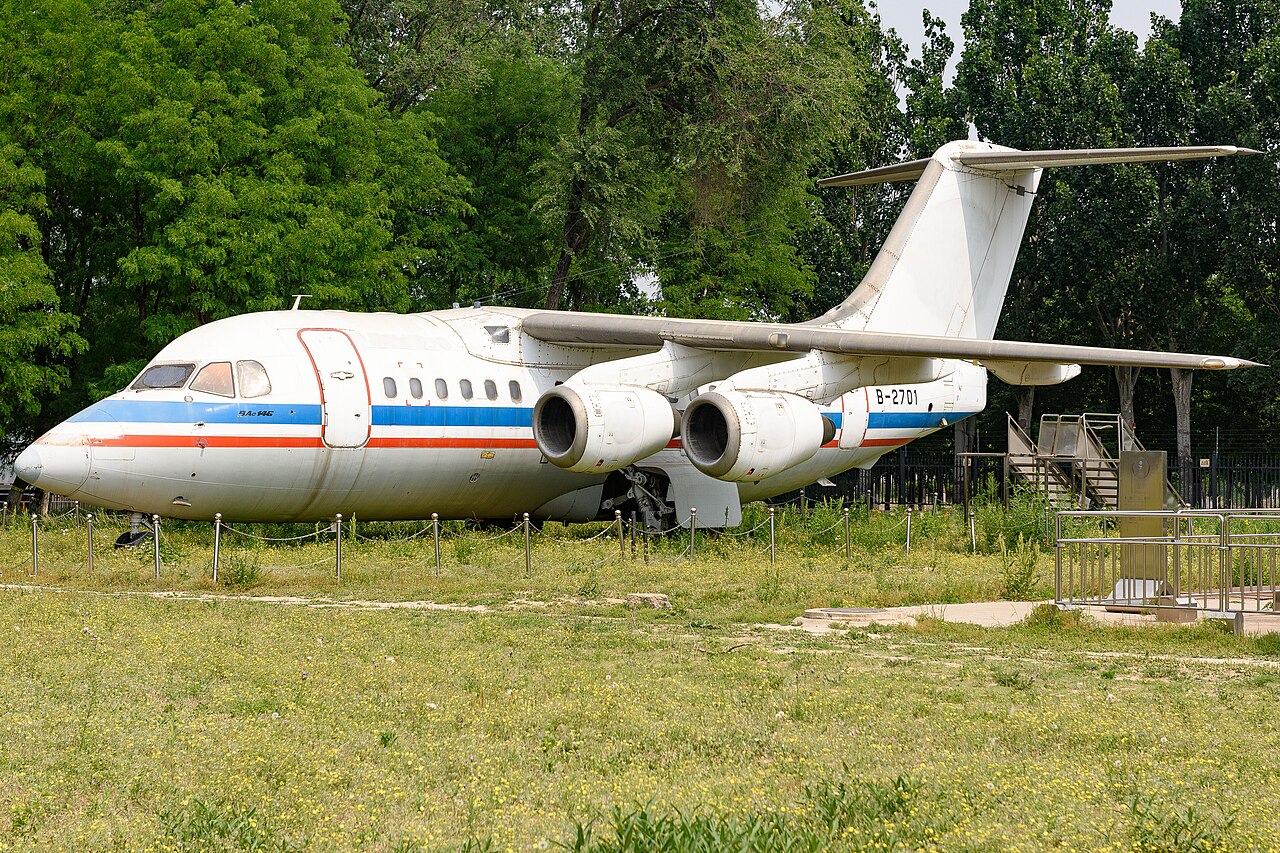
The British Aerospace 146-100 was the original, shortest-fuselage member of the BAe 146 family, a four-engined, high-wing regional jet built at Hatfield to bring quiet, short-field jet operations to routes previously flown by turboprops. Developed from the Hawker Siddeley HS.146 project of the early 1970s, it entered service in 1983 and became known for its exceptionally low noise footprint, earning the marketing name Whisperjet. For a sim pilot it offers an unusual four-engine, T-tail, high-wing handling profile at regional-airliner scale, including strong short-field and mountain-airfield performance.
The BAe 146-100 was the baseline, shortest-fuselage variant of the British Aerospace 146 family of short-haul and regional airliners, built in the United Kingdom by British Aerospace at its Hatfield site, a former de Havilland factory. It is a high-wing cantilever monoplane with a T-tail and four geared turbofan engines mounted on underwing pylons, fitted with retractable tricycle landing gear. Designed to replace turboprop feeder aircraft such as the Hawker Siddeley HS.748 and Fokker F27 Friendship while offering jet speed and comfort, the type became renowned for exceptionally quiet operation, which allowed it to serve noise-sensitive, city-centre airports such as London City Airport.
The lineage of the BAe 146-100 traces back to August 1973, when Hawker Siddeley Aviation launched the HS.146, a 70-seat regional jet intended to bridge the gap between turboprop airliners and small jets such as the BAC One-Eleven and Boeing 737. The concept of a small feeder jet had circulated among British manufacturers' drawing boards as far back as 1958. The chosen configuration used a high wing and T-tail for good short-field performance, powered by four Avco Lycoming ALF 502H turbofans rated at 6,500 lbf thrust each; a four-engine layout was adopted, in part, because it offered exceptional three-engine performance in the event of an engine failure, an attribute valued by operators flying from mountainous, hot, high or poor-grade airfields. The programme was launched with UK government backing covering half the development cost, in exchange for a share of revenue from each aircraft sold. In October 1974, the worsening economic climate following the 1973 oil crisis forced a halt to all work on the project, though low-key development continued to keep the option open for revival. In July 1978, British Aerospace, formed from the merger of Hawker Siddeley, BAC and Scottish Aviation, officially relaunched the programme as the BAe 146, marketing it as a quiet, economical turbofan replacement for ageing turboprop feeders. The first order came from Líneas Aéreas Privadas Argentinas in June 1981. Although British Aerospace had predicted the smaller 146-100 would outsell the stretched 146-200, airline interest ultimately favoured the larger variant. The prototype made its first flight on 3 September 1981 from Hatfield, where a large new assembly line had been established, followed shortly by two further prototypes; initial flight testing showed better-than-predicted takeoff and climb performance. The aircraft received its Certificate of Airworthiness on 8 February 1983, with first deliveries following in May 1983, and it was hailed on entry into service as the world's quietest jetliner. One preserved production 146-100, construction number 1010, first flew from Hatfield on 8 November 1983 under the test registration G-BKXZ. Production of the 146-100 continued until 1992, by which point 37 examples had been built, including three VIP aircraft for the Royal Air Force. The wider 146 family, later supplemented by the re-engined and modernised Avro RJ series built at Woodford, went on to total 387 aircraft, making it the most successful British civil jet airliner programme.
The 146-100 is a high-wing cantilever monoplane with a T-tail, four Textron Lycoming ALF 502 geared turbofans hung on underwing pylons, and retractable tricycle landing gear; an optional gravel kit could be fitted to allow operation from rough, unprepared airstrips. Early aircraft used the ALF 502R-3, rated at 30.0 kN (6,700 lb) thrust, while later production shifted to the more powerful ALF 502R-5 at 31.0 kN (6,970 lb) thrust. The airframe was built across several British Aerospace sites: the nose section and final assembly at Hatfield, the rear fuselage at the former Avro plant at Chadderton, the centre fuselage at Filton, the vertical stabilizer at Brough, and the engine pylons at Prestwick, with the wings produced by a subcontractor outside the UK. The 146-100 has a wing span of 26.21 m (86 ft 0 in), a fuselage length of 26.20 m (86 ft 0 in), a height of 8.61 m (28 ft 3 in) and a wing area of 77.3 sq m (832.0 sq ft). Operating empty weight is 23,288 kg (51,342 lb) and maximum takeoff weight is 38,100 kg (84,000 lb). Cabin layouts allowed for single-class seating for 70 passengers five-abreast at 84 cm (33 in) pitch, 82 passengers six-abreast at the same pitch, or up to 94 passengers six-abreast at a tighter 74 cm (29 in) pitch. A QT (Quiet Trader) freighter derivative of the family was capable of carrying standard pallets or LD3 containers. Later in the family's life the cockpit was updated with EFIS glass displays as part of the improvements that led to the Avro RJ designation.
The 146-100 cruises at 767 km/h (414 kt), with a long-range cruise speed of 670 km/h (361 kt). Range with standard fuel is quoted at 3,000 km (1,620 nm), reducing to 1,630 km (880 nm) with maximum payload. The four-engine, high-wing, T-tail configuration was specifically chosen to deliver strong short-field performance and, in British Aerospace's own words, exceptional three-engine performance following an engine failure, making the type well suited to operations from mountainous regions and from high, hot or poor-grade airfields. Early flight testing of the prototype in 1981 showed takeoff and climb performance that exceeded pre-flight predictions, and the aircraft's low noise signature on approach and departure was a defining handling characteristic that shaped its marketing as the Whisperjet.
The 146-100 was the baseline, shortest-fuselage member of the family, alongside the stretched 146-200, which added 2.39 m (7 ft 8 in) of fuselage length and 35 percent greater underfloor cargo volume, and the further-stretched 146-300, first flown on 1 May 1987. Military and VIP derivatives of the -100 included the BAe 146 CC2, a Statesman VIP version ordered by the Royal Air Force, and the standard RAF transport version designated BAe 146 C1; an air-refuelling-receptacle-equipped military variant, the -100STA, flew only as a prototype. Freighter and convertible derivatives across the family were designated QT (Quiet Trader) and QC (Quick Change), allowing standard pallets or LD3 containers to be carried. The wider family was later succeeded by the re-engined, modernised Avro RJ series, designated RJ70, RJ85 and RJ100, corresponding respectively to the 146-100, -200 and -300 airframes, and ultimately by the short-lived Avro RJX.
The first order for the type came from Líneas Aéreas Privadas Argentinas in June 1981, and the aircraft entered airline service from May 1983. The Royal Air Force operated 146-100 derivatives, including three VIP examples built as the BAe 146 CC2 Statesman and the standard C1 transport variant, alongside civil operators using the type on regional and short-haul routes. The 146-100's quiet operation made it particularly suited to noise-restricted, city-centre airports such as London City Airport, and the type's short-field capability, aided by the optional gravel kit, extended its usefulness to less-developed airstrips. Production of the 146-100 ceased in 1992 after 37 aircraft had been built.
Flying the 146-100 involves managing a four-engine turbofan layout on a relatively small regional airframe, a combination that is unusual among jet airliners and gives the type a distinct character on approach and departure. Its high wing and T-tail were designed to deliver strong short-field performance and notably quiet operation, characteristics that would be evident in the aircraft's low approach speeds and its ability to operate comfortably from short or constrained runways compared with twin-engine jets of similar size. The four separate engines also mean pilots have more redundancy to manage in the event of a single powerplant failure, reflecting the type's original design brief of exceptional three-engine performance for operations from demanding airfields.