Departure
97%
vs 95% ▲ 2
 MY FS FLIGHTS
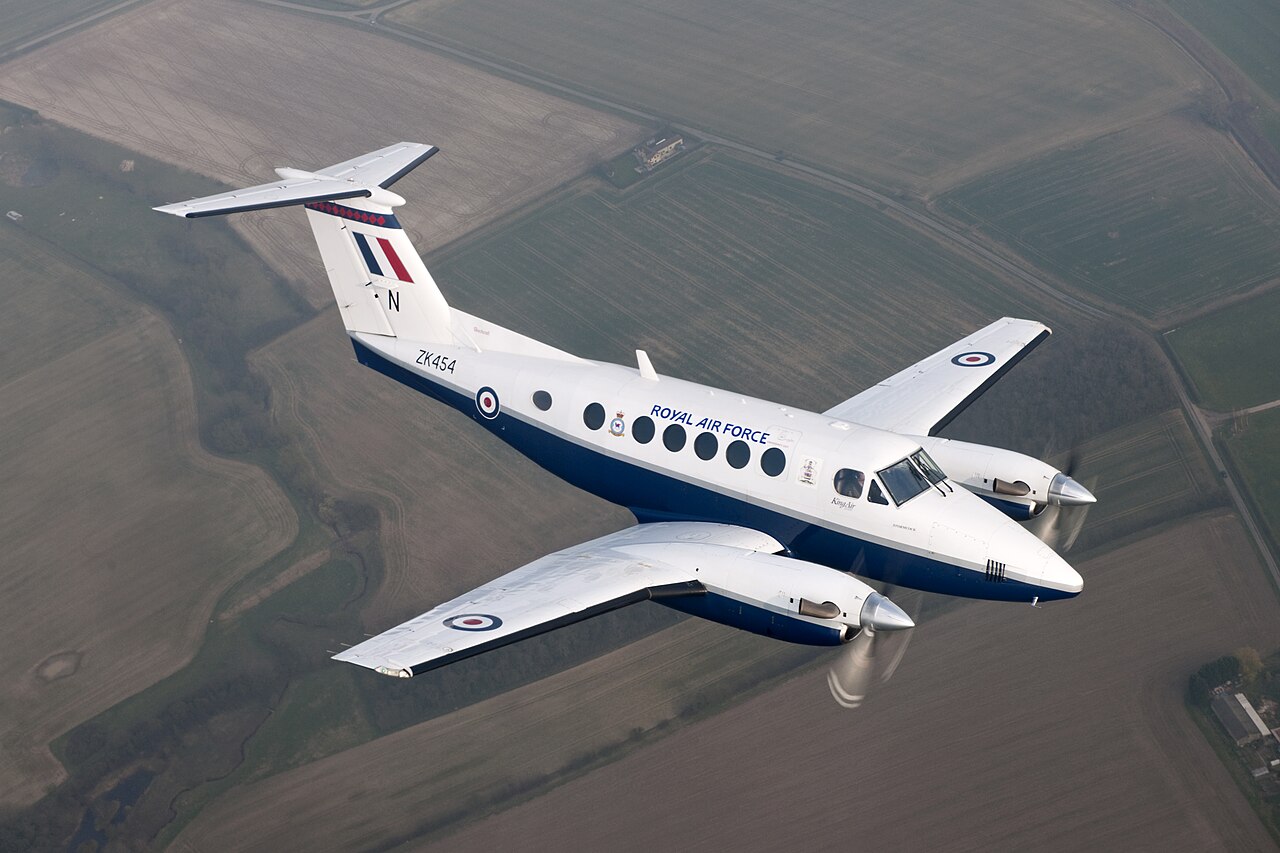
The Beechcraft King Air 350 is a twin-engine turboprop business and utility aircraft built by Beechcraft (as part of Hawker Beechcraft, now Textron Aviation), representing the largest and most capable member of the long-running King Air family. Stretched from the King Air 200/300 lineage with a larger cabin, winglets and uprated systems, it combines airline-style cabin comfort with genuine short-field capability, making it a mainstay of corporate transport, government, medevac and special-mission flying. For a simulator pilot it offers a realistic taste of turbine twin-turboprop operations, from PT6A engine management to modern glass-cockpit avionics.
The King Air 350 is a twin-turboprop cabin-class aircraft manufactured by Beechcraft, produced under the Hawker Beechcraft Corporation banner and, since 2012, by Beechcraft as part of Textron Aviation. It sits at the top of the King Air family, offering a pressurised cabin typically seating eight to nine passengers in club or double-club seating, with a semi-enclosed rear lavatory that can convert to an additional seat. Derived from the earlier King Air 200 series via the Super King Air 300, the 350 is used across corporate transport, government, air ambulance and special-mission roles, and remains one of the most widely used business turboprops in service.
The lineage begins with the Beechcraft Super King Air 300, launched in 1984 as an upgraded development of the Super King Air 200. Beechcraft subsequently stretched the fuselage, added two extra cabin windows and fitted new winglets, rebranding the type as the King Air 350 in 1990. The King Air 350 entered service around 1989 to 1990 as this stretched, higher-performance development of the 300 series. Production of the original King Air 350 continued until 2009, when Beechcraft shifted focus to an upgraded successor, the King Air 350i, released in 2010 with a quieter, more comfortable cabin, additional USB ports and electrical outlets, and armrest remote controls for cabin lighting and inflight entertainment. Aircraft built after 1998 incorporated the Ultra Electronics UltraQuiet noise control system as part of continuing improvements through the type's life. The manufacturer itself passed through several corporate changes during this period: British Aerospace sold its business jet division to Raytheon in 1993, which later sold its aircraft manufacturing business to Hawker Beechcraft, a company controlled by GS Capital Partners and Onex Partners. Hawker Beechcraft went bankrupt in 2012 and re-emerged as Beechcraft, now owned by Textron Aviation, which continues to build and support the King Air family.
The King Air 350 is an all-metal, low-wing twin turboprop with a pressurised cabin, tricycle landing gear and an airstair entry door. It is powered by two Pratt & Whitney Canada PT6A-60A reverse-flow, free-turbine engines, each rated at 1,050 shaft horsepower. The cabin measures 19 ft 6 in (5.95 m) long, 4 ft 6 in (1.37 m) wide and 4 ft 10 in (1.47 m) high, within an overall exterior length of 46 ft 8 in (14.22 m), a tail height of 14 ft 4 in (4.37 m), a fuselage diameter of 5 ft 3 in (1.60 m) and a wingspan of 57 ft 11 in (17.65 m). Maximum takeoff and landing weight is 15,000 lb (6,800 kg), with a maximum payload of 6,000 lb (2,750 kg) and fuel capacity of 430 US gallons (1,600 litres) of Jet A. Baggage volume is 71.3 cubic feet, split between an aft hold and wing lockers, sufficient for around five soft suitcases plus golf clubs or ski equipment. Large, round cabin windows with polariser shades give good natural light, and post-1998 aircraft feature the UltraQuiet noise control system, reducing in-flight noise to under 80 decibels. Avionics on the original King Air 350 comprised Rockwell Collins ProLine II, paired with a Universal UNS-1D/UNS-1K navigation system, an ALT-80A altimeter, dual airspeed indicators and a flight director, with an optional Rockwell Collins EFIS-8B electronic flight information system using three tube-type multifunction displays; Rockwell Collins ProLine 21 avionics became standard on later models. The King Air 350i introduced Collins Aerospace ProLine Fusion avionics with synthetic vision, enhanced situational awareness, engine indicating and crew alerting systems, and traffic alert and collision avoidance, along with touchscreen controls, fold-out tables and Wi-Fi capability.
Maximum cruise speed is around 312 knots (359 mph, 578 km/h), with an approach speed of about 104 knots (120 mph, 193 km/h). Certified ceiling is 35,000 ft, with a rate of climb of around 2,700 ft/min. Typical takeoff distance is around 3,300 ft and landing distance around 2,700 ft, underlining the type's strong short-field performance, which allows it to operate from remote airports with short runways and makes it popular for cargo and medical flying. Range is quoted at approximately 1,550 nautical miles (1,780 miles, 2,870 km) in standard configuration, sufficient for non-stop sectors such as London to Madrid or New York to Miami; extended-range variants fitted with additional fuel can remain airborne for seven to eight hours depending on payload.
The type's direct predecessor was the Super King Air 300, introduced in 1984 as a development of the Super King Air 200. Beechcraft stretched the fuselage, added two extra windows and fitted winglets to create the King Air 350, launched in 1990. Production of this original King Air 350 ran until 2009, when it was superseded by the King Air 350i, introduced in 2010 with Collins ProLine Fusion avionics, improved cabin comfort, additional power and USB outlets, and cabin remote controls. Extended-range derivatives include the King Air 350ER, which carries additional fuel for longer-range missions, and special-mission variants such as the King Air 350CER and 360CER, operated for example by NOAA, which are fitted with downward-facing sensor ports for coastal mapping, snow and soil moisture surveys and emergency response, with optical-grade glass plates allowing pressurised operation or removal for unpressurised sensor use.
The King Air 350 and 350i are used widely for corporate and executive transport, typically configured for eight to nine passengers in club or double-club seating, with reduced-fuel high-density layouts accommodating up to eleven. Beyond business aviation, the type's short-field capability and cabin flexibility have made it popular for air ambulance and medical evacuation work, cargo operations, and government and special-mission roles including surveillance. Government science agencies such as NOAA operate extended-range CER variants fitted with sensor ports for coastal mapping, snow and soil moisture surveys and emergency response, flown with a crew of two pilots plus a sensor operator and additional mission crew. In the private charter and fractional ownership market, the King Air 350i has been operated in significant numbers by membership programmes such as Wheels Up.
The King Air 350's combination of turbine performance and short-field capability, twin PT6A-60A engines and a modern glass cockpit in later ProLine 21 and ProLine Fusion-equipped examples make it a realistic step up from piston twins for simulator pilots exploring turboprop operations, including engine and propeller management, pressurisation, and single-pilot capable systems. Its strong short-field performance and versatility across corporate, medevac and special-mission roles mean it lends itself to a wide range of simulated flying, from short regional hops into small airfields to longer cross-country legs within its roughly 1,550 nautical mile range.