Departure
97%
vs 95% ▲ 2
 MY FS FLIGHTS
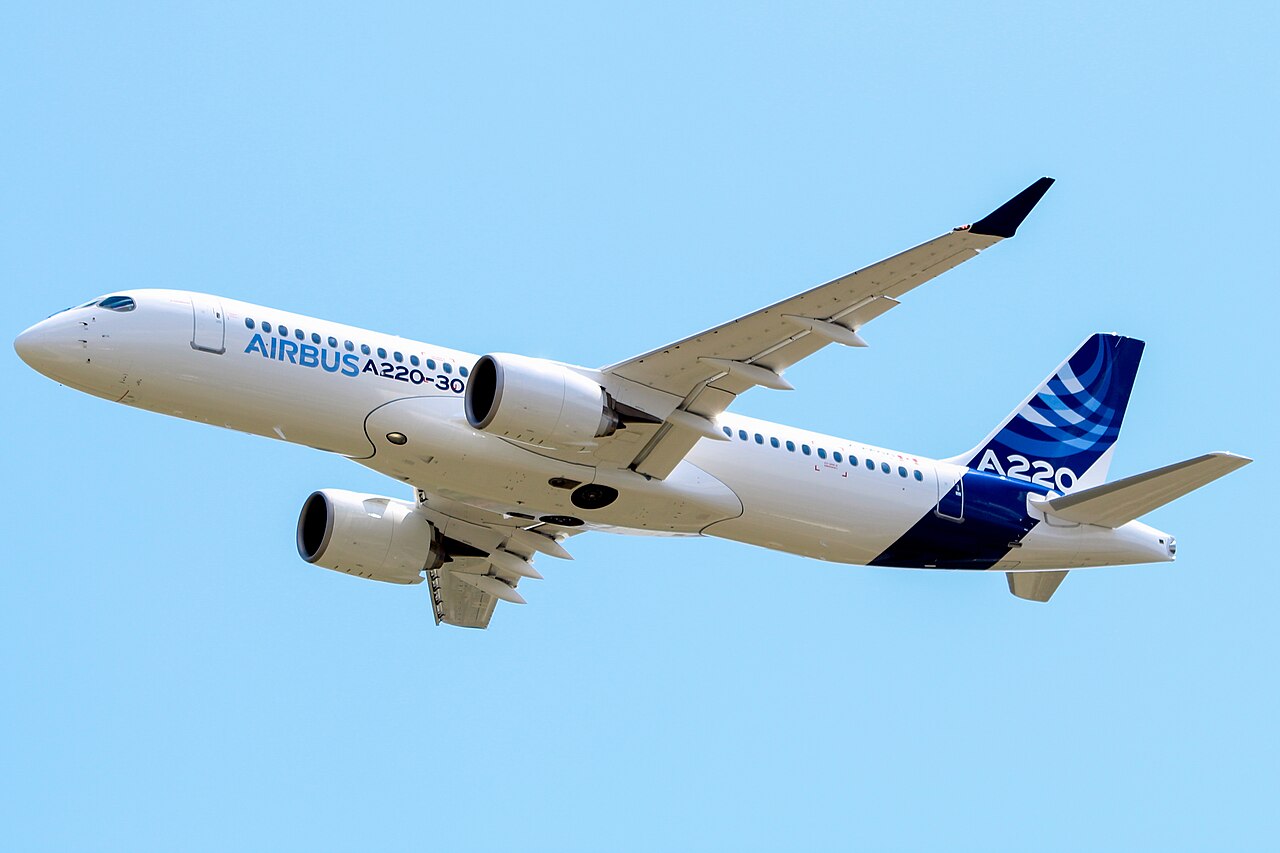
The Airbus A220-300 is a single-aisle narrowbody airliner seating between 120 and 160 passengers, originally developed by Bombardier as the CS300 before Airbus took majority control of the programme in 2018. Powered by geared turbofan engines and built with a clean-sheet composite and aluminium-lithium airframe, it is prized by operators and pilots alike for its efficiency, quiet cabin and mainline-standard comfort in a smaller-category jet.
The Airbus A220-300 is the larger of the two members of the A220 family, a twin-engine single-aisle jet built for the 100 to 160 seat market segment. It began life as the Bombardier CS300 before Airbus acquired a 50.01% majority stake in the programme through the Airbus Canada Limited Partnership, formally closing the deal on 1 July 2018 and rebranding the CS300 as the A220-300 on 10 July 2018. It occupies a niche between traditional regional jets and larger narrowbody aircraft, combining a clean-sheet design with advanced aerodynamics and modern systems to deliver mainline-style comfort and operating economics on regional and thin long-haul routes.
The aircraft was first manufactured in France in 2013 and made its maiden flight in February 2015 from Montreal, Canada, as the Bombardier CS300, exceeding expectations for noise, performance and economics during testing. It entered commercial service in 2016 with airBaltic. Early orders included a 2012 commitment from CDB Leasing Co. for five A220-100s and ten A220-300s with further options, a mid-2014 letter of intent from Petra Airlines for two aircraft of each variant, and a mid-2018 order from JetBlue for 60 A220-300s with deliveries expected from 2021. By November 2018 Airbus had booked roughly 400 A220 orders in total, rising to 421 orders for the A220-300 alone by August 2019, with 52 delivered by that point. In January 2019 Airbus broke ground on a second A220 final assembly line in Mobile, Alabama; production there began in August 2019, and the first Mobile-built A220-300 completed its maiden flight on 2 June 2020 before being delivered to Delta Air Lines on 22 October 2020.
The A220-300 is 127 feet 0 inches (38.70 m) long with a wingspan of 115 feet 2 inches (35.10 m) and a fuselage diameter of 12 feet 2 inches (3.70 m); overall height is around 11.5 metres. The cabin measures 10 feet 9 inches (3.28 m) wide, 6 feet 11 inches (2.11 m) high and 90 feet 3 inches (27.50 m) long, with a baggage volume of 1,116 cubic feet (31.6 cubic metres). It is powered by two Pratt & Whitney PW1500G geared turbofan engines, uprated on the -300 to deliver up to approximately 23,300 lbf of thrust each, compared with around 18,900 lbf per engine on the smaller A220-100, in order to handle the higher operating weight. Maximum takeoff weight is roughly 154,000 lb (70,000 to 70,900 kg), against about 63,050 kg for the A220-100, and maximum payload is 41,300 lb (18,700 kg). Fuel capacity is 5,800 US gallons (21,900 litres, 17,500 kg of Jet A). Avionics comprise a Rockwell Collins Pro Line Fusion suite, and the aircraft has no wingtip winglets. It shares over 99% commonality with the smaller A220-100, with a reinforced structure to support its greater size and weight.
Maximum cruise speed is 447 knots (514 mph, 828 km/h), and service ceiling is 41,000 feet (12,500 m). Range is quoted as up to 3,400 to 3,600 nautical miles depending on configuration, with the type certified to ETOPS-180 standard for extended overwater operations. Typical takeoff distance is 6,200 feet (1,890 m) and landing distance 4,950 feet (1,510 m). Pilots and crew report very little handling difference when transitioning between the A220-100 and the larger A220-300, making crossover between the two variants straightforward despite the -300's stretched fuselage and greater seating capacity.
The A220-300 is the stretched, higher-capacity member of the A220 family alongside the shorter A220-100. Typical seating on the -300 ranges from 130 to 160 passengers against 100 to 135 on the -100, and it has a longer fuselage, a higher maximum range of around 3,600 nautical miles versus 3,450 nautical miles for the -100, and uprated PW1500G engines to cope with its higher maximum takeoff weight. The two variants share more than 99% commonality in systems and construction. Speculation has also pointed toward a possible further-stretched A220-500 to compete more directly with larger narrowbody aircraft, though this remains unconfirmed as a production programme.
The A220-300 entered commercial service in 2016 with launch operator airBaltic and has since been adopted widely for regional and medium-haul flying, filling the gap between regional jets and larger narrowbodies while offering strong operating economics. Notable operators include Delta Air Lines, Air France, Swiss International Air Lines and Air Canada, the latter introducing 45 A220-300 aircraft to its fleet with an inaugural flight on 16 January 2020. Air Canada highlights a 20% reduction in CO2 emissions per seat compared with similar aircraft and describes it as the quietest commercial jet in its class. airBaltic and other operators emphasise the wider seats, larger windows, increased hand-luggage space and improved lavatories the type offers over comparable narrowbody jets.
For a pilot moving onto the type, the A220-300 is notable for how closely it handles compared with the smaller A220-100, with crews reporting a seamless transition between the two variants despite the -300's greater length and passenger capacity. Its geared turbofan PW1500G engines and modern Pro Line Fusion avionics suite reflect a genuinely clean-sheet, digitally integrated cockpit rather than a derivative design, and its ETOPS-180 certification and 3,400-plus nautical mile range mean it is flown on longer, thinner routes as well as short regional sectors, giving simulator pilots a broad operational envelope to explore from short-field regional work to extended overwater legs.