
Departure
95%
vs 95%
Track every flight, analyse your performance,
and master your flying skills with My FS Flights
Get 10 flights free every month!
Tracked and analysed flights over miles
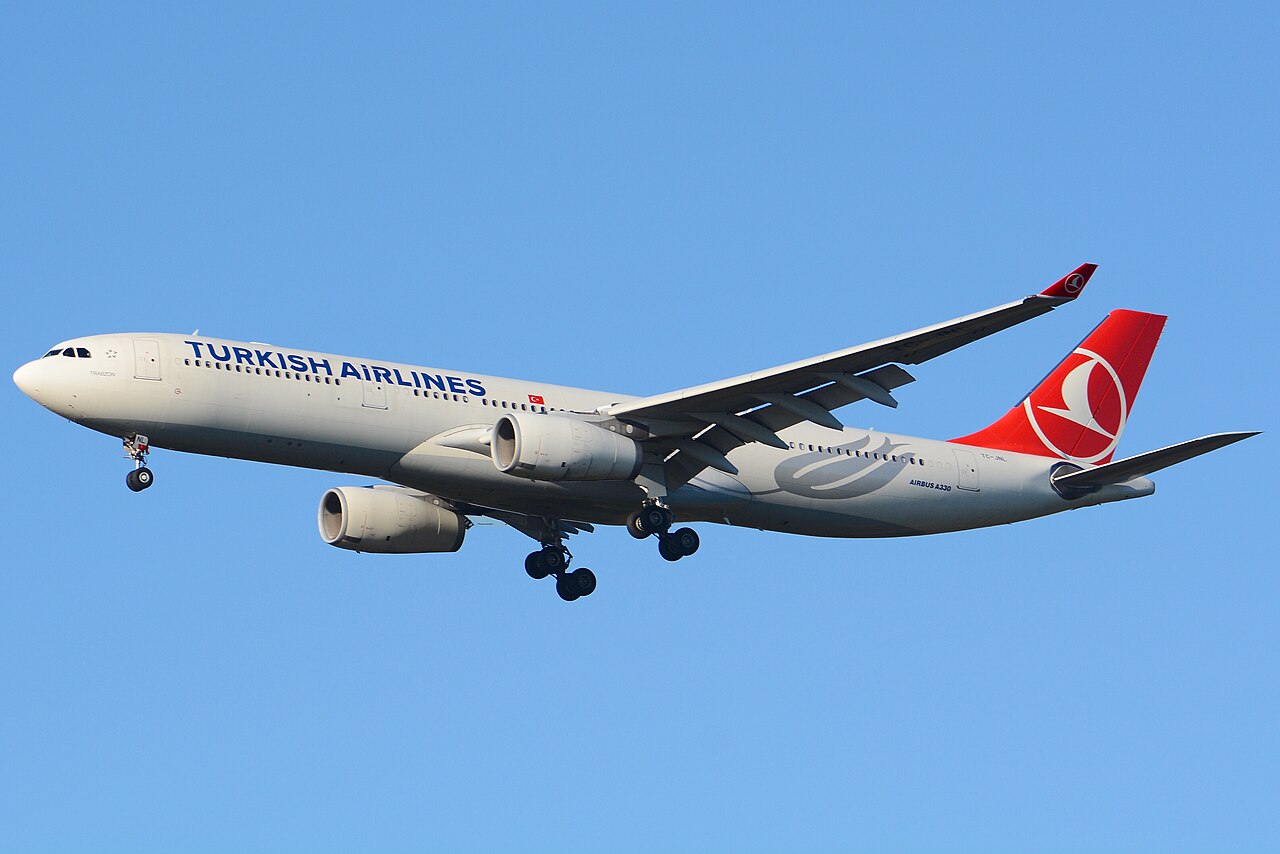
The Airbus A330-900 is the larger of the two A330neo variants, a re-engined and aerodynamically refined development of the A330-300 built by Airbus for the mid-size widebody market. Powered exclusively by the Rolls-Royce Trent 7000, it offers airlines a lower-cost alternative to clean-sheet widebodies such as the Boeing 787 while retaining much of the proven A330 airframe. For a sim pilot it represents a modern, computer-managed long-haul Airbus with fly-by-wire handling and the latest Airspace cabin philosophy.
The Airbus A330-900 is a wide-body airliner developed by Airbus as part of the A330neo ('New Engine Option') family, itself derived from the original Airbus A330, now referred to as the A330ceo (Current Engine Option). It is the larger of the two A330neo variants, based on the A330-300 fuselage, with the smaller A330-800 based on the A330-200. Manufactured in Toulouse, France, it retains the fuselage length of the A330-300 and A340-300 and sits in the mid-size widebody segment, competing with the Boeing 787 Dreamliner and, within Airbus's own range, the A350.
Airbus's initial response to the Boeing 787 launch in 2004 was an improved A330, but after negative feedback from airlines and lessors this evolved into the all-new A350 XWB by 2006. The idea of a re-engined A330 resurfaced after the commercially successful A320neo launch in December 2010, with AirAsia among the airlines pressing Airbus to re-engine the A330. In March 2014, Delta Air Lines expressed interest in an A330neo to replace its ageing Boeing 767-300ERs. Airbus formally launched the A330neo programme on 14 July 2014 at the Farnborough Airshow, powered by the new Rolls-Royce Trent 7000, promising a 14 percent improvement in fuel burn per seat and a range increase of 400 nautical miles, while retaining 95 percent parts commonality with the A330ceo. Development costs were estimated at around 2 billion dollars. Production of the first A330neo's centre wingbox and engine pylon began on 7 September 2015, and final assembly of the first aircraft (an A330-900, MSN1795) started in September 2016 at the Airbus Toulouse final assembly line. The schedule slipped by six weeks in December 2016 due to issues in Trent 7000 engine development at Rolls-Royce. The A330-900 made its maiden flight on 19 October 2017, part of a flight-test campaign of around 1,400 hours using three prototypes and the first production aircraft. It received its EASA type certificate on 26 September 2018, followed by FAA validation. The first aircraft, fitted with 298 seats, was delivered to launch customer TAP Air Portugal on 26 November 2018, and entered commercial service on 15 December 2018 with a flight from Lisbon to Sao Paulo. A higher weight variant with a maximum take-off weight of 251 tonnes was certified by EASA on 8 October 2020, giving operators such as Corsair International extra range and payload flexibility. As of June 2026, a total of 494 A330neo family aircraft had been ordered by more than 30 customers, of which 196 had been delivered, and 196 A330neo aircraft were in service with 25 operators. On 11 April 2023, Airbus delivered the 100th A330neo, an A330-900, to German airline Condor.
The A330-900 is exclusively powered by two Rolls-Royce Trent 7000-72 turbofans, each rated at 72,834 lbf (324 kN) of thrust, offering roughly double the bypass ratio of the engines fitted to the original A330. The aircraft features new wings with larger composite sharklets, similar in style to those of the A350 XWB, increasing wingspan while remaining within ICAO category E airport requirements, along with new engine pylons and a re-twisted wing with optimised slats, together improving aerodynamics by around 4 percent. Overall length is 63.69 m (208.96 ft), with a cabin length of 50.36 m, fuselage width of 5.64 m (222 in) and maximum cabin width of 5.26 m (206 in). Wingspan is 64.00 m (209.97 ft), height 16.79 m (55 ft), track 10.68 m (35.04 ft) and wheelbase 25.38 m (83.27 ft). Maximum taxi weight is 253.90 tonnes, maximum take-off weight 253.00 tonnes, maximum landing weight 191.00 tonnes and maximum zero fuel weight 183.00 tonnes. Maximum fuel capacity is 139,090 litres. The aircraft can carry up to 11 pallets or 33 LD3 containers in the hold, with a maximum payload of around 44,000 kg. Maximum seating capacity is 465 passengers in a high-density layout, with a typical three-class configuration of 287 to 303 seats, or between 260 and 300 seats depending on operator layout. The A330neo was the first Airbus jetliner to feature the Airspace cabin philosophy, built around four pillars: comfort, ambience, services and design, offering more personal space, greater luggage stowage and the latest generation of in-flight entertainment.
The A330-900 has a maximum range of 7,350 nautical miles (13,600 km), giving Airbus's launch operators the ability to fly all types of routes from short-haul segments to long-range sectors. It cruises at Mach 0.82. Maximum cruise speed has been quoted at around 496 knots (571 mph, 919 km/h), with an approach speed of around 142 knots (163 mph, 263 km/h). Service ceiling is 41,450 ft (12,600 m). Typical take-off distance is around 9,850 ft (3,000 m) and landing distance around 5,600 ft (1,700 m). Compared with the previous-generation Boeing 777-200ER, Airbus states the A330-900 reduces fuel consumption and CO2 emissions by 25 percent.
The A330neo programme comprises two variants: the A330-900, based on the A330-300 and retaining its fuselage length, and the shorter A330-800, based on the A330-200. The A330-900 is the larger and higher-capacity of the two, while the A330-800 offers a longer maximum range of 8,100 nmi (15,000 km) with 257 passengers against the A330-900's 7,350 nmi with 287 passengers. Both variants share the same Rolls-Royce Trent 7000 engines, each said to offer a 25 percent fuel-burn improvement over previous-generation engines. A higher-weight A330-900 variant, certified by EASA on 8 October 2020 with a maximum take-off weight of 251 tonnes, gave operators additional range and payload flexibility. Airbus has also studied cargo and military derivatives of the family: Amazon Air and UPS Airlines lobbied for a freighter version based on a stretched A330-900, and Airbus formally launched a tanker variant, designated A330 MRTT+, at the 2024 Farnborough International Airshow.
TAP Air Portugal was the launch customer for the A330-900, taking delivery of the first aircraft on 26 November 2018 and beginning commercial service on 15 December 2018 with a flight from Lisbon to Sao Paulo. Early and subsequent orders came from a range of airlines including Delta Air Lines, which ordered 35 A330-900s, AirAsia X, CIT Group and Corsair International. As of June 2026 the five largest operators of the A330neo family are Delta Air Lines with 39 aircraft, TAP Air Portugal with 19, Condor with 18, ITA Airways with 16 and Cebu Pacific with 14. The type is used across short-haul, medium-haul and long-haul operations, reflecting Airbus's original design intent that the A330neo would be economical on the shorter and medium-length long-haul sectors that make up the majority of world routes, rather than being optimised purely for ultra-long-range flying as with the A350 or Boeing 787.