Departure
98%
vs 95% ▲ 3
 MY FS FLIGHTS
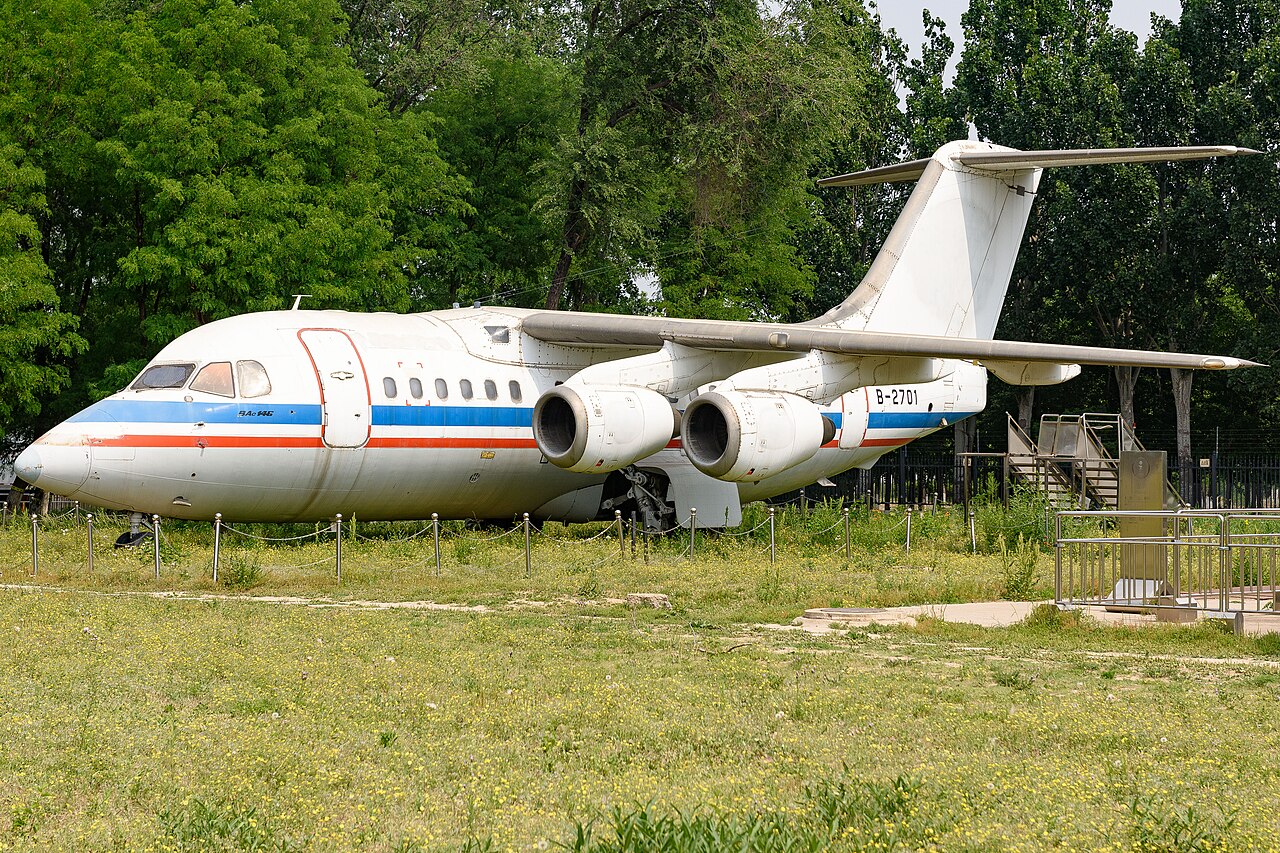
The Avro RJ100 is the largest member of British Aerospace's four-engined regional jet family, developed from the BAe 146-300 by Avro International Aerospace, part of BAE Systems. A high-wing, T-tailed airliner known for exceptionally quiet operation, it was designed to bring jet speed to short-haul routes and short or restricted airfields such as London City Airport. For a simulator pilot it offers the unusual challenge and character of a quad-engined regional jet with strong short-field manners.
The RJ100 is the Avro RJ derivative of the British Aerospace 146-300, the largest of the three BAe 146/Avro RJ fuselage lengths. It is a high-wing cantilever monoplane with a T-tail, powered by four turbofan engines mounted on underwing pylons, and fitted with retractable tricycle landing gear. Built to serve the regional and short-haul airliner market, it typically seats around 100 passengers and can accommodate up to 112 in a high-density economy layout. It belongs to a family regarded as the most successful British civil jet airliner programme, with 394 aircraft produced across the BAe 146, Avro RJ and Avro RJX lines.
The lineage of the RJ100 traces back to the HS.146, a 70-seat regional airliner project launched by Hawker Siddeley in August 1973 to bridge the gap between turboprop airliners like the HS.748 and Fokker F27 and small jets such as the BAC One-Eleven and Boeing 737. Development was halted in October 1974 due to the economic fallout from the 1973 oil crisis, but British Aerospace, Hawker Siddeley's successor, relaunched the project in 1978, marketing it as a quiet, fuel-efficient turbofan replacement for ageing turboprop feeder aircraft. The first order was placed by Lineas Aereas Privadas Argentinas in June 1981, and the prototype first flew on 3 September 1981 from Hatfield. The type received its Certificate of Airworthiness on 8 February 1983 and entered service that May, quickly earning a reputation as the quietest jetliner in the world. The improved Avro RJ family, of which the RJ100 is the largest variant, began production in 1992, sharing the fuselage of the BAe 146-300 but benefiting from engine, avionics and interior improvements, including an EFIS glass cockpit introduced from 1993.
The RJ100 retains the high-wing, T-tailed configuration of the BAe 146 family, chosen to give good short-field performance, together with retractable tricycle landing gear. It is powered by four geared turbofan engines mounted on underwing pylons; the Avro RJ series, including the RJ100, uses Honeywell LF507-1F turbofans, each rated at around 31.2 kN of thrust. This four-engine layout, while unusual for an aircraft of its size, was chosen partly because the engine type needed to be deployed in a quad configuration to deliver the required power and range, and it was seen as advantageous in the event of an engine failure, offering strong three-engine performance from high, hot or poor-grade airfields. The RJ100 has a length of around 102 ft (31 m), a height of about 28.4 ft (8.61 m) and a wingspan of roughly 86 ft. Cabin capacity is typically around 100 passengers in a two-class layout, rising to about 112 in an all-economy configuration. Production of the airframe was spread across several British Aerospace/BAE sites, with the rear fuselage built at Chadderton, the centre fuselage at Filton, the vertical stabiliser at Brough, engine pylons at Prestwick, and final assembly of the Avro RJ series at Woodford Aerodrome.
The RJ100 has a quoted range of around 1,550 miles (2,465 km) and a service ceiling of about 35,000 ft. Its geared turbofan engines and aerodynamic design give it markedly low noise levels, a characteristic exploited commercially under the aircraft's unofficial "Whisperjet" branding. The high-wing, T-tail layout and four-engine arrangement were intended from the outset to deliver strong short-field takeoff and climb performance, and early flight testing of the family showed better-than-predicted results in these respects.
The BAe 146 family was produced in three fuselage lengths, the -100, -200 and -300, with the corresponding Avro RJ versions designated RJ70, RJ85 and RJ100; the RJ100 is the Avro RJ equivalent of the 146-300 and the largest aircraft in the family. Freight-carrying examples were designated "QT" (Quiet Trader), while a convertible passenger-or-freight model was designated "QC" (Quick Change); a gravel kit could also be fitted to allow operation from rough, unprepared airstrips. A further-developed Avro RJX, with new engines, was announced in 1997 but only reached prototype and limited production status before the programme ended in 2001. In more recent years an RJ100 airframe was used as the flying testbed for the Airbus/Rolls-Royce E-Fan X hybrid-electric programme, in which one of the aircraft's four Honeywell LF507 turbofans was to be replaced by a 2 MW Rolls-Royce electric motor driven by an AE2100 turboshaft and a 2 t battery pack, before the project was cancelled in April 2020.
The RJ100 and its BAe 146 relatives have been widely used as regional and short-haul airliners, prized for their ability to operate quietly into noise-sensitive, city-centre airports such as London City Airport. Primary operators of the type have included Mahan Air, National Jet Express and Pionair Australia. Beyond passenger service, QT and QC variants allowed operators to use the type for freight and mixed passenger/cargo operations.
For a virtual pilot, the RJ100 stands out for its unusual four-engine layout on an aircraft of relatively modest size, giving it distinct handling characteristics compared with twin-engined regional jets, along with the strong three-engine performance the configuration was designed to provide. Its high-wing, T-tail design and short-field capability make it well suited to recreating operations into demanding, restricted airports such as London City, while its renowned quiet operation is a notable and historically significant feature of the type worth exploring in flight.