Departure
93%
vs 95% ▼ 2
 MY FS FLIGHTS
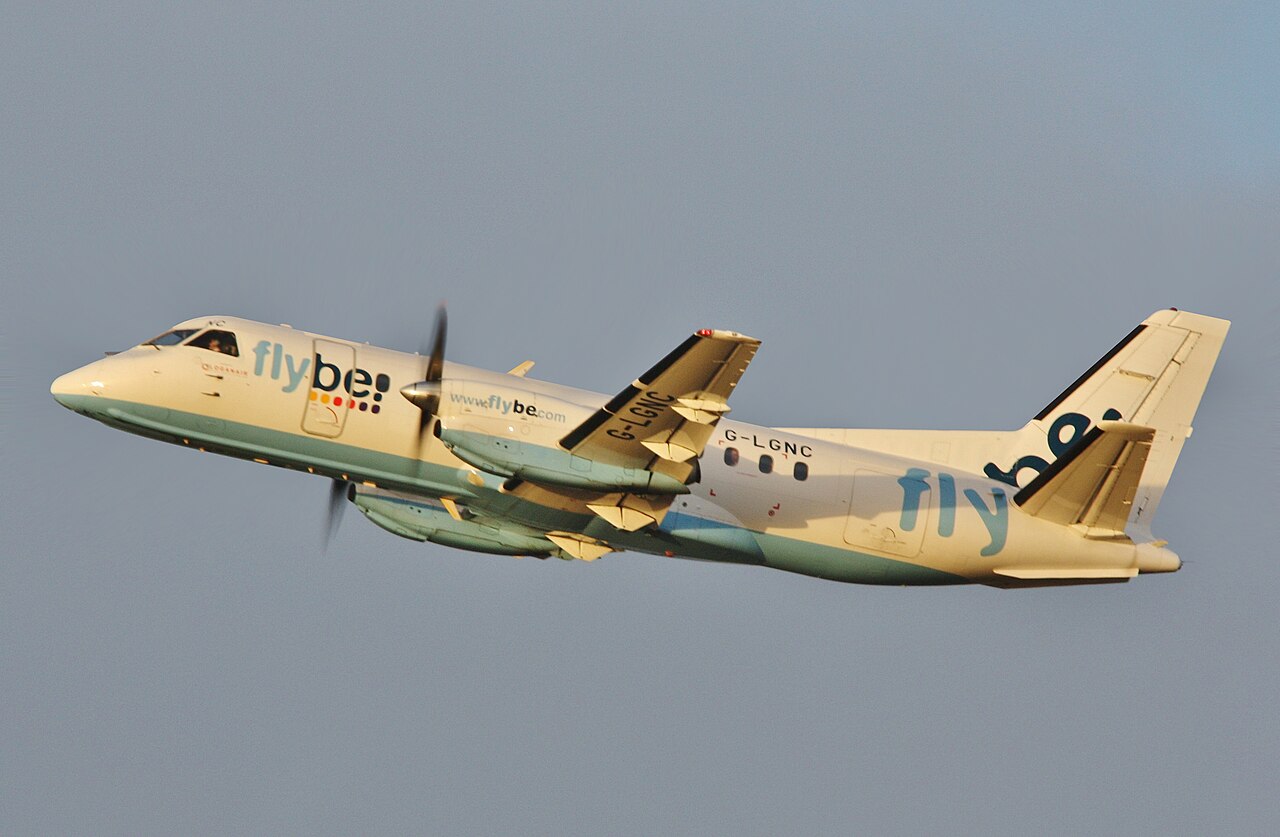
The Saab 340B is a twin-engine turboprop regional airliner developed jointly by Saab AB of Sweden and Fairchild Aircraft of the United States, seating between 30 and 36 passengers. It became the definitive second-generation version of the Saab 340 family, combining more powerful engines and refined aerodynamics with the type's reputation for reliability and low operating costs, making it one of the most widely used commuter turboprops ever built.
The Saab 340B is a twin-turboprop regional airliner, the improved second-generation model within the Saab 340 family produced jointly by Saab AB and Fairchild Aircraft. Designed to seat 30 to 36 passengers, it was conceived as a short-haul commuter aircraft optimised to match jet-like performance while retaining the fuel economy of turboprop propulsion. The 340 series was Saab's first major venture into civil aircraft manufacturing and later gave rise to the larger Saab 2000.
Saab's interest in the civil aircraft market grew during the 1970s, and in 1974 the company committed to developing its first major civilian airliner after decades focused on military types. Internal studies in the late 1970s concluded that a short-haul airliner should be optimised to carry around 30 passengers, and turboprop propulsion was chosen over turbofans for its economy, a decision influenced by the high oil prices of the era; the General Electric CT7-5A2 engine selected was judged competitive with contemporary jet engines. The programme grew too large for Saab to manage alone, and in January 1980 Saab partnered with US manufacturer Fairchild Aircraft, which took responsibility for the wings, tail unit and engine nacelles while Saab covered 75 per cent of development, systems integration and certification costs; the aircraft was accordingly designated SF340. The type's launch coincided with the deregulation of the US airline industry under the 1978 Airline Deregulation Act, which helped drive sales through the following decade. Manufacturing techniques shared with Saab's military programmes, including the then-developing JAS 39 Gripen, saw diffusion bonding used in place of rivets on the aluminium structure to save weight. The first SF340 flew on 25 January 1983, piloted by Per Pellebergs and Eric Sjoberg from Tannefors, Sweden, a flight lasting one hour and 21 minutes. Launch customer Crossair of Switzerland received its first aircraft on 6 June 1984, and one week later the type carried its first fare-paying passengers, a flight on which Pope John Paul II was among those aboard. Fairchild withdrew from aircraft manufacturing after completing the first 40 units, and in 1985 Saab dropped the Fairchild name, continuing production alone under the designation Saab 340A, with 159 A models eventually built; production of the wing and tail components was transferred to Sweden. In 1989 the improved second-generation 340B was introduced with more powerful engines and wider horizontal stabilizers, with 200 built, and that same year American Eagle placed a large order for 50 340Bs with options on 50 more. The final third-generation 340B Plus arrived in 1994, incorporating refinements developed alongside the larger Saab 2000, with 100 completed, bringing total B-model production to 300 and overall Saab 340 production to 459 aircraft before the line closed in 1999.
The Saab 340 was built with an all-aluminium fuselage and vertical stabilizer, manufactured and finally assembled by Saab in Linkoping, Sweden, while the wings, empennage and wing-mounted engine nacelles were originally produced by Fairchild before that work moved to Sweden in 1985. Metal bonding, using up to four layers, covers over 40 per cent of the airframe structure, optimising skin thickness and giving exceptional resistance to fatigue and cracking; static fatigue testing exceeded 200,000 cycles of take-offs and landings, equivalent to around 75 years of typical regional operation. The 340B is 19.73 metres long and 6.97 metres high, with a wingspan of 21.44 metres (22.75 metres with extended wingtips), a propeller ground clearance of 0.51 metres, a cargo door measuring 1.30 by 1.35 metres, a passenger door sill height of 1.64 metres and a cargo door sill height of 1.68 metres. It is powered by two General Electric CT7-9B turboprops delivering a maximum take-off power of 1,870 shp each, driving propellers from Dowty Rotol or Hamilton Sundstrand, compared with the earlier 340A's CT7-5A2 engines rated at 1,735 shp. Maximum fuel capacity is 2,580 kg on both variants, while maximum payload rises from 3,130 kg on the 340A to 3,400 kg on the 340B and B Plus. From 1994 the 340B incorporated an active noise and vibration control system as standard, cutting cabin noise and vibration by around ten decibels in cruise, and the 340B Plus made the previously optional extended wingtip modification, fitted to roughly 30 earlier 340Bs, standard across production. The 340B Plus also modernised the cabin interior and relocated the lavatory from the rear of the cabin to just aft of the flight deck, freeing up additional cargo volume in the original lavatory location.
The 340B has a maximum cruise speed of 283 knots (524 km/h), an improvement over the 340A's 271 knots (502 km/h), reflecting the more powerful CT7-9B engines fitted to the later model. Both variants share a maximum operating altitude of 25,000 feet (7,620 metres). The aircraft was designed from the outset to deliver jet-like short-haul performance while retaining the fuel economy associated with turboprop propulsion, a combination that underpinned its commercial appeal through the 1980s and 1990s.
The Saab 340A was the initial production model, powered by GE CT7-5A2 engines, with 159 built before Saab assumed full manufacturing responsibility after Fairchild's withdrawal in 1985. The Saab 340B, introduced in 1989, featured more powerful CT7-9B engines and wider horizontal stabilizers, with active noise control fitted as standard from 1994; 200 were built, with around 30 of these receiving an optional extended wingtip modification. The Saab 340B Plus, delivered from 1994, made the extended wingtips and an active noise and vibration control system standard, modernised the cabin and relocated the lavatory forward; 100 were built, bringing total B-model production to 300. A military derivative, the Saab 340 AEW&C, was also developed for airborne early warning roles. The 340 programme was ultimately succeeded by the larger, stretched Saab 2000, which inherited several of the improvements first introduced on the 340B Plus.
Launch customer Crossair of Switzerland introduced the type to service in 1984, and the Saab 340 went on to become the best-selling commuter aircraft in the world shortly after launch. American Eagle became a major operator after placing an order for 50 340Bs with options for 50 more in 1989. Japan Air Commuter took delivery of the final two aircraft built, configured in the older 36-seat layout. The first 340B Plus built was delivered new to Hazelton Airlines in Australia in 1995, later passing to Rex Airlines and subsequently to the Japanese Coast Guard. The type has completed over ten million flights since entering service, and as of 2023 more than 250 examples remained in active operation worldwide, with Rex Airlines cited as a primary current user and other operators including Loganair in the United Kingdom.
For a sim pilot, the 340B represents classic twin-turboprop regional flying: two CT7-9B engines delivering up to 1,870 shp each give the aircraft brisk performance for its class, with a cruise speed of 283 knots and a service ceiling of 25,000 feet. The extended wingtips, standard on the 340B Plus and optional on earlier 340Bs, were designed to improve take-off performance, which is relevant to short-field regional operations typical of the type's real-world route network. Its straightforward, low-wing turboprop configuration and widespread airline liveries around the world make it a recognisable and versatile subject for virtual regional airline flying, reflecting the type's real role as a dependable short-haul workhorse.