Departure
94%
vs 95% ▼ 1
 MY FS FLIGHTS
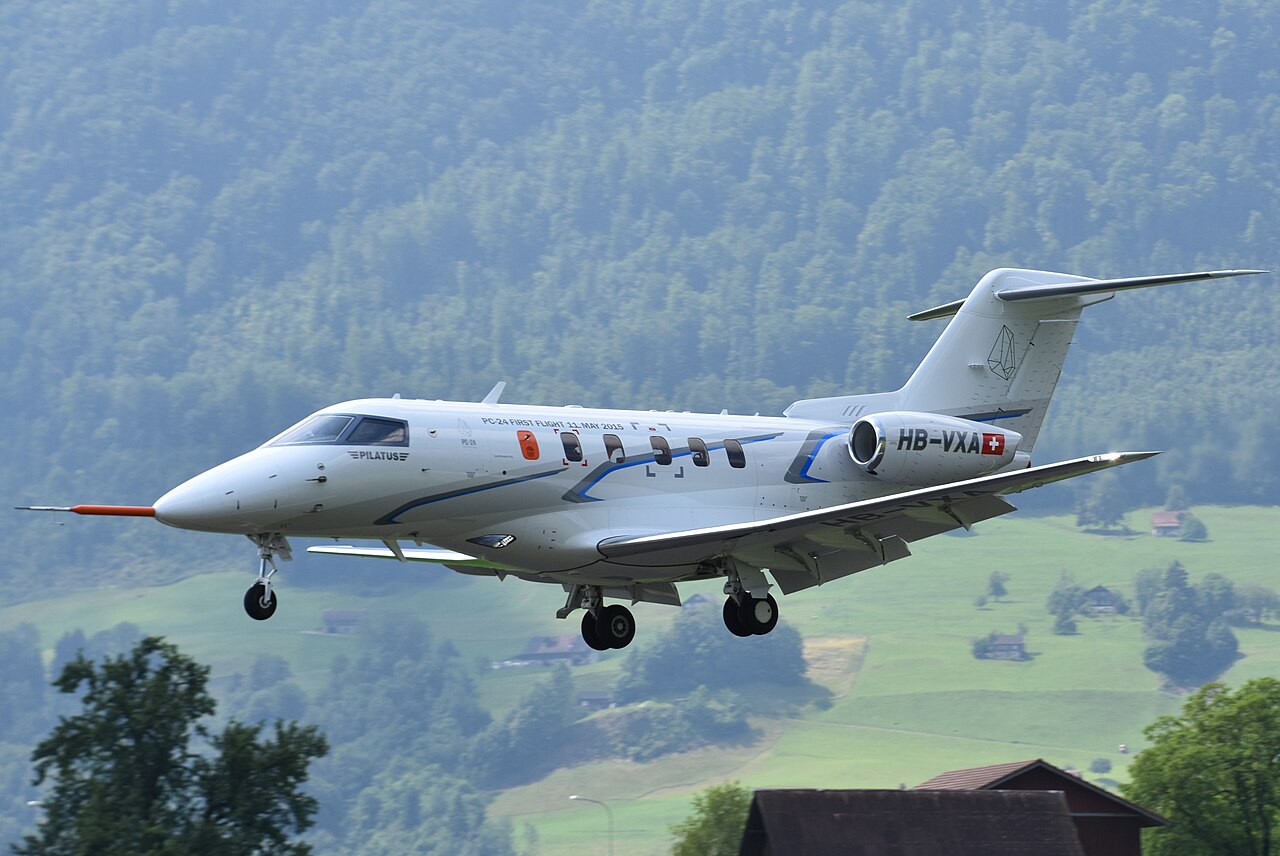
The Pilatus PC-24 is a twin-engine light business jet built by Pilatus Aircraft of Switzerland, developed as a faster, longer-ranged companion to the company's successful PC-12 turboprop while retaining its rough-field capability. Marketed by Pilatus as the world's first Super Versatile Jet, it combines a cabin larger than rivals in its class, a standard cargo door, and the ability to operate from short, unpaved runways, making it of particular interest to pilots who want jet speed without giving up backcountry access.
The PC-24 is a light business jet produced by Pilatus Aircraft of Switzerland, occupying a category the manufacturer describes as unique: combining the versatility of a turboprop with the cabin size of a medium light jet and the performance of a light jet. It is a twin-engine, low-wing design certified for single-pilot operation, and it competes directly with aircraft such as the Embraer Phenom 300 and Cessna Citation CJ4, while differentiating itself through unpaved-runway capability and a standard cargo door.
Pilatus began work on the PC-24 programme in 2007, following customer feedback after the commercial success of the single-engine PC-12 turboprop. Customers wanted an aircraft with greater range and top speed than the PC-12 while keeping its ruggedness and short-runway ability, and Pilatus funded the development internally. The programme was first mentioned publicly in the company's May 2011 annual report, and the aircraft was formally introduced at the European Business Aviation Convention and Exhibition (EBACE) in Geneva on 21 May 2013. At that event, Pilatus chairman Oscar Schwenk stated the PC-24 did not fit into any existing business jet category. The first of three prototypes, P01, was rolled out on 1 August 2014, Switzerland's national day; P01 was used to explore the flight envelope, P02 for avionics and autopilot integration testing (spending much of its life in the US), and P03 was representative of production aircraft, incorporating lessons from the other two. P01 first flew on 11 May 2015 from Buochs Airport, a flight of 55 minutes that began the two-year certification campaign. P02 flew for the first time on 16 November 2015, by which point P01 had logged 150 flying hours over more than 100 flights. During EBACE 2016, P02 achieved a transatlantic cruise speed in excess of 800 km/h (430 kn), better than expected. P03 joined the flight-test fleet in March 2017, and by May the three aircraft had logged 950 flights and 1,525 hours. In August 2017, the Williams FJ44-4A-QPM engine received EASA and FAA type and production certification, with the test fleet by then having accumulated over 1,700 hours. By October 2017 more than 2,000 hours had been flown, with P01 alone completing 626 flights and 900 hours. Type certification was granted by EASA and FAA on 7 December 2017, after the prototypes had flown 2,205 hours including icing conditions, extreme temperatures, bird strikes, structural stress tests and noise tests; performance goals were met or exceeded, with maximum speed raised from an original target of 425 knots to 440 knots (787 to 815 km/h). The first customer delivery followed on 7 February 2018, and the type entered service on 1 April 2018. In the fourth quarter of 2018 the aircraft was certified to take off and land on dry sand or gravel runways. Transport Canada certification was awarded on 27 June 2019, and in February 2020, following a multiyear campaign, the design was approved for full rough-field operation on grass, wet earth and snow-covered surfaces. By the first quarter of 2024, 212 examples had been built.
The PC-24 is powered by two Williams FJ44 turbofans, specifically the FJ44-4A-QPM variant, which received joint type and production certification from EASA and the FAA in August 2017. The aircraft is built with reinforced, rough-field-capable landing gear allowing operation from grass, gravel, earth, wet ground and snow, as well as paved runways. A defining feature is its standard cargo door, unusual in this class of business jet, which allows quick and efficient loading and unloading of bulky items and supports roles such as air ambulance and cargo carriage. The cabin is notably large, with Pilatus stating its volume exceeds that of business jets costing up to twice as much, and it can be configured with a divan convertible into a full-size bed. The flight deck uses the Pilatus Advanced Cockpit Environment (ACE), built around Honeywell equipment, featuring two 12-inch primary flight displays with SmartView synthetic vision, two 12-inch multi-function displays, a touch-screen controller, cursor control device, dual-channel autopilot with dual yaw damper, autothrottle with tactile feedback, automatic yaw trim, dual Flight Management System, LPV approach capability and RNP 0.3 capability. Other standard avionics include dual attitude reference systems, dual pitot-static systems, dual angle-of-attack sensors, a weather radar, radar altimeter, TCAS I, and an integrated enhanced ground proximity warning system, along with a 406 MHz emergency locator transmitter and lightweight data recorder. The cockpit is certified for single-pilot operation and can seat two crew with adjustable, reclining seats featuring four-point torso restraints and life vest storage.
The PC-24 has a maximum cruise speed of 440 KTAS (787 to 815 km/h, having been raised from an original target of 425 knots during flight testing). Maximum range is quoted at 2,000 nautical miles, with range figures based on a standard six-seat executive interior, NBAA IFR fuel reserves with a 100 nm alternate, 200 lb per passenger, cruise at flight level 450, and no wind. Take-off distance is 3,090 feet. During test flights, the aircraft demonstrated a transatlantic cruise speed in excess of 800 km/h (430 kn). In service use it has been described as able to cruise up to 440 KTAS and land at less than 100 KTAS, and it is certified for CAT II ILS approaches as well as steep approaches such as London City Airport's 5.5-degree approach.
The PC-24 is used across a wide range of missions, reflecting its billing as a Super Versatile Jet. Notable operators include the Qatar Emiri Air Force, PlaneSense, and the Royal Flying Doctor Service of Australia, which was scheduled to begin medevac operations with the type in 2019. The aircraft has been developed specifically as an air ambulance platform, becoming the world's first medevac aircraft equipped with a patient door and electric lift, with large doors enabling safe and easy patient loading. Its cargo door and short-field, rough-field capability have also made it attractive for relief and cargo operations, allowing operators to reconfigure the cabin quickly for different roles and to reach airports that other jets cannot use, including unpaved strips of grass, gravel, earth and snow.
Pilots who have flown the PC-24 describe it as capable of flying the widest variety of missions of any business jet to the broadest array of landing spots, combining comfort and speed with genuine short-runway and rough-field access. It is a sleek, single-pilot light jet with a large cabin and cargo area, capable of CAT II ILS approaches, and its ACE flight deck, with synthetic vision, autothrottle, dual inertial reference systems and LPV guidance, is designed specifically to reduce single-pilot workload. For simulator pilots, the appeal lies in a light jet that combines airline-style approach capability and jet speeds up to 440 KTAS with the ability to land on grass, gravel or dirt strips at under 100 KTAS, a combination that sets it apart from conventional light jets in its class.