Departure
83%
vs 95% ▼ 13
 MY FS FLIGHTS
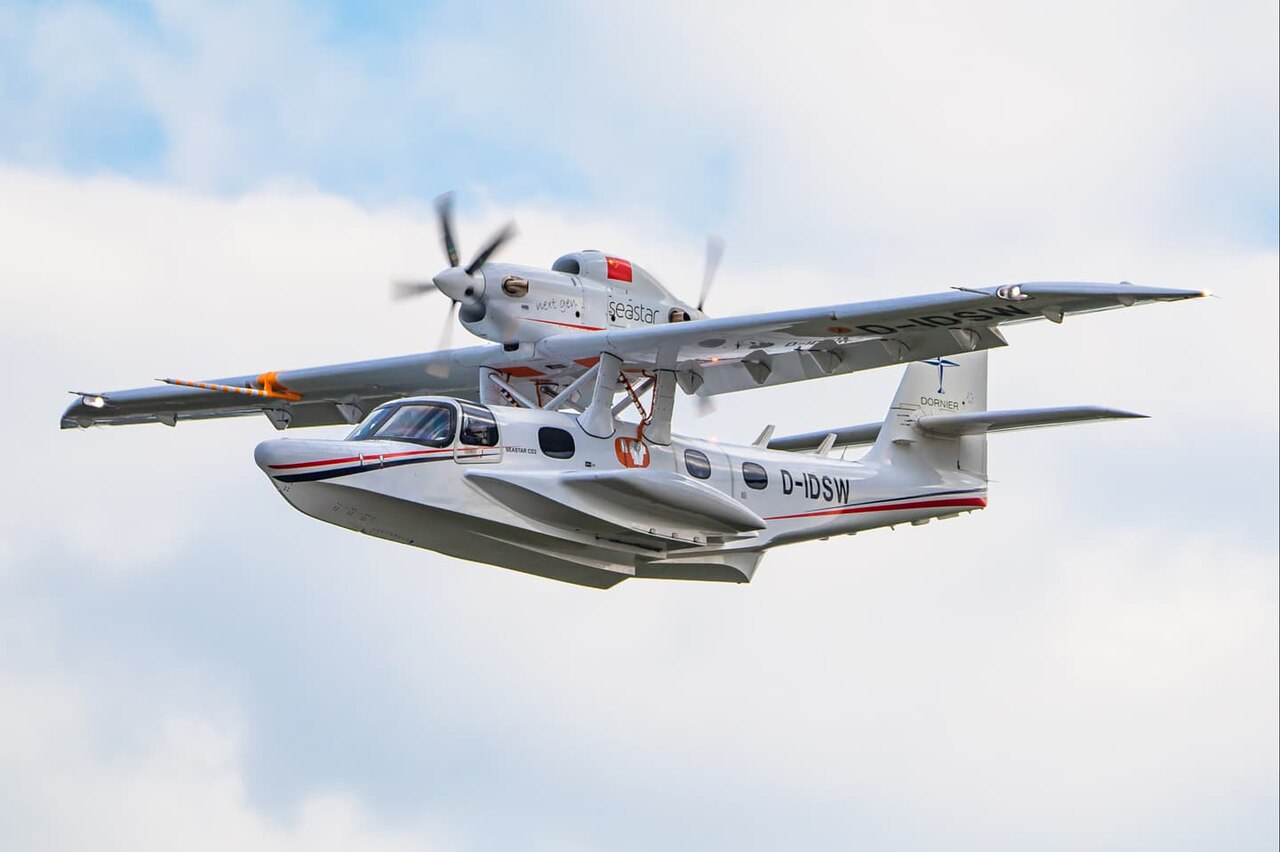
The Dornier Seastar is a twin-turboprop amphibious flying boat of largely composite construction, developed by Claudius Dornier Jr as a modern successor to the classic Dornier seaplanes. Conceived as a versatile utility amphibian for VIP transport, commuter, ambulance and surveillance roles, it has a long and troubled development history stretching back to 1984 and, despite repeated relaunch attempts, has never entered series production. For the simulator pilot it represents a rare and visually striking design: a true flying-boat hull with over-wing push-pull engines rather than a floatplane conversion.
The Seastar is a turboprop-powered amphibious utility aircraft built largely of composite materials, designed by Claudius Dornier Jr of Germany and later developed under the banner of Dornier Seawings. Unlike a floatplane, it is a true flying boat with a V-keel hull and sponsons rather than external floats, continuing a design lineage that traces back to earlier Dornier seaplanes. It has been positioned as a multi-purpose amphibian suited to VIP transport, commuter/regional airline work, ambulance duties and government surveillance, though it has never reached series production.
The first prototype, a proof-of-concept aircraft referred to as the CD1, used metal wings taken from a Dornier Do 28 and had the wing braced to the sponsons by large struts; it made its maiden flight from Hamburg on 17 August 1984. A second, more representative prototype featured a new composite wing with pointed tips similar to those of the Dornier 228, connected to the fuselage by cabane struts alone rather than to the sponsons, and was a larger aircraft overall; this CD2-standard machine first flew from Oberpfaffenhofen on 24 April 1987. Development work concluded in 1991 with a total of three aircraft produced. A European certificate of airworthiness was granted in 1990 and American airworthiness followed in 1991. The programme then suffered from chronic underfunding: the original company, Claudius Dornier Aircraft, filed for bankruptcy in November 1989 amid claims of insufficient German government support, having by then received more than 50 options and letters of intent. Dornier Composite Aircraft acquired the programme in 1990 but was itself bankrupt within two years, leading to the formation of a new company, Dornier Seastar, which sought partnerships in Asia. In 1993 a joint venture agreement was signed with a consortium of Malaysian investors to assemble the aircraft at a factory in Malaysia, with tooling, moulds and jigs shipped to Penang and a demonstration prototype placed at Subang Airport, Selangor; this venture was shelved in July 1995 for lack of capital, reportedly amid investor doubts about technical and financial viability. The company then sought new backers, proposing a joint venture with Hindustan Aeronautics in early 1998. By 2003 one of the two surviving prototypes had been restored and received public transport certification in December of that year. In February 2004 the company said it was evaluating manufacturing sites in Europe and Asia, citing feasibility studies suggesting global demand for around 250 aircraft over the following decade, and proposed three market-specific versions: a government surveillance variant, a 12-seat regional airliner, and a six-seat VIP layout. In August 2006 relaunch efforts involved prospective backing from Singapore and Abu Dhabi, the latter contingent on manufacture in Abu Dhabi. In October 2008 the company announced intentions to produce the aircraft in the United States, citing favourable currency exchange rates and plans to outsource fabrication mainly to American suppliers. In October 2009 Dornier Seawings announced it was formally launching manufacturing, though no aircraft were built as a result. In November 2018 the company received US$170 million in funding from Chinese backers to build a manufacturing facility and a single flying prototype, with series production intended to follow in 2021.
The Seastar's airframe is built almost entirely from composite materials, giving an all-composite structure that is corrosion-free even in saltwater and avoids the rivet- and bolt-related leakage issues associated with conventional metal airframes; the aircraft is certified for 30,000 flying hours before a special inspection is required for extension. The fuselage is shaped as a true flying-boat hull with a V-keel, giving handling on the water likened to a powerboat and reducing aerodynamic drag in flight for improved fuel efficiency. Sponsons attached to the centre fuselage house the fuel and the main landing gear, keeping the centre of gravity low, and also serve as a working platform. The wide-track landing gear allows smooth operation from runways as well as water, with a hydraulically controlled nose-wheel steering system making the type a genuine amphibian. The wing is designed for slow approaches, with specially shaped wingtips that facilitate tight turns on water and provide hydrodynamic lift support in the event of water contact. Power comes from two Pratt & Whitney PT6A-135A turboprop engines mounted in an in-line push-pull configuration over the wing; this arrangement eliminates asymmetric thrust in the event of an engine failure and minimises the risk of foreign object damage and water ingestion into the intakes. The cockpit is fitted with Honeywell's Primus Epic 2.0 avionics suite, comprising four 10-inch LCD displays arranged in a single line for shared situational awareness between pilot and co-pilot, plus a fifth independent backup display that retains essential flight parameters in the event of an electrical power failure; the system supports single-pilot operation and includes electronic checklists, graphical flight planning and alerts during taxi, take-off and landing. The cabin, described as the largest in its class, offers a flat floor throughout and can be configured with 6 or 7 premium leather seats and an optional lavatory for VIP use, 9 seats in a corporate layout, or fitted out as an ambulance platform; a large sliding door provides access between the cabin and baggage compartment. In cargo configuration the aircraft offers 348 cubic feet of space with a maximum bulk cargo length of 17.1 feet.
The Seastar's wing was designed to give a stall speed of 65 KCAS while still allowing a maximum cruise speed of 180 KTAS. It is capable of true seaplane operations in swells of up to around two to two-and-a-half feet, figures described as demonstrated rather than limiting, and its short take-off and landing capability allows it to operate from both runways and water, including under rough conditions.
The initial proof-of-concept prototype, sometimes referred to as the CD1, retained the basic shape of the eventual design but used straight-tipped metal wings taken from the Dornier Do 28, braced forward to the sponsons by struts. The subsequent definitive design, the CD2 standard, replaced these with a composite wing featuring pointed tips similar to the Dornier 228, connected to the fuselage alone with the sponson bracing removed, and was a larger aircraft overall; three examples of this later standard were built. In 2004 the company proposed developing three distinct production versions for different market segments: a surveillance variant for government agencies, a 12-seat regional airliner configuration for charter operators, and a six-seat VIP layout, though none of these reached production.
No Seastar has entered series production or airline/commercial service; only a handful of prototype and demonstration aircraft were ever completed. The type was envisaged as filling a niche role among private owners, airline and charter operators, and search and rescue organisations, with proposed applications spanning VIP and executive transport, commuter and regional airline work, air ambulance duties, and government surveillance missions. A prototype was placed at Subang Airport in Selangor for sales demonstration purposes during the Malaysian joint-venture period, and one restored prototype received public transport certification in December 2003, but sustained financial and organisational difficulties have prevented the aircraft from reaching operational fleets.